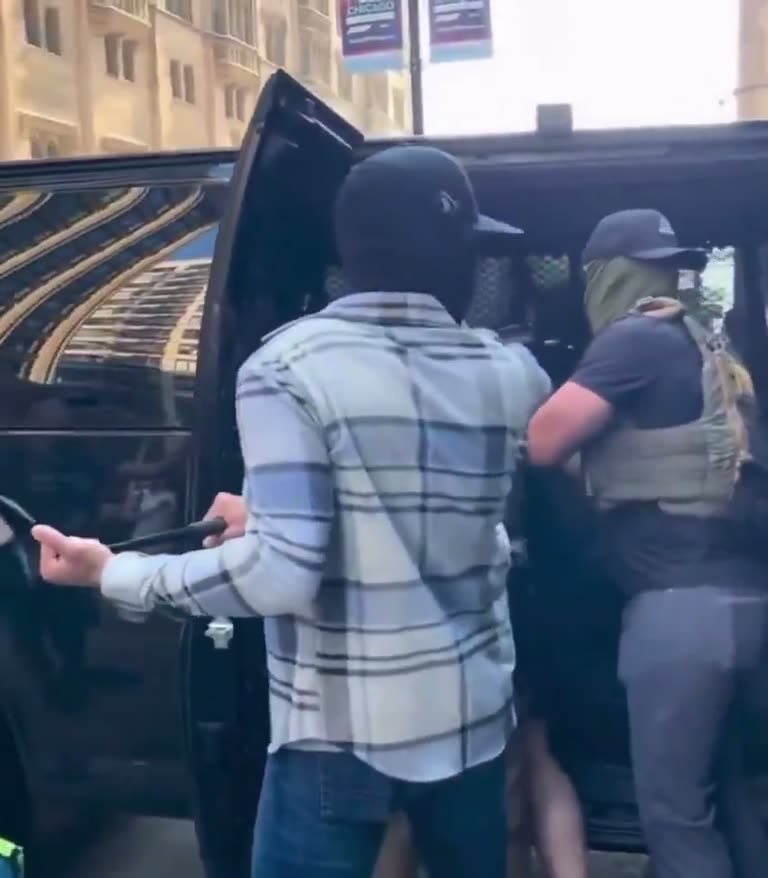
A tense scene unfolded on a Chicago street this morning as masked law enforcement officers loaded a suspect into a black van, while a woman repeatedly demanded to know where the individual was being taken. The encounter, captured on video, shows the woman challenging the officers’ authority as they carried out an operation. The footage has since sparked intense debate online about the rights of bystanders and the conduct of federal agents during arrests.
Overview of the incident and the key facts
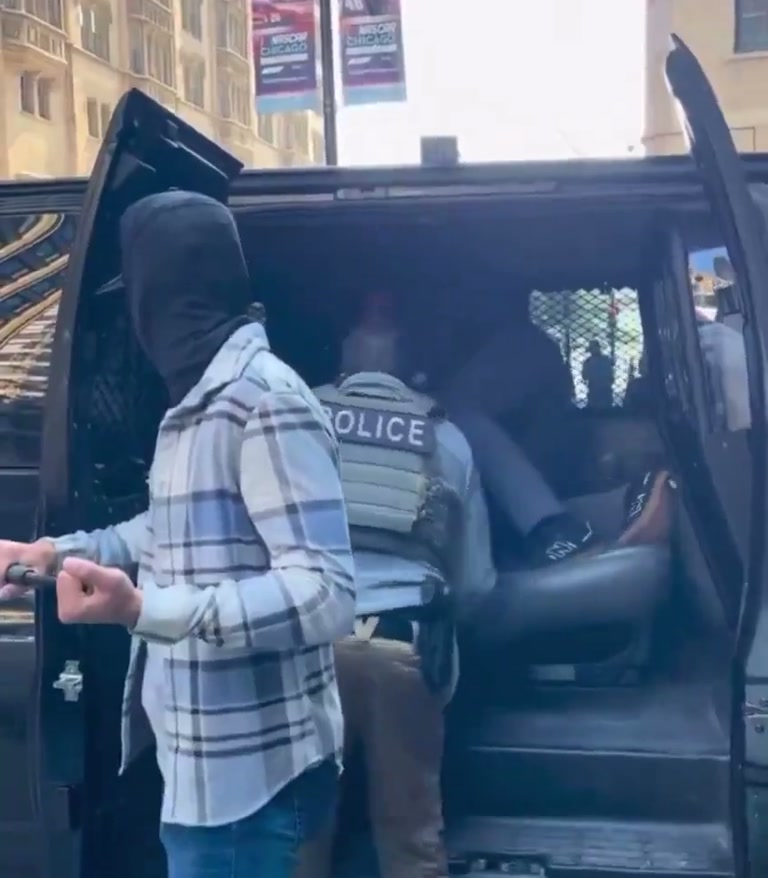
- The video shows masked officers, one wearing a vest marked "POLICE," loading a suspect into a black van.
- A woman is heard repeatedly asking where the person is being taken and demanding the officers identify their agency.
- The incident occurred in Chicago, with a watermark on the footage referencing "Unfiltered Under Trump."
- The suspect appears to be a human trafficker, according to the original video description, though this detail remains unverified.
- Bystanders can be heard questioning the officers' actions, with one woman claiming the officers are "kidnapping" the individual.
- The footage shows the suspect being pushed into the van by multiple officers, with one officer using physical force to guide them inside.
- The encounter highlights growing tensions around federal immigration enforcement operations in major U.S. cities.
The footage opens on a bright Chicago morning, the kind of clear, crisp day where the city’s usual hum of traffic and pedestrians is suddenly pierced by the sharp, urgent activity of a law enforcement operation. A black van sits parked at the kerb, its rear doors swung wide open, revealing a dark interior. Masked officers, their faces obscured by balaclavas and baseball caps, move with purpose. One officer, wearing a tactical vest with the word "POLICE" emblazoned in large, bold letters, is seen physically guiding a handcuffed individual towards the vehicle. The scene is raw, unfiltered, and deeply contentious.
As the officers work to load the suspect, a woman’s voice rises above the ambient noise. She is not a passive observer; she is an active participant, her tone a mixture of alarm, indignation, and a demand for accountability. "Where are you taking them?" she calls out, her question hanging in the air. The officers do not immediately respond, their focus fixed on the task at hand. The woman persists, her voice growing more insistent as she tries to ascertain the identity of the agency involved and the destination of the person being detained.
The video captures the claustrophobic intimacy of the moment. The suspect, whose face is obscured, is manoeuvred into the back of the van. The officer in the vest leans in, using their body weight to guide the individual inside. There is a brief struggle, a shuffling of feet, and then the suspect is inside. The woman, undeterred by the officers’ silence, continues her verbal challenge. She invokes the law, insisting that they are "required" to tell her where they are taking the person. The scene is a collision of two worlds: the opaque, swift machinery of federal enforcement and the insistent, vocal demand of a citizen for transparency.
The location is unmistakably Chicago, with the architecture and street signage offering a backdrop that is both familiar and specific. The footage bears a watermark indicating it was sourced from a channel called "Unfiltered Under Trump," which provides a political framing for the content. The description accompanying the video claims that the arrested individual is a "human trafficker," a serious allegation that adds a layer of moral complexity to the confrontation. However, this claim has not been independently verified by official sources.
This incident is not occurring in a vacuum. It is part of a broader, highly charged national conversation about immigration enforcement, the tactics used by federal agents, and the rights of bystanders to observe and question police actions. The presence of masked officers, a practice that has become more common in certain federal operations, adds to the sense of anonymity and, for some, intimidation. The woman’s repeated use of the word "kidnapping" reflects a deep-seated suspicion and fear that such operations can feel like disappearances to the communities they touch.
The video ends as abruptly as it began, with the van doors still open and the woman’s questions unanswered. The officers continue their work, the suspect is secured, and the woman is left standing on the pavement, her demands echoing in the empty space. The footage does not show the aftermath, nor does it provide a resolution. It simply captures a moment of high tension, a snapshot of a power dynamic playing out on a public street, leaving viewers to grapple with the questions it raises about authority, accountability, and the rule of law.
The legal and social dimensions of the encounter
The central legal question raised by the footage is whether the officers were, in fact, required to answer the woman’s questions. In the United States, the rights of bystanders to observe and record police activity are generally protected under the First Amendment, provided they do not interfere with police operations. However, the obligation of an officer to verbally respond to a bystander’s inquiries is not absolute. While many police departments encourage officers to provide basic information to de-escalate situations, there is no universal legal requirement for an officer to disclose the destination of a suspect or the specific agency they belong to in the middle of an active operation.
The woman’s assertion that the officers are "required" to tell her where they are taking the suspect is a common belief, but the legal reality is more nuanced. In the context of a federal immigration enforcement action, such as those conducted by U.S. Immigration and Customs Enforcement (ICE), agents are operating under federal authority. While they must adhere to constitutional protections, the operational security of a raid or arrest can justify a degree of secrecy regarding the immediate destination of a detainee. The woman’s demand, while emotionally compelling, may not have been legally enforceable in that exact moment.
The social dimension of the video is equally significant. It captures a palpable sense of community anxiety. The woman’s voice is not just her own; it represents a segment of the public that feels increasingly alienated from and suspicious of federal law enforcement. The use of the term "kidnapping" is a powerful, emotive word that underscores a profound distrust. It suggests that for some, the actions of these masked officers are indistinguishable from a criminal act, a perception that is deeply damaging to the legitimacy of law enforcement.
The officers’ silence is a tactical choice. In high-stress operations, engaging with bystanders can distract from the primary objective, which is the safe and secure transport of a detainee. However, this silence can also be interpreted as arrogance or a disregard for public accountability. The tension in the video is not just between the woman and the officers; it is a tension between the state’s monopoly on the legitimate use of force and the public’s demand for transparency. The footage serves as a flashpoint for these competing values, forcing viewers to confront the uncomfortable reality of how law enforcement operates in contested spaces.
The presence of the "POLICE" marking on the vest is also a point of interest. It confirms that the officer is a sworn law enforcement officer, but it does not specify which agency. This ambiguity can fuel speculation and conspiracy theories. In an era of increased scrutiny of federal agencies, the lack of clear identification can exacerbate tensions. The video, therefore, is not just a record of an arrest; it is a document of a breakdown in communication and trust between the state and a segment of its citizenry.
The insurance and financial implications of such operations
While the immediate focus of the video is on the confrontation, there are significant financial and insurance-related consequences that flow from these types of law enforcement operations, particularly for the communities and individuals involved. For the business owners and residents in the area where a raid occurs, the aftermath can be financially destabilising. If a federal operation involves forced entry into a property, the resulting damage—broken doors, shattered windows, damaged locks—can lead to significant property insurance claims.
Standard commercial property insurance policies and homeowners’ insurance policies typically cover damage to the structure caused by police action, provided the policyholder was not involved in the criminal activity that prompted the raid. However, the claims process can be fraught with complications. Insurers will often scrutinise the claim to determine if the damage falls under a covered peril or if it is excluded under a "war" or "government action" clause, though police raids are generally not considered acts of war. The policyholder will need to provide a police report, which can be difficult to obtain if the operation was a federal action with sealed records.
For the individual being arrested, the financial implications can be catastrophic, even before any conviction. If they are the owner of a vehicle that is towed and impounded, they will face daily storage fees, towing costs, and potentially the loss of the vehicle if they cannot afford to retrieve it. Their car insurance may not cover the cost of retrieval if the impoundment is the result of an arrest. If they are a business owner, the interruption to their business operations can lead to a loss of income, which may be covered by business interruption insurance, but again, only if the policy includes such coverage and the event is deemed a covered loss.
The broader community also bears a financial cost. The deployment of multiple agents, the use of vehicles, and the subsequent legal proceedings are all funded by taxpayers. In the United States, federal immigration enforcement is a significant budget item. The cost of a single raid can run into thousands of dollars, from the salaries of the agents to the maintenance of the vehicles and the administrative overheads. This is money that is diverted from other public services, such as schools, hospitals, and road maintenance.
From a liability perspective, if the officers caused damage to a third party's property during the operation—for example, if they damaged a neighbour's fence while pursuing a suspect—the affected party may file a claim against the government. Under the Federal Tort Claims Act, citizens can sue the federal government for property damage caused by the negligent or wrongful acts of federal employees. However, this is a complex legal process, and the government has a number of defences available. The financial burden on the individual to pursue such a claim can be prohibitive, often requiring expensive legal representation.
For the person being arrested, the legal costs are an immediate concern. Even if they are innocent, they will need to secure legal representation to fight the charges. If they are unable to afford a private lawyer, they may be assigned a public defender, who is often overworked and under-resourced. If they are convicted, they face fines, court costs, and potential asset forfeiture. The financial ripple effects of a single arrest can destroy a family’s economic stability, leading to loss of housing, inability to pay bills, and long-term debt. This is a critical, often overlooked, aspect of the immigration enforcement debate.
The role of bystander footage in modern policing
The video is a prime example of the power of bystander footage in the digital age. In the past, police operations were largely opaque, with the official narrative being the only one available to the public. Today, anyone with a smartphone can become a citizen journalist, capturing raw, unedited footage that can be shared instantly with a global audience. This has fundamentally changed the relationship between law enforcement and the public.
The footage from Chicago serves as a check on state power. It provides a visual record that can be used to hold officers accountable for their actions. If the officers were to later claim that the suspect was compliant and that no bystanders were present, this video would contradict that account. This evidentiary value is immense. It can be used in court, in internal affairs investigations, and in the court of public opinion.
However, the rise of bystander footage also presents challenges. The footage is often partial, capturing only a few seconds or minutes of a much longer event. It can be manipulated or taken out of context. The presence of a camera can also alter the behaviour of both the police and the public, a phenomenon known as the observer effect. In this video, the woman is acutely aware of the camera, and her demands are amplified by the knowledge that she is being recorded.
The virality of such footage can also lead to a rush to judgement. The video was posted with a caption claiming the suspect was a "human trafficker," a charge that carries immense moral weight. If this claim is false, it could unfairly prejudice the public against the suspect and undermine the presumption of innocence. The video’s watermark, "Unfiltered Under Trump," suggests a specific political agenda, which further complicates the objectivity of the presentation. Viewers must be discerning, recognising that the footage is a piece of evidence, not a complete verdict.
The proliferation of these videos has led to calls for greater police transparency and the mandatory use of body cameras. While federal agents in plainclothes operations often do not wear body cameras, the presence of citizen cameras acts as a de facto oversight mechanism. This can lead to a more cautious approach by officers, who know that their actions may be scrutinised by millions. However, it can also lead to a defensive posture, where officers are less likely to engage with the public for fear of being misrepresented. The balance between accountability and operational security is a delicate one, and videos like this one serve as a crucible for that debate.
Insurance and who pays
When a law enforcement operation of this nature occurs, the question of who pays for the aftermath is complex and often falls into a grey area of insurance law. For the individual being arrested, their personal property, such as a vehicle or phone, may be seized or damaged. If their car is impounded, the towing and storage fees are typically the responsibility of the owner. Standard car insurance policies do not cover the cost of retrieving a vehicle impounded due to an arrest. If the vehicle is damaged during the operation, a claim might be made against the police department, but this requires proving negligence, which is a high bar. The policyholder’s own comprehensive coverage might respond if the damage was caused by a covered peril like vandalism, but an arrest-related seizure is usually excluded.
For residents or business owners in the vicinity, any damage to their property—such as a broken window or a damaged door—would typically be claimed under their homeowners or commercial property insurance. Insurers will assess whether the damage was caused by a "civil commotion" or "police action." Most standard policies cover damage from police action as a "sudden and accidental" event, but the policyholder must be prepared to provide a police report and evidence that they were not involved in the criminal activity. The excess, or deductible, on these policies will apply, meaning the policyholder will have to pay the first portion of the repair cost out of their own pocket. For a small business, this unexpected cost can be a significant blow.
From a liability standpoint, if a bystander is injured during the operation, they may seek compensation. In the US, suing a federal agency requires navigating the Federal Tort Claims Act, a process that is notoriously slow and complex. In the UK, similar claims would be brought against the police force under common law or the Human Rights Act. In both jurisdictions, the claimant must prove that the officers acted negligently or used excessive force. The financial cost of such litigation is high, and the outcome is never guaranteed. For the officers involved, they are typically indemnified by their employer, meaning the government pays any damages, but they may still face internal disciplinary action.
The final piece of the financial puzzle is the cost to the taxpayer. The salaries of the agents, the fuel for the vehicles, the administrative costs of processing the arrest, and the potential legal fees if the arrest is challenged in court are all borne by the public purse. In the US, this is funded through federal appropriations, while in the UK, it comes from the Home Office budget. These are finite resources, and every operation of this type diverts funds from other public services. For the community, the cost is not just financial but also social, as trust in law enforcement erodes, making future cooperation more difficult. The insurance industry, too, bears a cost, as claims are paid out and premiums are adjusted to reflect the risk of operating in areas with high levels of civil unrest or police activity. Ultimately, the question of who pays is answered by a complex web of insurance policies, legal precedents, and public funding, with the burden often falling on the individual and the community.
| Incident parameter | Logged / on-scene information |
|---|---|
| Location | Chicago, Illinois, United States |
| Time of day | Morning |
| Law enforcement agency | Unidentified, officer vest marked "POLICE" |
| Suspect status | Handcuffed, placed into a black van |
| Bystander action | Woman demanded to know destination and agency identity |
| Video source watermark | "Unfiltered Under Trump" |
| Alleged offence | Human trafficking (per video description, unverified) |
| Vehicle involved | Black van with rear doors open |
Important note: The original video description claims the suspect is a human trafficker, but this has not been independently verified by official sources, and the identity of the law enforcement agency remains unclear.
Core questions still unanswered
- Was the individual being detained actually a human trafficker, as claimed in the video description?
- What legal obligation do federal officers have to respond to bystander questions during an active operation?
- How will the financial costs of this operation and any resulting legal challenges be covered?
Learn more: Woman Arrested on Camera: Immigration Incident Explained
🎥 Watch the video at the bottom of the page 👇
This story was edited from a publicly posted video; some details may not be independently verified.