A dramatic scene has emerged from the streets of France, showing a member of an intervention company being carried away by his colleagues after sustaining an injury during a tense public order operation. The footage captures the raw, physical reality of frontline policing, highlighting the intense pressure faced by officers during moments of widespread unrest.
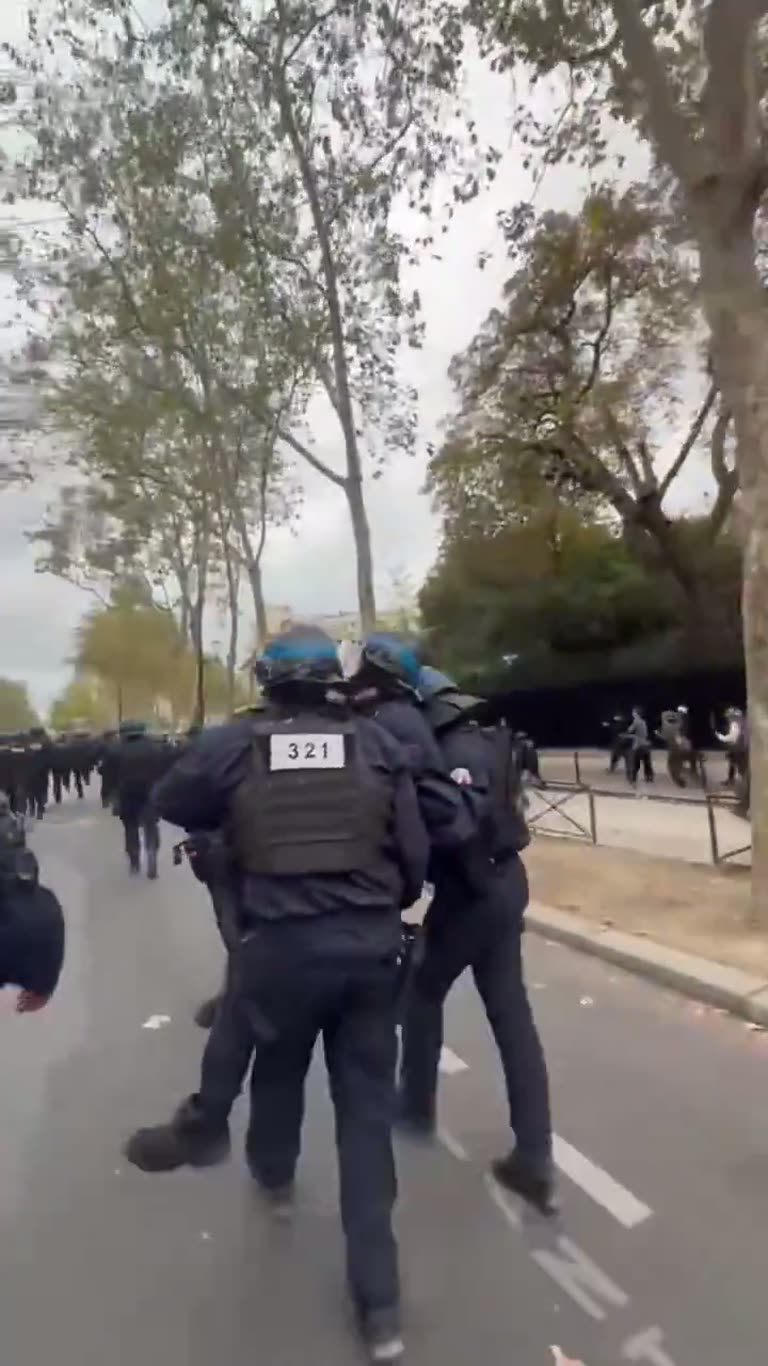
Overview of the incident and the key facts
- The video shows three officers in dark tactical gear moving quickly across a wide, paved street to evacuate an injured colleague.
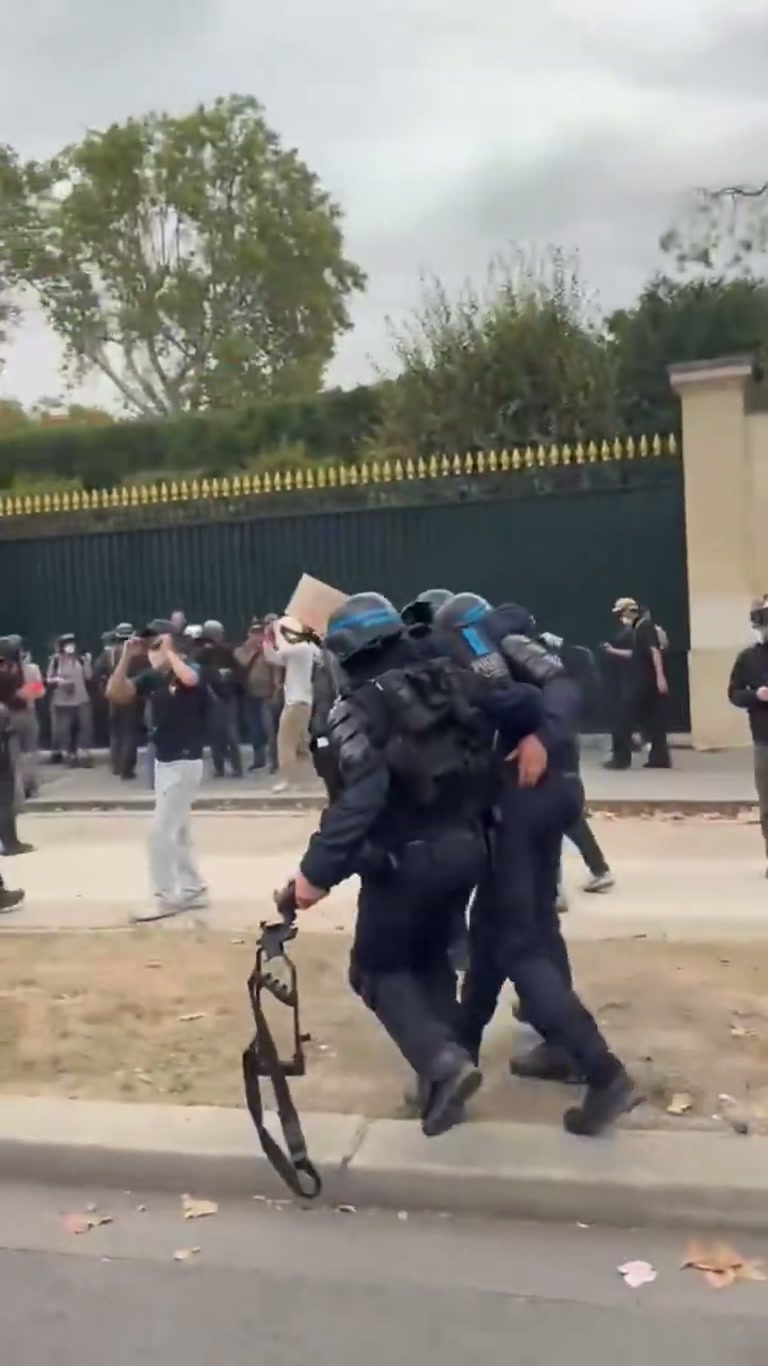
- The injured officer is supported by two comrades, his legs dragging as they rush him away from the immediate front line.
- A loud voice is heard on the audio directing the movement, shouting commands to secure the area and evacuate the casualty to the left.
- The environment appears to be a large European city, with classical architecture visible in the background and fallen leaves on the ground.
- The footage was shared online by a political figure, highlighting the physical risks faced by security forces during violent protests.
The physical reality of public order policing
The footage opens on a wide, grey street, the kind of grand urban artery that defines so many European capitals. The sky above is heavy and overcast, casting a flat, unflattering light over the scene. Three figures in dark blue tactical gear dominate the foreground, their bodies angled forward in a posture of urgent physical exertion. They are moving as a single unit, their movements synchronized by the desperate need to get an injured colleague out of harm's way. It is a moment of pure, unscripted action, where the machinery of state force is reduced to the simple, brutal task of carrying a wounded man to safety.
What strikes the viewer immediately is the sheer weight of the equipment and the physical burden of the task. The officers are clad in heavy vests, helmets with visors, and thick protective padding. Their colleague, the one being carried, is slumped between them, his feet barely touching the ground. The body language of the two carriers speaks of exhaustion and adrenaline. They are not marching; they are scrambling, their boots striking the asphalt in a hurried, uneven rhythm. The scene is devoid of the usual cinematic glamour of action films; it is sweaty, heavy, and deeply human.
The setting itself adds a layer of grim contrast to the unfolding drama. In the background, large stone buildings with classical columns and wrought-iron gates suggest a seat of power or a government district. The trees lining the avenue are turning, with autumnal leaves scattered across the road and pavement. It is a peaceful, almost beautiful urban landscape, now marred by the presence of hundreds of officers in riot gear. The juxtaposition of the city's timeless elegance with the raw, chaotic violence of the moment creates a powerful visual tension.
As the camera tracks the small group, we see the wider context of the operation. In the background, a long line of officers in similar dark uniforms stands in formation, a wall of blue against the grey stone. They are holding a perimeter, facing away from the camera, presumably towards a crowd or a threat that remains unseen. The lone group carrying the injured man is breaking away from this formation, moving laterally to the left. It is a tactical withdrawal within a larger standoff, a momentary pause in the confrontation to deal with the human cost of the operation.
A moment of brotherhood under pressure
The emotional core of this clip lies not in the violence, but in the palpable sense of camaraderie. The description accompanying the video, shared by a French political figure, refers to the injured officer as a "camarade" and a "brother in arms." This language elevates the incident from a simple accident to a testament of unit cohesion. The officers carrying their colleague are not just performing a duty; they are protecting their own. The way they hold him, with arms locked around his back and shoulders, suggests a bond forged in the intense shared experiences of riot duty.
The audio from the scene reinforces the urgency of the moment. A commanding voice, likely an officer coordinating the evacuation, is heard shouting instructions over the din of the street. The orders are sharp and repetitive: "On l'emmène, allez sur le mouvement de la section, on va le sécuriser. À gauche, à gauche, à gauche, évacuez-le à gauche." This translates to a rapid-fire sequence of commands: "We're taking him, go on the section's movement, we're going to secure him. To the left, to the left, to the left, evacuate him to the left." The repetition of "à gauche" acts as a rhythmic anchor, a lifeline of communication in a stressful environment.
This verbal choreography shows the high level of training and discipline that underpins such operations. Even in the midst of an evacuation, the officers are thinking about the broader tactical picture. They are not just running away; they are moving to a designated safe zone, ensuring they do not break the line or expose themselves to further risk. The voice on the audio is calm but forceful, a steady hand guiding the physical effort. It is a reminder that behind the intimidating facade of riot shields and helmets, there is a highly organized structure designed to manage chaos.
The identity of the injured officer remains unknown, as does the nature of his injury. The footage does not show the moment of impact or the cause of the injury. It could have been a fall, a projectile, or a physical altercation. The lack of this information forces the viewer to focus entirely on the aftermath, on the immediate response. The scene captures the unpredictable nature of public order policing, where danger can come from anywhere and where the line between order and chaos is razor-thin.
The aftermath and the cost of conflict
As the group moves further down the street, the camera captures the reaction of the surrounding environment. The street is not entirely empty; there are other figures visible in the background, some in civilian clothing, watching the scene unfold. The presence of these bystanders adds a layer of complexity. Are they protesters, curious onlookers, or residents going about their day? The footage does not provide a clear answer. However, their presence serves as a reminder that these events take place in the public sphere, affecting the lives of ordinary people.
The video ends before we see the final destination of the injured officer or the resolution of the wider standoff. This open-ended conclusion leaves the viewer with a sense of unresolved tension. We are left to wonder what happened next, whether the officer recovered, and what the broader consequences of the clash were. The clip serves as a snapshot of a single, intense moment in a much larger narrative of social and political unrest. It captures the physical and emotional toll of conflict, not just on the individuals involved, but on the community as a whole.
The incident highlights the dangers faced by emergency responders and law enforcement personnel. While much of the public debate around protests focuses on the actions of the crowd or the tactics of the police, this footage puts a human face on the state's enforcement arm. It shows that officers are not invincible; they are flesh and blood, susceptible to injury and trauma. The image of a wounded man being carried by his peers is a universal symbol of the cost of conflict, transcending political boundaries and ideologies.
Insurance and who pays
When a public order officer is injured in the line of duty, the financial implications are significant, though they are typically handled through a different framework than civilian insurance. In the United Kingdom, police officers are not usually covered by standard personal accident insurance for injuries sustained on duty; instead, they fall under the Police Injury Benefit Scheme. This statutory scheme provides for a gratuity or pension if an officer is permanently disabled as a result of an injury received in the execution of their duty. This is a crucial distinction from the US, where workers' compensation laws vary by state but generally cover medical expenses and lost wages for law enforcement injuries.
For the officer in the video, assuming the incident occurred in France, the French social security system and specific police mutual funds would likely cover medical costs and provide compensation for any temporary or permanent incapacity. The "garantie" for public servants in France is robust, often covering 100% of medical expenses related to the injury. However, the process is not automatic. The officer must provide a "procès-verbal" or official report detailing the circumstances of the injury to trigger the administrative process. If the injury was caused by a third party, the state or the officer may seek to recover costs through liability claims, though this is often complex in a riot scenario.
The liability question is particularly thorny. If the injury was caused by a protester throwing a projectile, that individual could theoretically be held liable for civil damages. However, in the chaos of a riot, identifying and successfully suing the specific individual is often impossible. This is where the concept of "state liability" or "employer liability" comes into play. The state, as the employer, has a duty of care to its officers. If it can be shown that the officer was placed in unnecessary danger due to poor tactical decisions or inadequate equipment, there could be grounds for a claim against the state itself. This is rare, as courts generally afford significant discretion to police commanders in dynamic situations.
For the general public caught in such clashes, the insurance picture is different. If a bystander's car is damaged or a shop window is broken during a riot, standard commercial or auto insurance policies may cover the damage. In the UK, the Riot (Damages) Act 1886 allows individuals and businesses to claim compensation from the local police fund for damage caused by rioters. This is a unique piece of legislation that recognises the state's responsibility to maintain order. In the US, there is no equivalent federal law, and recovery often depends on the specific policy terms or suing the perpetrators. However, most standard commercial policies exclude "acts of war" or "civil commotion," meaning business interruption insurance might not pay out unless specific riot cover was purchased.
For the officers themselves, the "excess" or deductible concept doesn't apply in the same way as a car insurance claim. Instead, the "loss" is measured in physical recovery and potential career impact. If an officer is unable to return to frontline duties, the financial impact can be severe, affecting pension calculations and future earning potential. The "claim" in this context is an administrative process of proving the injury is service-related. It requires medical boards, witness statements, and a bureaucratic tenacity that can be as exhausting as the physical recovery. The video, while dramatic, is also the first piece of evidence in what will likely be a lengthy administrative process for the injured officer.
| Incident parameter | Logged / on-scene information |
|---|---|
| Location | France (implied by text and uniform style) |
| Time of day | Daytime, overcast conditions |
| Event type | Public order operation / riot control |
| Involved parties | Members of an intervention company (police) |
| Action shown | Injured officer being evacuated by colleagues |
| Audio direction | "À gauche" (To the left) commands |
| Source | Matthieu Valet (social media post) |
Important note: The exact location, time, and nature of the officer's injury are not independently verified in the provided sources.
Core questions still unanswered
- What specific event or protest led to this intervention company being deployed in this area?
- What was the exact nature of the officer's injury and how was it sustained?
- Should police injury compensation schemes be standardised across Europe to ensure all officers receive equal support?
Learn more: School Scuffle: Insurance and Liability Questions Raised
🎥 Watch the video at the bottom of the page 👇
This story was edited from a publicly posted video; some details may not be independently verified.