A construction worker has died after being struck by a powerful discharge from a high-pressure concrete hose on a busy urban street. The sudden, violent impact unfolded in full view of passers-by and was captured by a nearby surveillance camera. The footage has since spread widely online, prompting urgent questions about safety protocols, liability, and who ultimately pays when a workplace tragedy becomes a public spectacle.
Overview of the incident and the key facts
- A construction worker was killed after a high-pressure concrete hose discharged on a street worksite.
- The incident was captured on surveillance video and has since circulated widely on social media.
- Two other workers wearing hard hats were present; one appeared to be directing operations nearby.
- The exact cause of the hose failure and the sequence of events remain under review.
- The case raises significant questions about employer liability, insurance cover, and compensation.
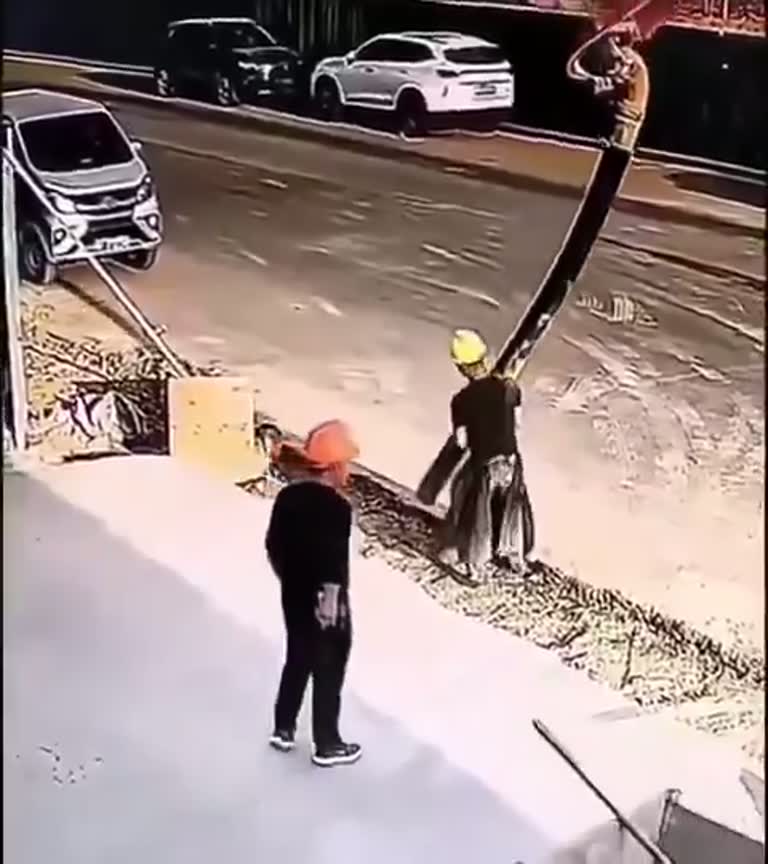
The footage begins in an almost mundane way. A residential or commercial street, cars parked along the kerb, daylight falling flat across the tarmac. Three workers in hard hats are visible near a concrete mixing vehicle and a section of pavement that has been dug up or prepared for pouring. One worker, wearing a yellow hard hat and dark clothing, is handling a long, flexible hose attached to the mixing equipment. Another worker in an orange hard hat stands further back, seemingly observing or coordinating the pour.
What happens next is brutally quick. The hose suddenly whips or discharges with immense force, and the worker holding it is struck by a powerful blast of material. The body of the worker is obscured in the cloud of discharge, and the scene instantly shifts from routine labour to chaos. The worker in the orange hard hat turns and moves away from the blast zone, while the hose continues to flail or expel material. The surveillance camera captures the entire sequence without sound, but the violence of the motion is unmistakable.
According to the original video description, the worker died after receiving the discharge. The description states that the worker was manipulating the hose of a mixer when the powerful impact occurred. The footage has been shared widely, with viewers expressing shock at how quickly a normal worksite can become a scene of tragedy. The description does not name the worker, the company, or the precise location, and no official conclusion has been released.
The incident occurred during a concrete pour on a public street.
The worker was handling a high-pressure hose connected to a mixer.
A sudden discharge struck the worker, and the event was captured on camera.
No official cause or liability determination has been made public.
The moment the hose turned deadly
The video itself is short, but it carries the weight of a full tragedy. In the first frames, the worker in the yellow hard hat is standing with legs braced, holding the hose with both hands. The posture suggests experience, routine, the kind of muscle memory that comes from repeating a task hundreds of times. There is no visible sign of panic or hesitation. The worker in the orange hard hat stands a few metres away, hands at their sides, watching the pour.
Then the hose kicks. It is not a gradual failure but a sudden, explosive release. The force appears to come from the pressure inside the line, and the worker is caught at the point of discharge. The body is pushed or struck, and the hose continues to move violently. The worker in the orange hard hat steps back, and the scene dissolves into a blur of motion and material. The surveillance camera, mounted high and fixed, does not flinch, but the humans in the frame do.
What makes the footage so unsettling is its ordinariness. There is no dramatic music, no warning sign, no moment of realisation captured on a face. It is simply a task, and then it is not. The viewer is left to reconstruct the seconds that separate a normal shift from a fatal accident. The description confirms the outcome: the worker died after receiving the discharge. The video does not show medical assistance or the immediate aftermath, and no audio transcript is available to clarify what was said or shouted in those final seconds.
A worksite on a public street: risks and regulations
Concrete pouring on a public street is a common sight in towns and cities, but it is also a high-risk activity. High-pressure lines, heavy machinery, and the presence of pedestrians and traffic create a complex safety environment. In the United Kingdom, the Health and Safety Executive (HSE) requires employers to assess risks and put controls in place for work involving pressure systems and concrete pumping. In the United States, the Occupational Safety and Health Administration (OSHA) sets similar requirements for construction sites, including training, equipment inspection, and personal protective equipment.
The footage shows workers wearing hard hats, which suggests some level of safety compliance. But hard hats alone do not protect against the force of a high-pressure discharge. The hose itself, the couplings, the pressure relief systems, and the training of the operator all matter. When a hose fails or a coupling gives way, the stored energy in the line can turn the hose into a whip-like hazard. The worker closest to the discharge is the most exposed, and in this case, the exposure proved fatal.
Questions will inevitably be asked about whether the equipment was inspected, whether the pressure was within safe limits, and whether the worker had received adequate training for that specific task. The video does not answer those questions, and no official report has been released. But the incident fits a pattern that safety professionals warn about: the moment when routine meets unchecked risk. The description does not specify the country or city, though the presence of certain vehicle models and the general street layout have led some viewers to speculate. Without official confirmation, those details remain unverified.
The human cost and the public reaction
Behind every workplace fatality is a family, a community, and a set of futures altered in an instant. The video captures a worker in the middle of a shift, doing a job that keeps cities building and growing. The description does not name the worker, but the loss is real. Colleagues on site would have witnessed the event, and emergency services would have been called. The footage does not show that aftermath, but the mind fills it in: the sudden silence, the shouting, the arrival of paramedics, the slow realisation that someone has died.
Online, the reaction has been a mixture of shock, sympathy, and anger. Some viewers have focused on the visible lack of barriers or exclusion zones around the worksite. Others have questioned why a high-pressure hose was being operated so close to a public road. Many have voiced concern about the safety of construction workers more broadly, particularly those who work on temporary sites with heavy equipment. The original description frames the event as a tragic accident, and the footage has been shared widely across social media platforms.
It is worth noting that the video has been edited and circulated without full context. The description does not identify the employer, the location, or the date. No official conclusion has been published. The absence of that information makes it difficult to draw firm conclusions about what went wrong or who, if anyone, was responsible. What is clear is that a worker went to work and did not come home. That fact alone is enough to justify a closer look at the systems meant to prevent such outcomes.
Insurance and who pays
When a workplace fatality occurs, the financial consequences can be as complex as the legal ones. In the United Kingdom, employers are legally required to hold employers' liability insurance, which covers claims from employees who are injured or killed at work. This insurance is mandatory for most businesses, and it exists precisely to ensure that workers or their families can seek compensation without the employer having to pay out of pocket. The policy typically covers legal costs, compensation awards, and related expenses, but it does not cover everything. There are exclusions, and there are limits.
In the United States, the system works differently. Workers' compensation insurance is the primary mechanism for covering workplace injuries and deaths. It is a no-fault system, meaning that workers or their families can receive benefits regardless of who was at fault. Those benefits usually include medical costs, a portion of lost wages, and death benefits for dependants. However, workers' compensation typically prevents the worker from suing the employer in court, except in cases of gross negligence or intentional harm. The rules vary significantly from state to state.
For the family of the worker in this video, the path to compensation would depend on where the incident occurred and how the worker was employed. If the worker was directly employed by a construction company, employers' liability or workers' compensation would likely be the first port of call. If the worker was a subcontractor or self-employed, the picture becomes murkier. Some contractors require subcontractors to carry their own insurance, but not all do. If the equipment belonged to a third party, there could be a product liability claim. If the site was not properly secured, there could be a public liability element.
Employers' liability insurance (UK) or workers' compensation (US) is the primary cover for workplace fatalities.

Exclusions may apply if the employer was uninsured or if the worker was classified as self-employed.
Claims typically require evidence of the incident, witness statements, and official reports.
Compensation amounts vary widely and are not determined by the video alone.
The excess or deductible on a commercial policy can also affect how a claim is handled. In the UK, employers' liability policies usually have a small or zero excess for injury claims, but the employer still has a duty to report the incident to the HSE under RIDDOR (Reporting of Injuries, Diseases and Dangerous Occurrences Regulations). In the US, OSHA requires employers to report fatalities within eight hours. Failure to do so can result in fines and further legal complications.
Repair or replacement costs are not the central issue here, because the loss is human, not material. But there may be property damage to the street, the equipment, or nearby vehicles. Those costs would fall under different policies: commercial motor insurance for the vehicles, public liability for the street, and equipment cover for the mixer and hose. The interaction between these policies can be complex, and disputes sometimes arise over who pays what. For the family, the priority is usually a death benefit or compensation claim, not the repair bill for a hose.
What the video does not show is whether the employer had insurance at all. Uninsured construction sites are a known problem in some jurisdictions, and they leave workers and their families in a precarious position. If the employer was uninsured, the family may have to rely on state safety nets or pursue the company's directors personally. That process can take years and may not result in full compensation. The absence of official information about the employer in this case makes it impossible to say which scenario applies. What is clear is that the financial aftermath of a workplace death is rarely simple.
For anyone watching this footage and wondering about their own cover, the key point is that workplace insurance is not optional for most employers. If you are an employee, your employer should have employers' liability or workers' compensation cover. If you are a subcontractor, check your own policy and the terms of your engagement. If you are a homeowner or business owner with work being done on your property, check that the contractor has insurance before work begins. The consequences of an uninsured incident can be devastating, and the paperwork is not something anyone wants to deal with in the aftermath of a tragedy.
The wider safety conversation
Incidents like this one tend to reignite debates about construction safety. In the UK, the HSE regularly publishes guidance on concrete pumping and pressure systems, and fatalities in the sector are investigated thoroughly. In the US, OSHA has specific standards for concrete construction and equipment inspection. But regulations only work if they are followed, and enforcement varies. The video shows a worksite that appears to have some safety measures in place, but the outcome suggests those measures were not enough.
Some safety experts argue that high-pressure hoses should be fitted with secondary restraints or whip checks to prevent exactly this kind of failure. Others point to the importance of exclusion zones, communication, and training. The worker in the video appears to be experienced, but experience is not a substitute for equipment that works. If the hose was old, damaged, or improperly connected, no amount of skill would have prevented the discharge. The investigation, if one is conducted, will likely focus on those technical details.
For the public, the footage is a reminder that construction work is dangerous and that the people who do it are exposed to risks that most of us never see. The video has been shared widely, and some viewers have expressed anger at what they perceive as a lack of care. Others have simply expressed sorrow. The description does not name the worker, but the loss is felt by those who knew them. The conversation online will continue, but the facts remain limited.
High-pressure concrete hoses can fail suddenly and with lethal force.
Safety measures include whip checks, exclusion zones, and regular equipment inspection.
Investigations typically examine equipment, training, and site management.
No official conclusion has been published in this case.
What happens next
In the coming days and weeks, several things are likely to happen. If the incident occurred in the UK, the HSE would be notified, and an investigation would begin. If it occurred in the US, OSHA would be involved. The employer's insurance company would be contacted, and the family would be advised on their rights. If the employer was uninsured, the family might need legal advice about pursuing the company or its directors. The video itself may be used as evidence, but it is not a substitute for a formal investigation.
For the family, the priority is usually a death benefit or compensation claim. In the UK, this might involve a claim under the employers' liability policy or a fatal accident claim. In the US, it would typically go through workers' compensation. The amounts vary, and no figure has been released in this case. The video does not show any discussion of money, and the description does not mention compensation. Any suggestion of a payout would be speculation.
The other workers on site may also be entitled to support, particularly if they witnessed the incident. Some employers provide counselling or employee assistance programmes. Others do not. The psychological impact of a workplace fatality can be significant, and it is often overlooked in the rush to establish legal liability. The video captures only the physical event, not the emotional aftermath.
What remains is a set of questions about safety, responsibility, and the value of a life. The footage is short, but it carries a long tail of consequences. The family will need answers, the authorities may provide some, and the insurance system will determine who pays. The rest is left to the courts, the regulators, and the public conversation. For now, the only certainty is that a worker died, and the video shows how quickly it happened.
| Incident parameter | Logged / on-scene information |
|---|---|
| Location | A public street with parked cars and roadworks (exact city unverified) |
| Time of day | Daylight |
| People present | At least three workers in hard hats; one operating the hose, one observing, others nearby |
| Equipment | Concrete mixer and high-pressure hose |
| Outcome | Worker died after receiving the discharge, per original description |
| Footage source | Surveillance camera, widely shared online |
| Official status | No official conclusion or liability finding released |
Important note: Some details, including the exact location, employer, and cause, remain unverified and are subject to official investigation.
Core questions still unanswered
- What safety measures should be mandatory for high-pressure concrete pouring on public streets?
- Who should bear the financial responsibility when a workplace fatality occurs on an uninsured site?
- How can employers better protect workers from sudden equipment failures like this one?
Learn more: School Fight Video: Knockout & Insurance Liability Explained
🎥 Watch the video at the bottom of the page 👇
This story was edited from a publicly posted video; some details may not be independently verified.