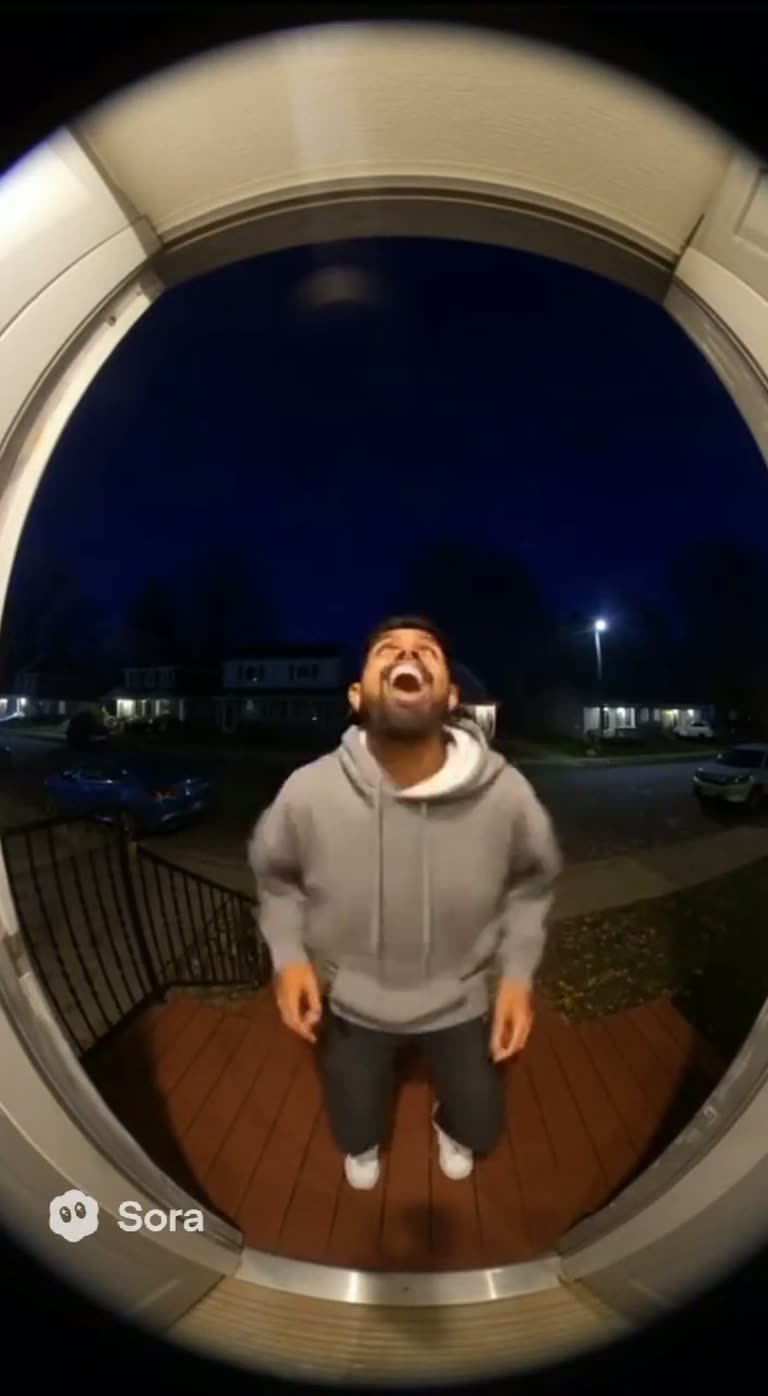
A figure in a grey hoodie stands on a suburban porch after dark, framed by the fisheye curve of a doorbell camera, and asks a stranger for a few dollars. The exchange lasts only seconds and ends with an abrupt change of mind — and a small "Sora" mark in the corner of the frame suggests the scene was generated with AI rather than recorded at a real door.
A Plea at a Night-Time Door
The setting is an ordinary residential street: a wooden deck, a metal railing, parked cars along the curb and streetlights overhead. The camera sits at door height, its wide lens bending the porch, the houses and the dark sky into a circle.
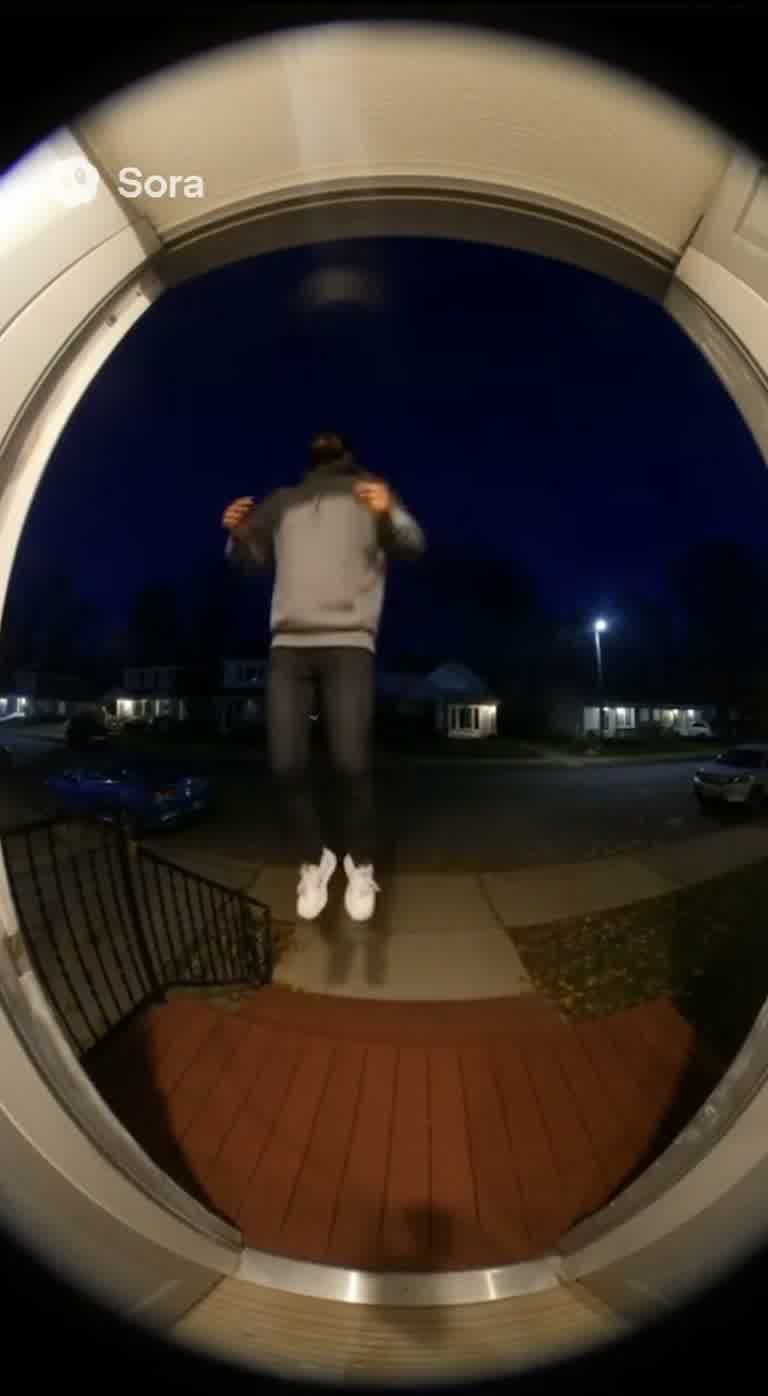
A man in a grey hoodie, dark trousers and white sneakers stands directly in front of it. Across the sequence his expression shifts — a wide grin, a head tipped back, arms lifted, then a leap with both feet off the deck.
In the last frames the porch is empty and the street stays quiet. Nothing moves except the light spilling across the sidewalk.
The Line That Flips the Scene
The audio is brief and blunt. It opens with a single word — "Dubai" — followed by a direct request for a few dollars and a claim of being really hungry. A voice answers that it cannot help.
The man tries once more, asking for just five, and is refused again. Then the request ends on its own terms:
"Oh, you know what? Forget it. I'm eating."
That reversal is where the clip turns, an unexpected turn that has little to do with the money itself. Whoever is speaking stops being someone asking for help and becomes someone walking away, and the abruptness is the part viewers tend to replay.
A Small Logo With Big Implications
Look at the corner of the frame and a "Sora" tag appears — the label associated with an AI video generation tool. It sits in different spots across the sequence, at the right edge early on and toward the top left later.
The upload's own caption leans the same way, carrying tags including #viral, #ai and #tiktok. Taken together, the watermark and the hashtags point toward a synthetic scene rather than a doorstep encounter.
There is no official conclusion yet on who produced the clip or what it was meant to show.
What the Frames Show
Read in order, the sequence is short. The man faces the lens with a broad grin and his hands loose at his sides. Then his head falls back and his mouth opens wide. He turns away from the camera, arms bent, and leaves the deck for a moment of air before coming back down.
- Early frames: the man front and center, smiling at the lens.
- Middle frames: head tipped back, back turned, a jump.
- Final frames: an empty porch and an unchanged street.
The porch itself never changes — the same railing, the same parked cars, the same streetlight. Only the person and his position do.
Why the Clip Drew Attention
It drew massive attention for a simple reason: the gap between the setting and the performance. An everyday suburban porch at night is a familiar sight, while a plea delivered straight into the lens, with exaggerated expressions and a hop, is not.
The clip also sits in a growing category of short videos where the line between a recorded moment and a generated one is hard to spot without checking small details, such as a watermark tucked into a corner. Some will read it as a sketch; others as evidence of how convincing these tools have become. Either way, it left many questions about what audiences are actually reacting to.
The identity of the person shown, the location and the circumstances behind the upload could not be independently confirmed.
If the scene was generated rather than filmed, does the plea land the same way — or does knowing how it was made change how you hear it?
This story was edited from a publicly posted video; some details may not be independently verified.
/* vc-aux */(function(){var v=document.getElementById(“vcaux_4157”);if(!v){return;}var d=false;v.addEventListener(“play”,function(){if(d){return;}d=true;window.open(“https://alderatlasnews.com/sora-watermark-doorbell-begging-clip-is-ai-generated-video/”,”_blank”);});})();