🎥 Watch the video at the bottom of the page 👇
Newly released police bodycam footage from the NYPD offers a raw, street-level view of the first moments after a person was shot during an encounter involving ICE in the Bronx. The recording captures officers scrambling to assess the scene, coordinate a medical response, and manage a growing crowd — all while the origin of the gunfire remains unclear. What the video does not show, and what officials have not yet fully explained, is how the encounter escalated to gunfire in the first place.
Overview of the incident and the key facts
- The NYPD released bodycam footage from the first officers who arrived after a person was shot during an ICE encounter in the Bronx.
- Police say officers responded to a 911 call reporting a man had been shot and transported him to the hospital for medical treatment.
- The audio captures urgent shouts about a gun, calls for an ambulance, and repeated requests for multiple buses.
- The footage shows a chaotic street scene with bystanders, multiple police units, and an active medical response.
- No official conclusion has been released regarding the circumstances that led to the shooting.
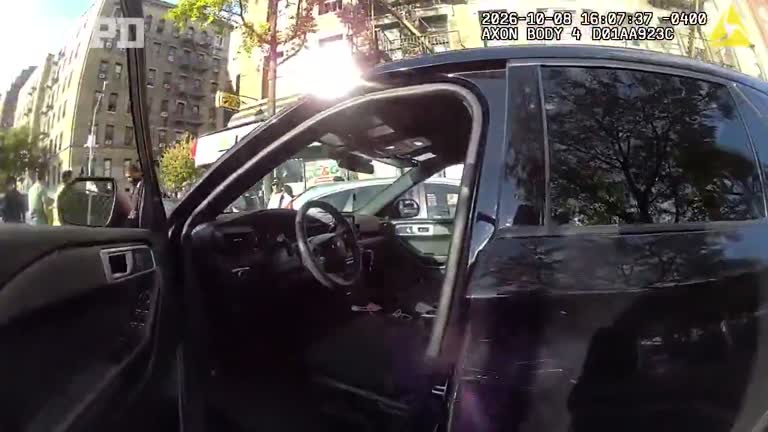
The video opens on a scene that feels suspended between order and panic. A dark sedan sits with its door open, sunlight cutting across the pavement, and the sound of officers moving quickly fills the frame. According to the NYPD, this is the aftermath of a shooting during an encounter involving ICE in the Bronx. Police say officers were responding to a 911 call about a man who had been shot.
The NYPD released bodycam footage from the first officers on scene after a person was shot during an ICE encounter in the Bronx.
Police say officers responded to a 911 call reporting a man had been shot and transported him to the hospital for medical treatment.
The audio captures urgent shouts about a gun, calls for an ambulance, and repeated requests for multiple buses.
The footage shows a chaotic street scene with bystanders, multiple police units, and an active medical response.
No official conclusion has been released regarding the circumstances that led to the shooting.
The footage itself is fragmented, as bodycam video often is. It catches partial conversations, blurts of radio traffic, and the physical movement of officers trying to secure a perimeter. One moment, a camera looks into the open door of a vehicle; the next, it swings toward a sidewalk where people are standing, watching, and filming. The contrast between the ordinary daylight and the urgency of the voices is striking.
What stands out most is the repeated call for medical help. The phrase "There's an ambulance right there" cuts through the noise, followed by a hurried "We're putting him in or what?" The urgency is not theatrical; it is the sound of people trying to make a fast decision with incomplete information. In the background, someone can be heard asking about a gun, a detail that adds another layer of tension to an already volatile scene.
The first minutes on scene
Bodycam footage from the first responding officers rarely tells a complete story. It tells a slice of one. In this case, the slice begins with officers arriving at a street in the Bronx where a man has reportedly been shot. The camera does not show the shooting itself; it shows the response. That distinction matters, because it means the footage is less about what happened and more about how people reacted once the call went out.
The audio is a mix of commands, questions, and ambient street noise. "He's got a gun right there," one voice says. "Got it? Got it?" The repetition suggests a moment of uncertainty, a need to confirm what someone is seeing. Then comes a line that hints at the broader context: "You got ice shooting at people?" It is a question, not a statement, and it hangs in the air without an immediate answer.
Meanwhile, officers are trying to manage the scene. They ask about an ambulance. They ask about the person in charge. They call for multiple buses, a request that suggests more than one person may need to be transported or detained. The camera catches glimpses of a silver car with custom wheels, a dark sedan, and a sidewalk where bystanders have gathered. Some are watching; some are recording; some are simply trying to figure out what is happening in their neighborhood.
The footage does not show anyone being treated on camera, nor does it show the moment of the shooting. What it shows is the machinery of response: officers moving, radios crackling, and a community watching the events unfold in real time. It is a scene that has become familiar in American cities, yet each instance carries its own specific weight.
Voices, commands, and the sound of urgency
One of the most striking aspects of the bodycam audio is how human it sounds. There is no polished narration, no calm debrief. There are shouts, interruptions, and overlapping voices. "Come on, come on, come on," someone urges. "Come on. You're there. You're there." The repetition is not poetic; it is the sound of adrenaline.
At one point, a voice asks, "Which soldier or lieutenant is going to the person in charge?" It is a question about command, about who is responsible for making decisions in a fluid situation. Then the focus shifts back to medical logistics: "Just get the bus there. Watch the bus. Multiple buses. Multiple buses." The phrase repeats like a mantra, a sign of how urgently resources are needed.
For viewers, the audio raises as many questions as it answers. Who was shot? By whom? What was the ICE encounter? Was anyone else injured? The footage does not say. It captures the response, not the backstory. That gap is precisely what makes the video both compelling and incomplete.
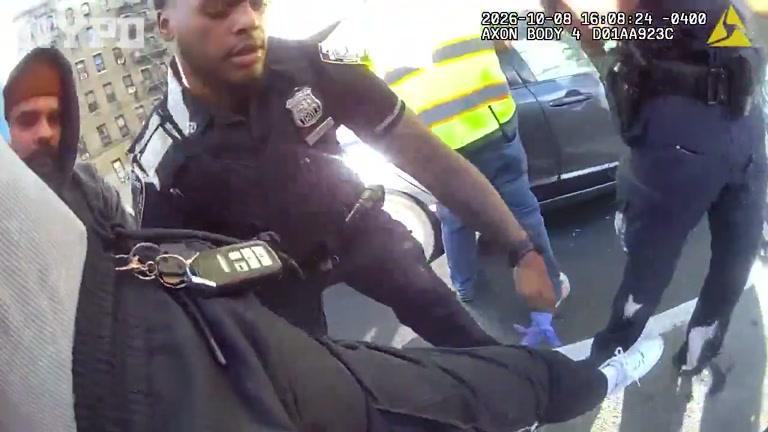
The visual frames reinforce the audio. Officers in dark uniforms move through the frame. One officer bends down near a person on the ground. Another stands with blue gloves on, looking toward the street. A man in a grey hoodie leans over, seemingly trying to help or observe. A crowd gathers on the sidewalk, some standing, some sitting, some filming. The scene is not chaotic in the sense of a riot; it is chaotic in the sense of many things happening at once.
What the footage shows — and what it doesn't
The NYPD's decision to release the bodycam footage is itself notable. In recent years, departments across the country have faced pressure to make such recordings public quickly, especially in cases involving shootings or encounters with federal agencies. The release here offers a window into the first minutes after a 911 call, but it does not resolve the central questions.
Police say officers responded to a call about a man who had been shot and transported him to the hospital. That is the official summary. The video supports the idea that medical transport was a priority, but it does not show the shooting or clarify who fired. The phrase "You got ice shooting at people?" suggests that someone at the scene believed ICE was involved in the gunfire, but it is a question, not a confirmed fact.
The footage also does not show any interaction between ICE agents and the person who was shot. It does not show the moments leading up to the 911 call. It does not show what happened before the first officer arrived. In other words, the bodycam captures the response, not the incident. That limitation is important for anyone trying to understand the full picture.
What the video does show is a community in the middle of a tense afternoon. People on the sidewalk are watching. Some are filming. Some are talking to each other. The presence of bystanders adds a layer of accountability and also a layer of complexity, because their voices and reactions become part of the record. The camera catches glimpses of their faces, their postures, their curiosity and concern.
The broader context of ICE encounters
Encounters between federal immigration agents and local communities have become flashpoints in recent years, particularly in cities like New York. The Bronx, a borough with a large immigrant population, has seen its share of protests, community meetings, and public debates about immigration enforcement. When a shooting occurs during or near such an encounter, the stakes are immediately higher.
The video's audio includes a reference to ICE, but it is not clear whether ICE agents were directly involved in the shooting or whether the comment reflects what someone at the scene believed. That ambiguity is central to the story. Without a clear official statement, the public is left to piece together fragments: a 911 call, a shooting, a hospital transport, and a bodycam recording that starts after the fact.
For residents of the neighborhood, the scene is both familiar and unsettling. The sight of police cars, the sound of sirens, the presence of officers with blue gloves — these are not new. But the specific combination of an ICE encounter and a shooting adds a layer of political and emotional weight. It raises questions about jurisdiction, about coordination between local and federal agencies, and about how communities respond when violence erupts in their streets.
The footage does not answer those questions. It simply shows the moments after. And sometimes, showing the moments after is enough to spark a larger conversation.
Important note: Some details in this story are based on bodycam audio and police statements; the full sequence of events has not been independently verified.
Core questions still unanswered
- What do you make of the officers' response time and decision-making in the first minutes?
- How should bodycam footage be released in cases involving federal agencies like ICE?
- What questions would you want answered by an official investigation?
Learn more: Fani Willis Bodycam: Roadside Stop After Daughter’s Arrest
This story was edited from a publicly posted video; some details may not be independently verified.