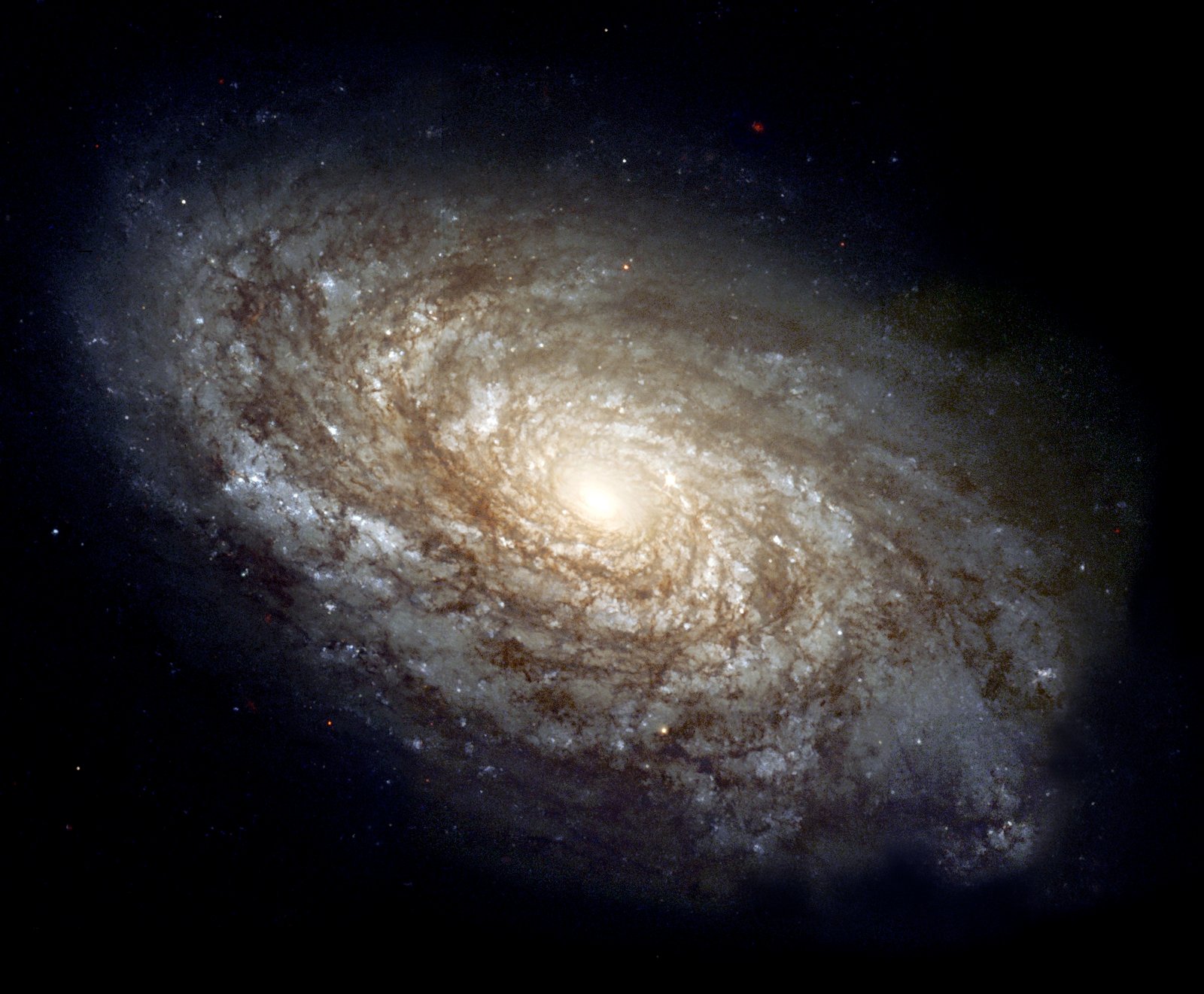
A press release about a photograph can look like decoration. NASA released a new Hubble view of the N44 region on 3 September, and at first glance it is another beautiful nebula: glowing gas, dark dust, a bright cavity near the middle. The picture is more interesting than that, because the cavity is evidence. Something carved it out, and the shape of the hole tells astronomers about the stars that did the carving.
Images like this are arguments as much as they are illustrations. Reading them well means asking what produced the structure, and what the image cannot show.
Where N44 is, and why that matters
N44 lies in the Large Magellanic Cloud, a small satellite galaxy of the Milky Way roughly 160,000 light-years away. That proximity matters. It is close enough for Hubble to resolve individual stars and detailed structure, but far enough to be seen as a complete system rather than a local fragment. The Large Magellanic Cloud is one of the best natural laboratories for studying how stars form and how they interact with their surroundings.
What carved the cavity
NASA describes the central opening as approximately 210 by 140 light-years across – an enormous void by any terrestrial standard. The most likely sculptors are massive stars. Their intense radiation and powerful winds push surrounding gas outward, and when they end their lives as supernovae, the explosions drive the process further. Over millions of years, this can excavate a cavity and compress the material at its edges, sometimes triggering new star formation in the denser shell.
Reading stellar winds and explosions
The cavity is not empty in the sense of containing nothing. It is filled with hot, thin gas that is difficult to see in the wavelengths used for the image. What the picture shows is the boundary: the denser material that has been swept up and lit by the stars within. Interpreting it requires combining what is visible with what other observations reveal about temperature, density and motion.
The “superbubble” idea
Astronomers use the term superbubble for structures like this, formed when the combined effects of many massive stars and their explosions carve out a large region of a galaxy’s interstellar medium. These bubbles matter because they shape how gas is distributed and how it cools, which in turn affects where and when new stars can form. A superbubble is therefore not just a hole; it is part of the cycle that recycles material through generations of stars.
Why the image is not a discovery
It is worth stating plainly: this is a new presentation of a known region, not the discovery of a new object. The scientific value lies in the clarity and framing of the view, which can reveal structure that earlier images obscured. Press releases often blur the line between “new picture” and “new finding”, and readers do well to keep the distinction in mind.
The limits of a snapshot
A photograph is a single moment. It cannot show whether the cavity is still expanding, how fast, or how long ago the most recent supernova occurred. For that, astronomers need spectra – measurements of light spread by wavelength – and repeated observations over time. The image raises questions; spectroscopy and monitoring answer them.
What astronomers still want to know
The open questions are the familiar ones of star formation: how much of the gas in the surrounding shell is collapsing into new stars, how the energy from massive stars is distributed, and how a region like N44 compares with similar structures elsewhere. Each of those requires data the photograph alone cannot provide. The picture is a starting point, and a striking one.
Why the Large Magellanic Cloud is a favourite target
Astronomers return to the Large Magellanic Cloud again and again for practical reasons. It is close enough to resolve detail, it contains regions of vigorous star formation, and it lacks the confusing foreground that complicates studies of more distant galaxies. It is also visible from the southern hemisphere, which gives observatories there a productive target. For a phenomenon like a superbubble, which unfolds over millions of years and involves many stars at once, having a nearby, well-studied example is invaluable.
The difference between a nebula and a superbubble
The words are often used loosely, so it helps to separate them. A nebula is a cloud of gas and dust, whether glowing or dark. A superbubble is a specific structure: a cavity carved by the combined winds and explosions of many massive stars. Not every nebula is a superbubble, and the distinction matters because it points to a different physical history. N44 contains both dense star-forming regions and the cavity that gives the image its drama, which is why it is such a rich target for study.
This report draws on NASA / Hubble.
Image: NASA , ESA , J. Hester and A. Loll (Arizona State University) · Public domain · via Wikimedia Commons.