Some of the most important climate evidence is stored in ice. As snow falls and compacts over thousands of years, it traps tiny bubbles of ancient air, preserving a direct sample of the atmosphere from before humans could measure it. Ice cores are the closest thing climate science has to a time machine, and they underpin much of what is known about natural variability.
What an ice core is
A core is a cylinder of ice drilled from a glacier or ice sheet, extracted in sections and analysed in laboratories. The deeper the ice, the older it is, because layers accumulate over time. Scientists date the layers and measure the composition of the trapped air and the chemistry of the ice itself.
What the bubbles contain
The trapped air preserves the concentration of greenhouse gases such as carbon dioxide and methane at the time the snow compacted. Because these gases are measured directly rather than inferred, ice cores provide some of the strongest evidence linking atmospheric composition to temperature over hundreds of thousands of years.
The longest continuous records extend back around 800,000 years, covering several ice ages and warm periods. That span allows scientists to see how the climate system behaved under conditions different from today, and to test the models used to project the future.
What the ice also records
Beyond gases, the ice contains dust, ash from volcanic eruptions, and chemical traces that indicate past temperatures and atmospheric circulation. Volcanic layers provide date markers, and dust reveals how winds and deserts changed. Each signal adds a piece to the picture.
Extracting a deep core requires drilling through kilometres of ice in extreme cold, and the equipment must not contaminate the sample. Cores are fragile and must be kept frozen through transport and storage. International collaboration is essential, because few countries have the resources to drill alone.
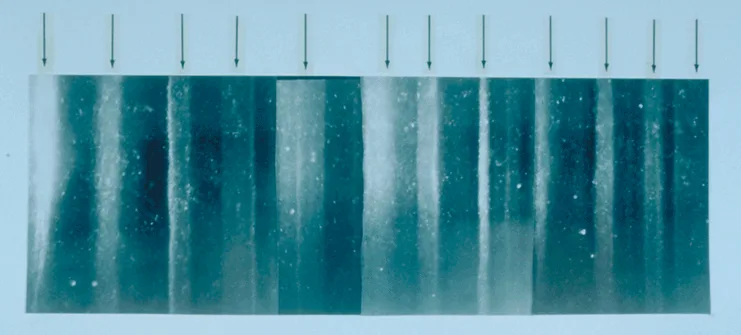
The race to preserve the record
Some of the oldest ice is in regions that are warming, and there is concern that archives could be lost before they are sampled. This has created a sense of urgency around drilling projects, which take years to plan. Preserving the record is a scientific priority that is easy to defer and impossible to recover.
The ice confirms that carbon dioxide and temperature have moved together over long periods, and that current concentrations are far above the range of the last 800,000 years. It also shows that changes can be abrupt, which is relevant to how the climate system might respond to rapid forcing.
What ice cores cannot tell us
Ice cores are point measurements, not global averages, and the resolution of older layers is coarse. They tell us about the atmosphere at a location and about global composition, and they do not directly describe regional rainfall or local conditions. Combining them with other records is what produces a global picture.
Layers are counted like tree rings, with annual signals where accumulation is clear, and volcanic ash provides independent markers. Deeper and older ice is harder to date, and uncertainty grows with depth. The dating is what allows the trapped air to be placed in time, so it is foundational to every conclusion drawn from the record.
What the record cannot show
Ice cores capture global atmospheric composition and local conditions at the drill site. They say little about regional rainfall or about conditions in the tropics, where much of the world’s population lives. Other archives, such as corals, lake sediments and tree rings, fill in the regional picture.
Drilling projects involve multiple countries, shared logistics and long planning horizons. The samples are stored in specialised facilities and shared among researchers, which requires agreements about access and curation. The cooperation is one of the more successful examples of international scientific collaboration.
What other archives show
Corals, stalagmites, lake sediments and tree rings each record aspects of past climate, with different resolutions and regional coverage. Combining them with ice cores produces a picture that no single archive could provide. The work of reconciling different records is a substantial part of climate science.
Deep drilling projects cost millions and require specialised teams, aircraft and cold storage. Funding is competed for, and the planning horizon is long. The value lies in the irreplaceable nature of the record, which is why the investment is defended despite the cost.
Ice cores remain one of the clearest windows into the climate system, and they are finite. The case for funding the next drilling project rests on the fact that the record cannot be reconstructed once the ice is gone, and that arguments about the future are better made with evidence from the past.
This report draws on National Oceanic and Atmospheric Administration (NOAA) and Intergovernmental Panel on Climate Change (IPCC).
Image: Wikimedia Commons · Public domain · via Wikimedia Commons.