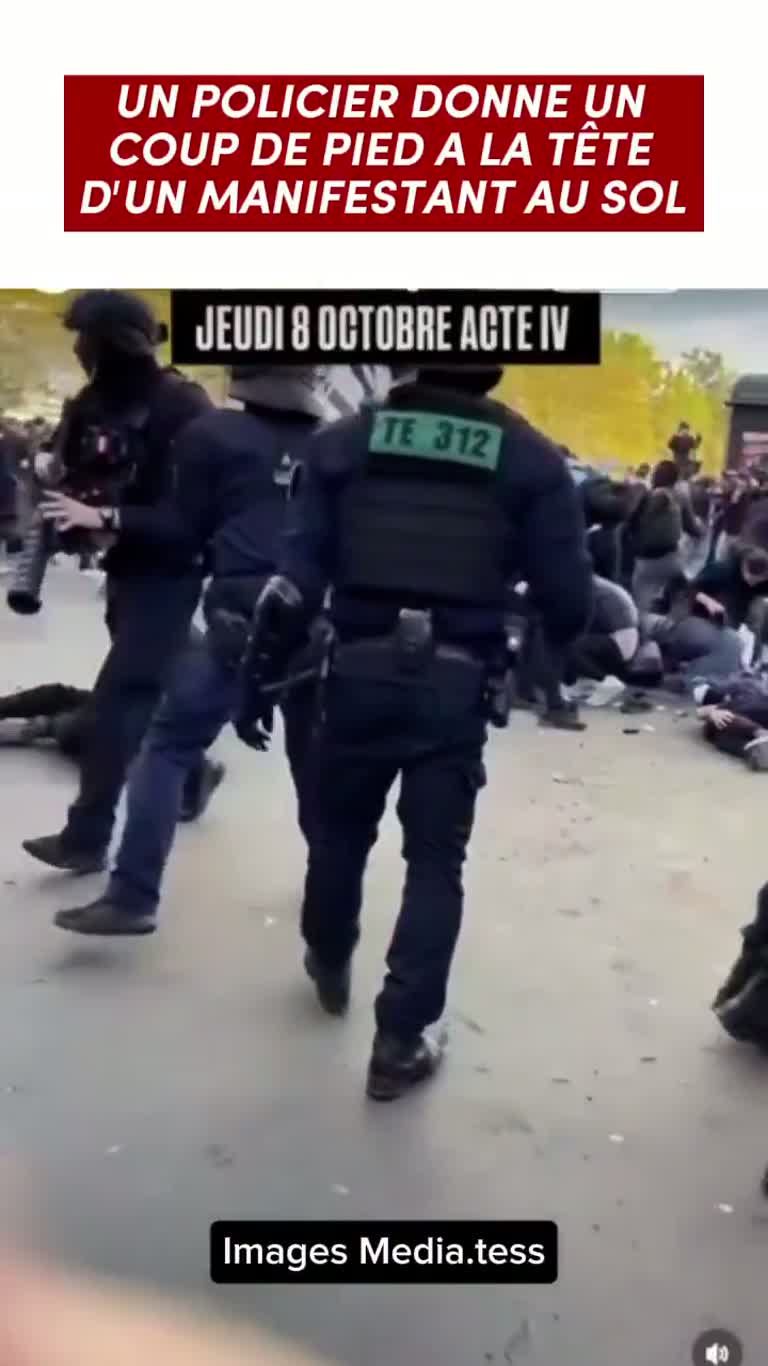
A brief clip circulating online appears to show a French riot police officer aiming a kick at the head of a protester who is already lying on the ground. The footage, captioned as being from Thursday 8 October, Act IV of a demonstration, has sparked a firestorm online as viewers debate what actually happened in the moments before the camera started rolling. The incident has drawn massive attention, raising urgent questions about policing, liability and who pays when state force meets a human skull.
Overview of the incident and the key facts
- The video is captioned "UN POLICIER DONNE UN COUP DE PIED A LA TÊTE D'UN MANIFESTANT AU SOL" (A police officer gives a kick to the head of a protester on the ground).
- The footage is labelled "JEUDI 8 OCTOBRE ACTE IV" (Thursday 8 October, Act IV), placing it within a broader wave of French demonstrations.
- The visible sequence shows a line of officers in dark riot gear moving across a paved street as several people lie or sit on the ground around them.
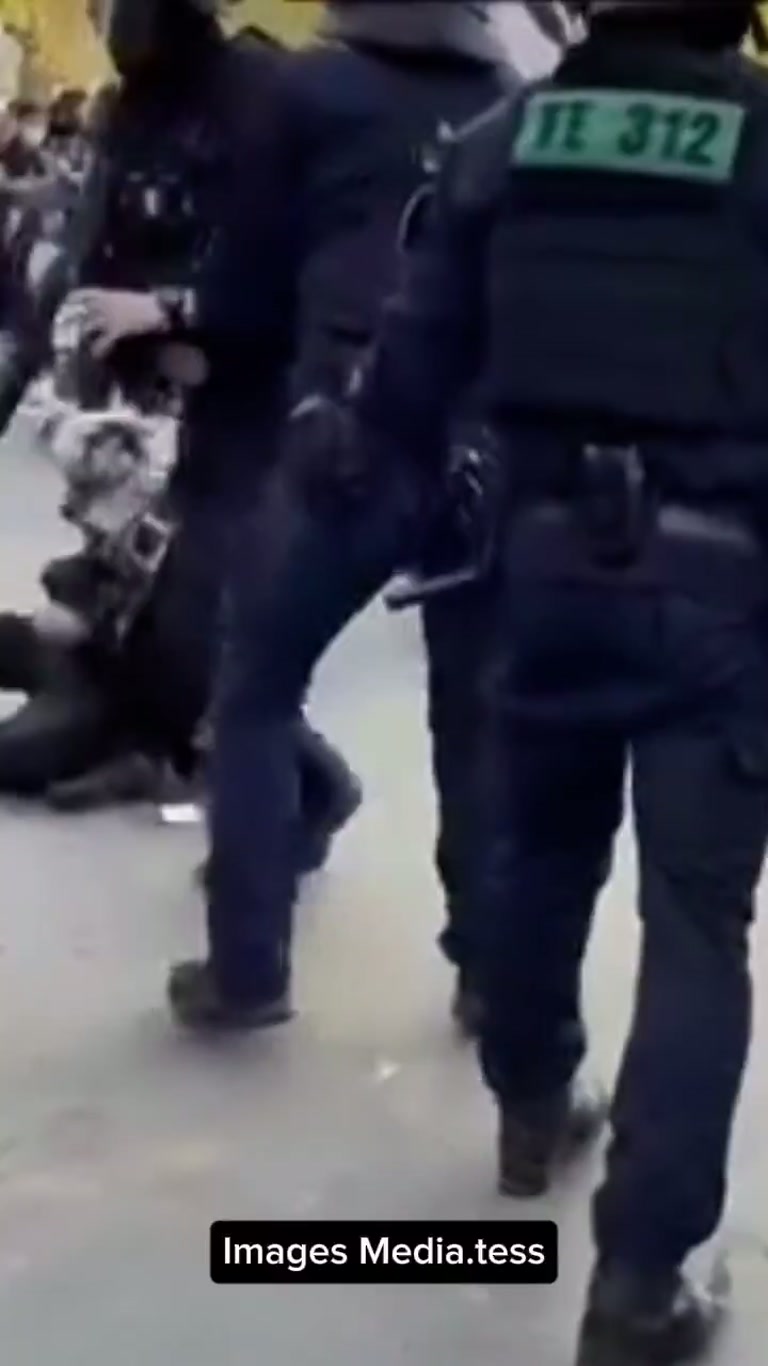
- One officer, identified in the frame by a green patch reading "TE 312", is seen mid-motion with a leg raised near a person on the ground.
- The clip is short, filmed from behind the police line, and does not show the lead-up to the moment or any official conclusion.
- The only audible sound in the recording is a single "Oh", suggesting a nearby onlooker reacting in the moment.
The footage opens on a wide, tree-lined boulevard. Yellow leaves still cling to the branches overhead, and daylight falls flat and grey across the asphalt — the kind of soft, overcast afternoon that makes everything look slightly washed out. A line of officers in dark blue riot gear is striding across the road from left to right, shields and helmets obscuring their faces. On the ground around them, several figures are sprawled or crouched, some clearly protesters, some simply caught in the wrong place at the wrong moment.
The caption burned across the top of the clip is blunt: a police officer gives a kick to the head of a protester on the ground. The label underneath reads "JEUDI 8 OCTOBRE ACTE IV" — Thursday 8 October, Act IV — anchoring the scene to a specific day in a specific protest cycle. The watermark "Images Media.tess" sits at the bottom of the frame, a reminder that this is a fragment of a much longer event, cut down to its most controversial second.
What the camera actually shows is this: officers moving through the street, a man in dark clothing lying low on the tarmac, and one officer — the one with the green "TE 312" patch on his back — with a leg lifted in a motion that looks, from behind, like a kick aimed downward. The person on the ground does not appear to be resisting in that instant. The audio captures a single, quiet "Oh" — the sound of someone nearby seeing it happen.
That is the whole of the verified visual record. There is no wide shot of the charge that preceded it, no clear view of what the man on the ground did or did not do, no statement from the officers involved, and no official conclusion from French authorities. The clip begins after the confrontation has already begun and ends before anyone has been helped, arrested or explained. Everything else — the why, the before, the after — remains outside the frame.
The street, the crowd and the atmosphere
Protest scenes in France have a rhythm of their own. There is the slow build as crowds gather, the drums and chants, the smell of smoke and cheap coffee, the nervous energy of people checking their phones for updates on where the police line is moving. Then there is the moment the mood turns — a charge, a bottle thrown, a line of shields pushing forward — and the street that was a gathering place becomes a corridor of noise and motion. This clip sits squarely in that second phase.
The frames suggest a broad avenue with trees on one side and crowds still visible in the background, some walking, some watching, some clearly trying to move away. Officers in full kit dominate the foreground. The ground is scattered with small white objects — debris, leaflets, bits of paper — the usual litter of a demonstration that has moved through. Nobody in the frame looks calm. The body language of the officers is forward-leaning, purposeful, driven by whatever order or instinct is moving the line.
What strikes a viewer watching the sequence is the asymmetry of it. The officers are upright, armoured, mobile. The people on the ground are none of those things. One man lies curled, another sits with his back turned, a third is a blur of dark clothing near the centre. The gap between the standing and the fallen is where the controversy lives. When a person is already down, the question of what level of force is reasonable becomes not just legal but moral — and, for insurers and courts, deeply financial.
The crowd in the background adds its own texture: phones up, faces turned, the low hum of a city watching something happen. The single "Oh" on the audio is the human punctuation mark. It is not a scream, not a shout of anger. It is the sound of surprise — the sound of someone realising that what they are seeing is going to matter.
What the footage does and does not show
This is where careful reading matters. The caption makes a claim — a kick to the head — and the visual sequence is consistent with a kick motion aimed at a person on the ground. But the clip is filmed from behind and slightly to the side of the officer in question. It does not show contact with the head with total clarity. It does not show whether the man on the ground was already injured, whether he had been resisting seconds earlier, or whether the officer was reacting to something off-camera.
The clip also does not show what happened next. Did the man receive medical attention? Was he arrested? Was the officer stood down, investigated, or praised? There is no official conclusion visible in the source material, and no statement from French authorities is included. That absence is not unusual for viral fragments — but it is exactly the gap that fuels online debate. Users shared it widely, opinions were split, and it fueled heated debate online about policing, protest and the limits of force.
For anyone trying to understand the legal and financial consequences, the missing context is everything. A clip that shows a single second of force cannot by itself establish liability. It can spark a review, prompt an investigation, and trigger a compensation claim — but the outcome depends on evidence that this footage simply does not contain. The people involved, their injuries, their insurance status and the official findings all sit outside the frame. That is why the story kept developing long after the video stopped.
The insurance angle: who pays when force causes injury
When a person is injured during a protest — whether by police force, by a fellow demonstrator, or by falling debris — the question of who pays is rarely simple. In the United Kingdom and the United States, the routes to compensation differ significantly, and the policies that might respond are not always obvious to the person lying on the ground. This is where the story moves from viral clip to financial reality.
Start with health. In the UK, anyone injured in a public place would typically be treated by the NHS, which is funded through taxation rather than private insurance. That does not mean there is no financial consequence — lost wages, travel to hospital, rehabilitation and long-term care can all create real costs. In the US, by contrast, emergency treatment is billed, and a single CT scan after a suspected head injury can run into thousands of dollars. A health insurance policy, whether employer-provided or purchased privately, would be the first port of call for medical bills. But even comprehensive health cover comes with deductibles, co-pays and out-of-network traps, and a claim related to a violent incident may invite extra scrutiny.
Then there is liability. If a police officer is found to have used excessive force, the state may be liable — but suing the state is a slow, specialised process with strict notice deadlines and limited damages in some jurisdictions. In the US, qualified immunity can shield officers from personal liability in many cases. In the UK, claims against the police typically proceed through the civil courts, and the Independent Office for Police Conduct (IOPC) may investigate. None of this is quick, and none of it is guaranteed. A viral clip is evidence, not a verdict.
Where insurance policies genuinely come into play is around the edges. A person injured at a protest might have personal accident cover through an employer, a union, or a travel policy if they were away from home. Home insurance in the UK sometimes includes public liability cover that extends to the policyholder's actions away from the property — though it rarely covers injuries sustained as a victim of someone else's force. In the US, renters or homeowners liability cover typically protects the insured if someone else is hurt on their property or by their actions, not the other way round.
The hard truth is that compensation for injuries caused by police force usually depends on a successful legal claim, not on an insurance payout. And that claim depends on evidence — medical records, witness statements, bodycam footage and official findings. The viral clip may be the spark, but it is not the whole fire. Anyone in that position would need specialist legal advice, and the financial outcome would hinge on questions of liability, causation and the specific facts of the case, none of which can be resolved by a fifteen-second video.
Excess, exclusions and the claims maze
For those who do hold insurance, the small print matters enormously. A health policy may exclude injuries sustained during the commission of a crime — so if a protester is deemed to have been breaking the law, a claim could be rejected. A personal accident policy may pay a fixed sum for specific injuries, such as a fractured skull or loss of sight, regardless of fault, but the payout is capped and the definition of "accident" can be narrow. Travel insurance, if the person was visiting from abroad, might cover emergency medical treatment but exclude participation in demonstrations or civil unrest.
In the UK, the Financial Ombudsman Service can step in if a claim is handled unfairly, and the Consumer Rights Act 2015 provides some protection around unfair terms. In the US, state insurance regulators oversee complaints, and policyholders can appeal denials. But none of these routes are fast, and none of them guarantee a payout. The excess — the amount the policyholder pays before the insurer steps in — is another hurdle. For a health policy, that might be a few hundred pounds or dollars; for a liability claim, it can be far higher.
Repair and replacement costs are not really the issue here, because the loss is physical injury rather than property damage. But the financial ripple effects are real: lost income, childcare costs, transport to medical appointments, and the long tail of rehabilitation. Some of these may be recoverable through a personal injury claim, some through insurance, and some not at all. The people involved in this clip may never see a payout, and no reliable figure for compensation exists in the source material. What does exist is a clear reminder that in the aftermath of force, the financial questions are as urgent as the moral ones.
If a claim were to be made, the steps would be familiar to any insurance professional. First, report the injury and preserve evidence — medical records, photographs, witness contact details. Second, notify the relevant insurer within the policy's deadline, which is often days rather than weeks. Third, cooperate with the investigation, providing statements and documentation. Fourth, if the claim is denied, consider an appeal or a complaint to the ombudsman or regulator. Fifth, if liability rests with a third party, pursue a civil claim within the limitation period — typically three years in the UK for personal injury, and varying by state in the US. None of this is easy, and none of it is instant.
Important note: Some details in this report remain unverified, including the full context of the incident, the identities of those involved, and any official findings.
Core questions still unanswered
- Should the state or an insurance policy be responsible when force causes injury during a protest?
- Would a health or personal accident policy actually pay out in a case like this?
- What evidence would a court need before deciding who is liable?
Learn more: Vermont ICE Raid Bodycam: Troopers Push Protesters
🎥 Watch the video at the bottom of the page 👇
This story was edited from a publicly posted video; some details may not be independently verified.