The deep ocean floor holds deposits of metals used in batteries and electronics, and for years extracting them was a thought experiment. That is changing. Companies have applied for exploration and exploitation rights in international waters, and regulators are working out rules for an industry that does not yet exist at scale.
The debate that follows is not only technical. It concerns who owns the seabed, who bears the risk of damage, and whether the metals are needed at all.
What is down there
Three deposit types attract attention: potato-sized nodules rich in nickel, cobalt and manganese; crusts on seamounts; and sulphide deposits around hydrothermal vents. Each forms over millions of years, which means they are effectively non-renewable at human timescales.
Why companies are interested
Demand for battery metals is expected to grow as energy systems electrify. Land-based deposits are often concentrated in a few countries, and some are of declining grade. Seabed deposits are large and geographically dispersed, which makes them attractive to governments seeking supply security.
Deep-sea ecosystems are poorly understood and slow to recover. Nodule fields support organisms that grow for decades or centuries, and the sediment plumes created by mining could smother life far from the extraction site. Scientists have warned that the baseline data needed to measure impact does not yet exist.
The governance question
Seabed mining beyond national jurisdiction is regulated by an international authority, which is negotiating a mining code. The rules cover environmental assessment, benefit sharing and liability, and they are contested because the interests of sponsoring states, companies and conservation groups differ sharply.
One argument against mining is that the metals are already above ground in discarded devices. Recycling rates for some of these metals are low, and improving them would reduce demand for new extraction. Substitution, where a material can be replaced in a battery chemistry, is another route that reduces pressure.
The precautionary option
Several countries have called for a moratorium until the science is clearer and the rules are in place. Others argue that a pause simply shifts extraction to less regulated waters. The disagreement reflects a broader question about how to act when evidence is thin and the consequences are hard to reverse.
The indicators worth following are the progress of the mining code, the number of licences granted and the publication of independent environmental baselines. Those will show whether the industry advances on evidence or ahead of it.
The economics of extraction
Deep-sea mining is capital-intensive, and the business case depends on metal prices that fluctuate. A project that looks viable at high prices may not be at low ones, which makes investors cautious. The uncertainty is compounded by the absence of an agreed regulatory framework, because no one wants to fund a venture whose rules may change.
Some states sponsor exploration contracts through their national agencies, while others have called for a pause. The split reflects different interests: countries with seabed claims or mining industries tend to support development, while those focused on ocean conservation tend to urge caution. The disagreement is playing out in the international negotiations.
The monitoring challenge
Measuring the impact of mining on deep-sea ecosystems is difficult and expensive. The areas are remote, the organisms are slow-growing and the effects may appear years later. Building a monitoring programme before extraction begins is one of the conditions scientists consider essential, and it requires funding that has not yet been committed.
Deep-sea ecosystems recover slowly, if at all. A disturbance experiment in the Pacific left tracks that were still visible decades later, and the communities that recolonised them were different from those that were removed. That evidence is limited to one site, and it is the strongest argument for caution in the absence of broader data.
The role of consumers
Demand for battery metals ultimately comes from consumers, through the devices and vehicles they buy. Recycling, repair and longer product life reduce the need for new extraction, and they depend on design and policy as much as on individual choice. The connection between a phone and a seabed is distant, and it is real.
The mining code has been under negotiation for years, and the pace reflects genuine disagreement rather than bureaucratic delay. Sponsoring states want rules that allow extraction to proceed; conservation-minded states want rules that make it difficult. Companies want certainty before they invest. Scientists want baseline data collected before any disturbance begins, which takes time. The result is a negotiation in which each party is waiting for something the others control, and progress depends on whether the authority can produce a framework that is credible enough to attract investment and strict enough to satisfy its critics. That is a narrow target.
This report draws on the International Seabed Authority and the International Union for Conservation of Nature.
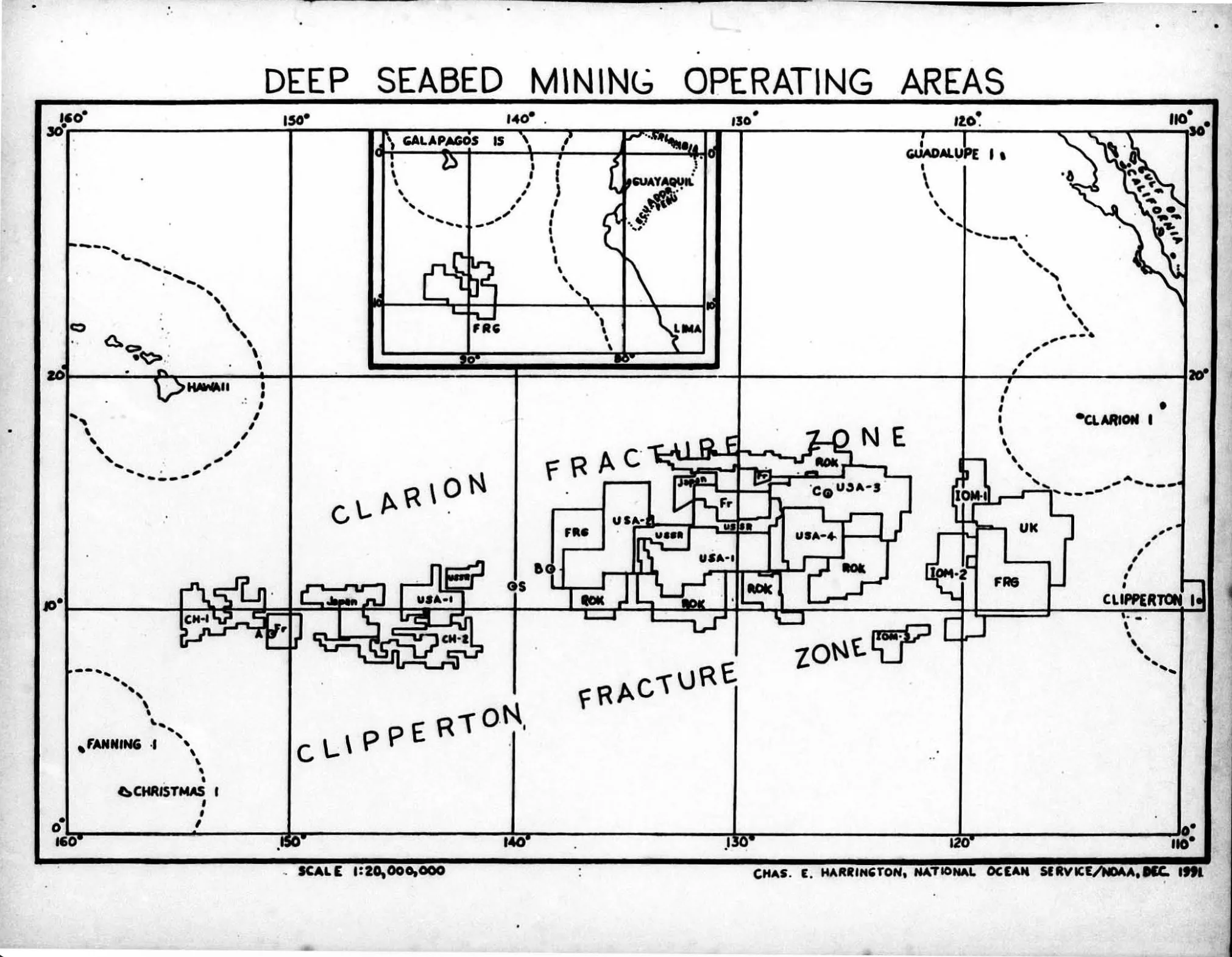
Image: Chas. E. Harrington, National Ocean Service/NOAA · Public domain · via Wikimedia Commons.