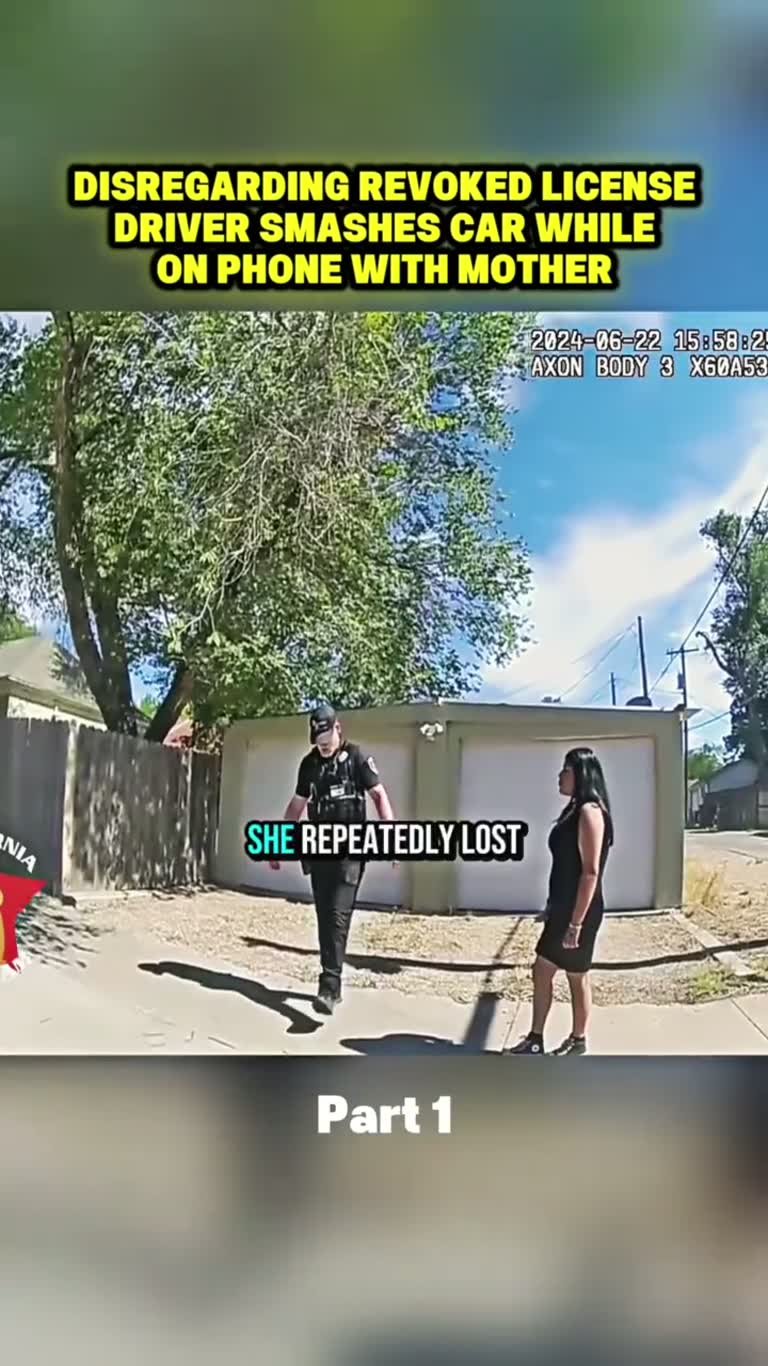
What should have been a straightforward lift home after a family birthday unravelled in the forecourt of a BP garage, with police body-camera footage capturing the moment two sisters were taken into custody. Officers had responded to a report of a reckless driver who ran over a bicycle on Greenwood Road and drove off with a flat tyre. Instead of a simple traffic stop, they encountered contradictory accounts, an open alcohol container and a family argument that boiled over in front of the police.

Overview of the incident and the key facts
- Police were called to a report of a vehicle that had struck a bicycle on Greenwood Road and left the scene with a flat tyre.
- A woman named Caitlin told officers she was the designated driver taking family and friends out for a birthday celebration.
- She repeatedly changed her account of their route and how the tyre was damaged, raising officers' suspicions.
- An open alcohol container was visible in the driver's side door, according to the footage and transcript.
- Caitlin cited a torn ankle ligament while failing field sobriety tests, as her mother shouted and interfered nearby.
- The situation peaked when Caitlin's sister backhanded their mother in view of police, leading to both sisters being restrained.
A routine call that refused to stay routine
The night began with a simple report: a driver had struck a bicycle on Greenwood Road and continued on with a flat tyre. On paper, it was the kind of call that officers handle quickly — locate the vehicle, check on the cyclist, sort out the damage. But as the body-camera footage unfolds, the scene refuses to behave like a routine traffic matter. The vehicle turns up at a BP station, and from the first exchange it is clear that the people inside have very different ideas about what happened.
A woman later identified as Caitlin steps forward as the designated driver, or D.D., explaining that she was bringing family and friends home from a birthday celebration. It is a reasonable story on its face, the sort of responsible arrangement people make every weekend. The problem, as the footage shows, is that the details around it keep shifting. Officers ask straightforward questions about the route and the flat tyre, and the answers never quite line up. What starts as a conversation about a bicycle and a damaged wheel becomes something heavier.
The forecourt itself becomes a stage. Bright forecourt lights, the low hum of the pumps and a small group of people standing around a car with a visibly flat tyre. Officers are trying to establish basic facts. Around them, the mood is tightening — voices rising, hands gesturing, a family argument beginning to cut across the police questions. It is the kind of scene where a single raised voice can change everything.
Contradictions, an open bottle and a torn ligament
Suspicion mounts quickly when officers spot an open alcohol container in the driver's side door. In the transcript, the phrase "an open alcohol" is used as the camera sweeps past the vehicle. For police, that single detail reframes the whole stop. It moves the encounter from a report of careless driving into a potential impaired-driving investigation, and it changes how every subsequent answer is weighed.
Caitlin, for her part, offers an explanation for why she cannot complete the field sobriety tests: a torn ankle ligament. It is a claim officers hear in various forms, and it puts them in an awkward position. They cannot simply accept it at face value, but they also cannot ignore a genuine injury. In the footage, she repeats the excuse as the tests are attempted and failed, and the frustration on both sides becomes visible. The gap between what she says and what the officers observe widens with each exchange.
Meanwhile, her mother is described as continuously screaming, causing a disturbance and interfering with the officers. The transcript captures a fragment of that tension: "Stop yelling. Stop yelling." What might have been background noise becomes central to the encounter. When a family member steps into an active investigation, officers have to manage two problems at once — the original allegation and the new disruption happening inches away.
The contrast is striking. On one side, a police investigation trying to establish facts about a bicycle, a flat tyre and an open container. On the other, a family gathering that was supposed to be a celebration now shouting across a petrol station forecourt. The footage makes clear that the emotional temperature was rising faster than anyone could control.
The moment the chaos peaked
The turning point arrives when Caitlin's heavily intoxicated sister backhands their mother in full view of the police. In the transcript, the sequence is blunt: the chaos peaks, and both sisters end up being restrained and taken into custody. It is the kind of moment that turns a traffic investigation into a multi-person arrest, and it happens in seconds. The camera catches the shift from argument to physical contact to officers moving in.
For the officers, the decision is immediate. A physical altercation in front of police cannot be ignored, regardless of who started it or why. What follows is the familiar choreography of a chaotic arrest — raised voices, hands restrained, people being moved apart. The footage does not editorialise; it simply records a family falling apart in public while a separate investigation waits in the background.
At the station, the account continues. Caitlin is described as remaining combative, hurling insults, refusing a urine sample and insisting she is being treated unfairly. Refusing a sample is a decision with legal consequences in many jurisdictions, and it tends to extend rather than end the process. The transcript's closing note is stark and slightly ambiguous: "In the end… She fled."

The whole arc — from a birthday ride to a bicycle collision to a family scuffle to a refusal at the station — is compressed into a few minutes of footage. It is the kind of story that spreads because every layer adds another question. Was the original bicycle collision as serious as reported? Why did the accounts keep changing? And what exactly happened after the camera stopped rolling?
Insurance and who pays
For anyone watching this unfold, the financial consequences are almost as messy as the arrest itself. Start with the bicycle. If a vehicle struck a cyclist and left the scene, the cyclist's injuries and the damage to the bike would normally be pursued through the driver's motor insurance — specifically the third-party liability section, which exists precisely for harm caused to other people. In the UK, that liability cover is compulsory, and the Motor Insurers' Bureau can step in when an uninsured or untraced driver is involved. In the US, the equivalent rules vary by state, with some requiring uninsured-motorist cover and others relying on the driver's liability policy. Either way, the cyclist's first practical step is to report the collision to the police and gather any witness details, because a claim needs a documented event, not just a story.
Then there is the vehicle with the flat tyre. If the wheel was damaged in the same incident, a comprehensive policy would typically cover the repair, minus the excess. In the UK, that excess is the amount the policyholder pays before the insurer settles the rest; in the US, the equivalent is the deductible. A single damaged wheel and tyre might fall below the excess, in which case the driver pays out of pocket and the claim becomes pointless. If the damage extends to the suspension or bodywork, the maths changes quickly. Without an independent assessment, no reliable repair figure can be quoted from this footage alone.
The open alcohol container and the failed sobriety tests raise a harder question. Most motor policies exclude claims arising from driving while intoxicated, and an insurer can refuse to pay for the driver's own damage if a policy condition was breached. That does not necessarily wipe out the insurer's duty to pay third parties — in the UK, for example, the insurer may still have to settle a liability claim and then seek recovery from its own policyholder. For the driver, the practical effect is a claim that may be denied, a premium that rises sharply and, depending on the jurisdiction, a legal bill that no policy will touch.
There is also a liability dimension around the family scuffle itself. Home insurance often includes personal liability cover, but it generally excludes intentional acts and criminal conduct. A backhand in front of police would almost certainly fall outside the scope of any standard household policy. If someone suffered an injury in that moment and sought compensation, the claim would be directed at the individual, not at an insurer. This is the part of the story where cover runs out fastest.
Finally, consider the practical steps anyone in this situation should take. Report the incident to police and obtain a reference number. Photograph the damage and the scene. Notify your insurer promptly and be honest about the circumstances, because a misdescribed claim can be refused later. Keep receipts for repairs, medical treatment or alternative transport. If you are the injured third party — in this case, potentially the cyclist — you can claim directly from the at-fault driver's insurer, and you do not need to negotiate with the driver personally. What you cannot do is assume the payout. Liability has to be established, excesses apply, and intoxication or intentional acts can override cover entirely.
The insurance and legal picture here is genuinely unresolved, and that is the point. A birthday celebration, a bicycle on the road and a flat tyre at a petrol station should be three unrelated things. Instead, they collided into one night that ended with two sisters in custody and a set of questions no camera can answer. What do you make of this — should the cyclist's claim, the vehicle damage and the family fallout all be handled by the same insurer, or should each be settled separately?
| Incident parameter | Logged / on-scene information |
|---|---|
| Location | Greenwood Road and a BP gas station |
| Time of day | Overnight, per footage timestamps |
| Initial report | Reckless driver ran over a bicycle and fled with a flat tyre |
| Driver's stated role | Designated driver for a birthday group |
| Observed detail | Open alcohol container in the driver's side door |
| Family conduct | Mother screaming and interfering; sister backhanded mother |
| Outcome | Both sisters restrained and taken into custody |
Important note: Several details, including the final legal outcome and the cyclist's condition, are not confirmed by the available sources.
Core questions still unanswered
- Should the cyclist's injury claim and the vehicle damage be handled by separate insurers?
- Does an open container in the door justify a full impaired-driving investigation on its own?
- Who should bear the cost when a family argument turns physical in front of police?
Learn more: Woman Sways on Roadside in Late-Night Bodycam Stop
🎥 Watch the video at the bottom of the page 👇
This story was edited from a publicly posted video; some details may not be independently verified.