A routine fuel stop at a busy Orlando Wawa spiralled into a dramatic pursuit this week, after three young teenagers were allegedly caught on camera using a small device to compromise gas pumps and nearby cash machines. What began as a quiet, unassuming moment quickly became a high-stakes race against the clock, with officers tracking the suspects in real time as a victim's live banking alerts sounded the alarm. The entire sequence, captured on body-worn cameras, offers a rare window into how modern financial crime is detected, reported and pursued.
Overview of the incident and the key facts
- Three teenagers were observed at a Wawa petrol station in Orlando, where they reportedly handled both a fuel pump and nearby ATMs using a small device.
- A customer noticed something unusual and contacted the authorities, triggering a rapid response.
- The suspects allegedly withdrew between $1,000 and $3,000 at multiple cash machines during the spree.
- Live banking alerts received by a victim helped officers track the group in real time, leading to a takedown.
- A search of the suspects' vehicle reportedly uncovered a green Fidelity Bank card and further evidence pointing to a larger operation.
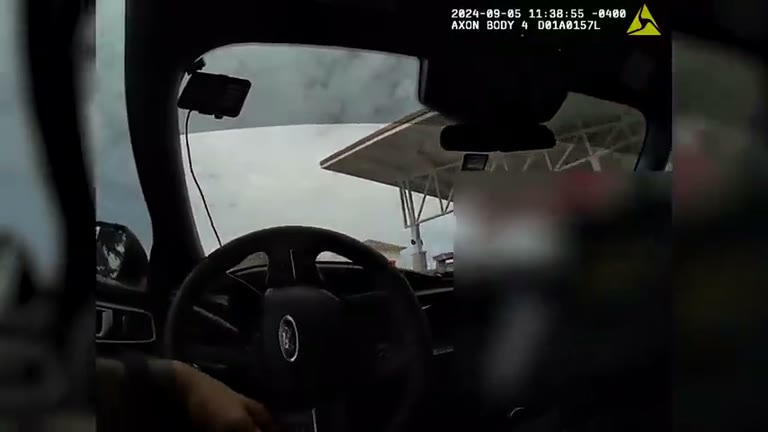
The footage opens inside a vehicle, the dashboard camera rolling as the car pulls into a forecourt under a flat, overcast Florida sky. It is the kind of grey, humid afternoon that Orlando knows well — the air thick, the light dull, the world moving at the slow pace of a fuel stop. Three young teenagers step out, their movements brisk and purposeful, the sort of hurried choreography that blends into the everyday bustle of a busy service station. Nothing about the scene screams urgency, and yet, within minutes, everything will change.
What the camera captures next is deceptively ordinary: one of the group approaches a fuel pump while another drifts towards a cluster of nearby cash machines. A small device changes hands. It is a detail so subtle that most people filling their tanks would never notice it — but one customer does. That single moment of observation, the decision to pay attention to something slightly out of place, becomes the turning point of the entire episode. A phone call is made, and the machinery of law enforcement begins to turn.
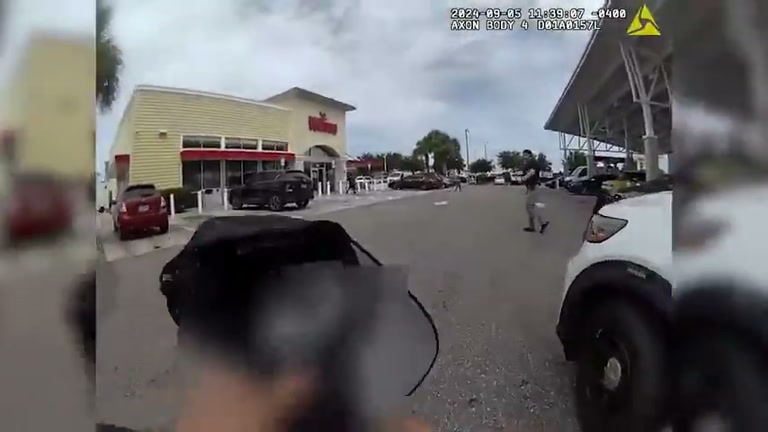
From there, the pace accelerates sharply. The body-worn footage cuts between the inside of a patrol car, a forecourt lined with parked vehicles, and the fluorescent glare of a convenience store. Officers are seen moving with intent, their radios crackling, their eyes scanning. The narrative shifts from a quiet suburban forecourt to a live pursuit, the sort of real-time coordination that turns a routine shift into a high-stakes operation. The suspects, unaware that they are being tracked, continue their alleged spree.
The forecourt moment that sparked a chain reaction
Service stations have always been vulnerable. They are open, transient spaces where strangers come and go, where a person can linger for a few minutes without raising suspicion. The Wawa in question is no different — a bright, well-lit hub of coffee runs and late-night snacks, its forecourt a stage for countless unremarkable interactions every single day. That ordinariness is precisely what makes it such a tempting target for those looking to move unnoticed. The footage captures this duality perfectly: the mundane backdrop of a fuel stop, and the quiet, deliberate actions unfolding within it.
According to the accompanying audio, the group allegedly installed and then removed a skimming-style device at the pump, a technique that has become increasingly common at petrol stations across the United States. These devices, often small and unobtrusive, are designed to capture card data without the cardholder ever realising. The fact that a fellow customer spotted something amiss speaks volumes about the power of everyday vigilance. It is a reminder that in the age of digital crime, the most effective defence is sometimes simply a pair of observant eyes.
The footage then shows the group moving towards the ATMs, where they reportedly withdrew sums ranging from $1,000 to $3,000 across multiple machines. To the casual observer, it looks like ordinary banking — a person checking a balance, taking out cash, going about their day. But behind the scenes, a victim is receiving live alerts on their phone, watching transactions appear that they did not authorise. That digital breadcrumb trail becomes the thread that officers will follow, and the reason the suspects' luck is about to run out.
The tension builds as the footage shifts to the arrival of law enforcement. Officers are seen approaching the forecourt, their posture alert, their movements coordinated. The chase that follows is not a Hollywood-style pursuit with screeching tyres and dramatic crashes; it is something more grounded and, in its own way, more compelling — a methodical, real-time response to a crime in progress. The suspects are tracked, cornered and taken into custody, the kind of swift resolution that depends on technology, communication and a citizen who decided to make a call.
What officers reportedly found inside the vehicle
Once the suspects were detained, the investigation moved quickly to the vehicle. According to the audio transcript, officers discovered a green Fidelity Bank card said to be linked to a sum of $1,000, along with other items that suggested the group was not acting in isolation. The presence of these items transforms the case from a simple theft into something far more serious. It hints at a broader operation, a network of individuals potentially involved in financial crime, and a level of organisation that goes beyond a few opportunistic teenagers.
The discovery of additional evidence, reportedly including weapons, adds another layer of gravity to the situation. When a routine fraud investigation escalates into something involving firearms, the stakes rise dramatically for everyone involved — the officers, the public, and indeed the suspects themselves. It is a sobering reminder that financial crime is rarely a victimless endeavour; it is often intertwined with other, more dangerous activities. The footage captures the moment of the search, the careful handling of items, the quiet professionalism of officers who know they are dealing with something bigger than it first appeared.
For the community, the incident raises uncomfortable questions. How often do these devices go unnoticed? How many people have had their card details compromised at a pump without ever knowing? The speed with which this particular case was resolved is reassuring, but it also highlights the vulnerability of everyday infrastructure. The Wawa forecourt, like thousands of others across the country, is a place of convenience — and convenience, by its very nature, can be exploited.
The suspects now face a legal process that will determine their guilt or innocence. Under the principle of presumed innocence, no conclusion can be drawn until the courts have had their say. What the footage does show, however, is the effectiveness of a joined-up response: a vigilant member of the public, a banking alert system, and a police force equipped to act on real-time information. It is a chain of events that, on this occasion, worked exactly as it was designed to.
The financial fallout and the insurance questions
Whenever money is taken, the question of who ultimately bears the loss comes to the fore. In cases of card skimming and unauthorised withdrawals, the answer is rarely straightforward. For the victim whose live banking alerts triggered the response, the immediate concern is recovery. Under US federal law, specifically the Electronic Fund Transfer Act and its implementing Regulation E, consumers have protections against unauthorised electronic transfers. If a card is reported lost or stolen promptly, liability is typically capped at $50; if the card number is used but the card itself is not lost, the consumer generally has no liability at all, provided the issue is reported in a timely manner.
However, these protections apply to the account holder, not to the financial institution's own losses. Banks often absorb the cost of fraudulent transactions, but they may seek to recover funds through civil action against the perpetrators. In this case, the reported recovery of a Fidelity Bank card and a sum of $1,000 could become key evidence in any subsequent prosecution or restitution order. It is worth noting that restitution is not guaranteed, and any compensation would depend on the outcome of the legal process — a point that is often misunderstood by the public.
For the service station itself, the incident raises questions about liability and insurance cover. Businesses typically hold commercial general liability policies, but these often exclude intentional criminal acts. More relevant may be a commercial property policy or a specific cyber and crime endorsement, which can cover losses related to theft, fraud and data breaches. The forecourt operator may also face scrutiny over the maintenance of its pumps; if a skimming device was installed, questions may arise about how it was able to be fitted and whether adequate checks were in place.
On the motorist's side, personal car insurance is unlikely to respond to this kind of loss, as it covers the vehicle itself and third-party liability, not financial fraud. However, some comprehensive policies or standalone card protection plans may offer limited reimbursement for fraudulent transactions, though these are usually secondary to the bank's own protections. Home contents insurance sometimes includes a limited "money and credit card" element, but the sums insured are typically small and the cover narrow.
The excess, or deductible, is another factor. Even where a policy responds, the policyholder is usually required to pay the first portion of any claim. For a $1,000 loss, a $250 or $500 excess could significantly reduce any payout. For the victim in this case, the primary route to recovery is likely through their bank rather than their insurer. The key practical step is to report the fraud immediately, keep records of all alerts and correspondence, and cooperate fully with any investigation. The faster the report, the stronger the consumer's position.
From a UK perspective, the framework differs. UK consumers are protected by the Payment Services Regulations, and in most cases, banks must refund unauthorised transactions unless they can prove the customer acted fraudulently or with gross negligence. The Financial Ombudsman Service provides a route for disputes. For UK readers, the lesson is the same: speed of reporting is everything. Whether in Orlando or Manchester, the difference between full reimbursement and a financial hit often comes down to how quickly the alarm is raised.
Consumer protection and the road ahead
The Orlando case is a timely illustration of how technology cuts both ways. Skimming devices and card-cloning tools have become more sophisticated, but so too have the detection systems that flag unusual activity. Live banking alerts, in particular, have become a powerful tool for consumers. They transform a passive account into an active watchdog, notifying the holder within seconds of a transaction. In this instance, that alert was the spark that led to a real-time police response — a chain reaction that began with a single ping on a phone.
For consumers, the practical takeaways are clear. Check card readers before use, especially at petrol stations and ATMs. Look for loose fittings, unusual attachments or anything that seems out of place. Use contactless or mobile payments where possible, as these can reduce exposure to skimming. Enable transaction alerts through your banking app, and never ignore a notification that something has happened. If a card is compromised, report it immediately and follow the bank's instructions to the letter.
For businesses, the incident is a reminder of the importance of regular inspections and staff training. Forecourt operators should ensure that pumps and ATMs are checked frequently, and that any suspicious behaviour is reported. CCTV coverage, like the body-worn and surveillance footage in this case, can be invaluable both as a deterrent and as evidence. Insurance policies should be reviewed to ensure that crime and cyber endorsements are adequate, and that any exclusions are understood before a claim is needed.
As for the broader investigation, the suggestion that the group may be part of a larger operation means the story is unlikely to end here. Financial crime networks are often complex, and the recovery of evidence in one case can lead to others. The outcome no one expected — a quiet forecourt stop turning into a multi-agency investigation — is a reminder that crime rarely stays contained. It ripples outward, touching victims, businesses, insurers and communities.
What remains unanswered is how many other motorists may have been affected before this particular spree was interrupted. The devices, if confirmed, may have captured data from multiple cards over an unknown period. That possibility is precisely why authorities urge vigilance and why consumer protection frameworks exist. In the end, the case is a collision of technology, crime and justice — and a reminder that in a world of instant transactions, the fastest response is often the most effective.
| Incident parameter | Logged / on-scene information |
|---|---|
| Location | Wawa service station, Orlando, Florida |
| Time of day | Afternoon, according to dashboard footage |
| Suspects | Three teenagers |
| Reported method | Small device used at a fuel pump and ATMs |
| Reported sums | $1,000 to $3,000 |
| Trigger for response | Live banking alerts received by a victim |
| Key evidence | Green Fidelity Bank card reportedly linked to $1,000 |
Important note: Some details in this report are based on a publicly posted video and accompanying audio, and may not be independently verified.
Core questions still unanswered
- Who should ultimately bear the financial loss when card skimming occurs at a service station — the bank, the business or the consumer?
- Would your own insurance policy respond if your card was compromised at a petrol pump, and would the excess make a claim worthwhile?
- What practical steps do you take to protect your card details when filling up or using an ATM?
Learn more: Orlando Bodycam: Woman Claims Injury During Arrest
🎥 Watch the video at the bottom of the page 👇
This story was edited from a publicly posted video; some details may not be independently verified.