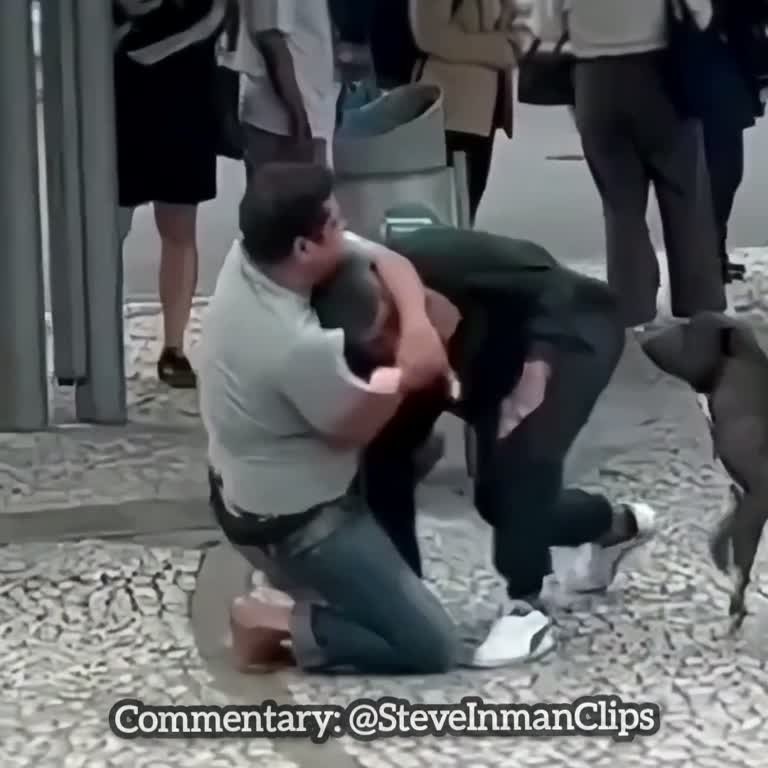
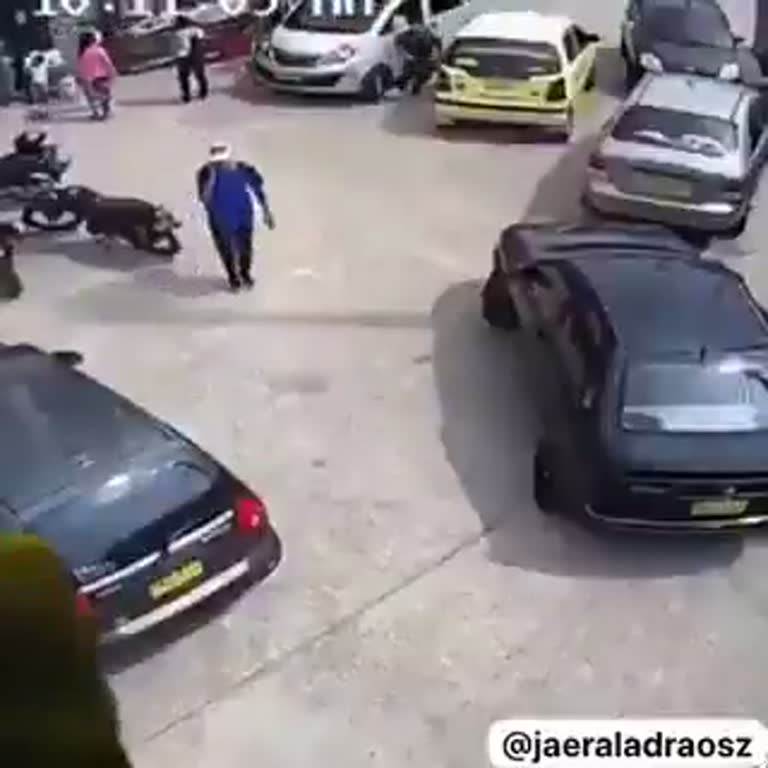
The footage opens on an ordinary concrete car park, engines idling and pedestrians milling about, before a sudden eruption of movement turns the scene on its head. A man in a blue top breaks into a frantic run, weaving between parked cars, and for a moment it looks as though he might actually get away. What happens next, captured by an overhead camera, is the kind of turning point that stops a room cold.
Overview of the incident and the key facts
- A man in a blue top is seen sprinting across a paved car park, attempting to flee the scene.
- An overhead camera captures the entire sequence, including the dramatic moment he is intercepted.
- A sudden flying kick halts the escape attempt almost immediately, bringing the pursuit to an abrupt end.
- Several parked vehicles, including dark saloons and a yellow-and-white taxi, frame the chaotic scene.
- The footage has spread widely online, drawing attention for the sheer speed of the intervention.
The video begins in an almost mundane setting: a concrete car park, the kind found behind shops or beside busy roads, with cars parked at slightly awkward angles and a few figures moving in the distance. A white van and a silver hatchback sit near the top of the frame, while a dark saloon and a yellow taxi occupy the right-hand side. Then the rhythm changes. A man in a blue top and dark trousers appears, running hard across the open ground, his body angled forward in a full sprint.
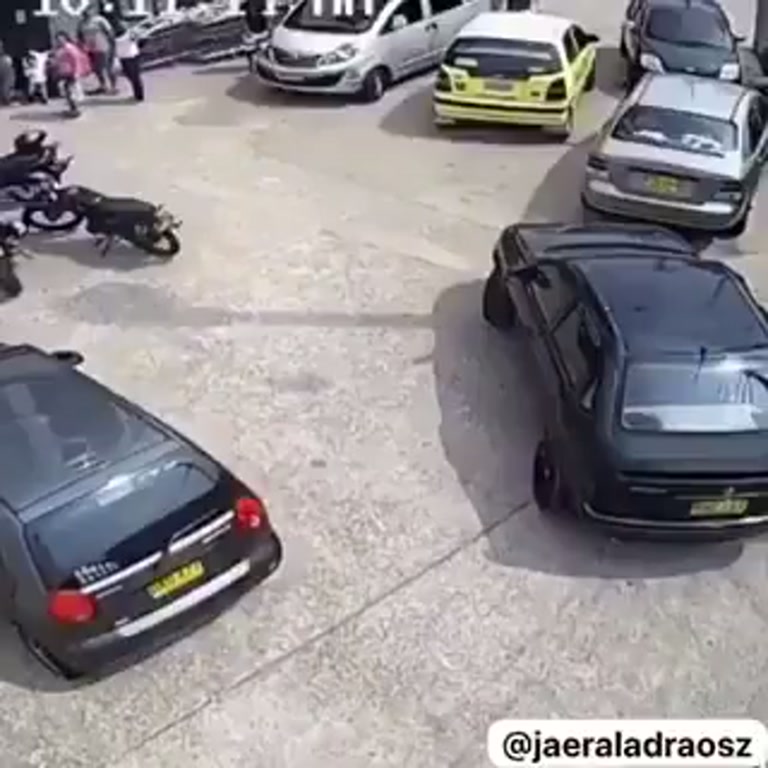
Within seconds, the reason for the urgency becomes clear. The camera captures a sudden intercepting motion, and the runner's momentum is cut off in an instant. He stumbles and goes down, his attempted escape collapsing into a tangle of limbs on the pale concrete. The overhead angle makes the geometry of the moment stark: the open space, the parked cars, the blur of the intervention, and then stillness.
What makes the clip so compelling is not just the speed of the takedown but the contrast with the setting. There is no dramatic chase through back alleys or a high-speed pursuit on a motorway. It is an ordinary car park on an ordinary day, and then it is the scene of a sudden, decisive interception. The footage does not show what happened before the sprint or what happened after the man hit the ground, leaving the viewer to fill in the gaps.
Frames from the sequence show a small group of people scattered around the edges of the car park, some near motorcycles, others walking towards the parked vehicles. The yellow-and-white taxi and the dark saloons remain stationary throughout, silent witnesses to the chaos unfolding between them. The man's blue top is the brightest moving object in the frame, a visual anchor for the eye as the scene tips from calm to conflict.
The chase and the moment of interception
The chase itself lasts only a matter of seconds, but the footage stretches those seconds into something almost cinematic. The runner's stride is long and desperate, arms pumping, head down, as he tries to put distance between himself and whoever is behind him. The camera, fixed high above the scene, gives a god's-eye view of the attempt, making the eventual outcome feel both inevitable and shocking.
There is a brief moment where the man appears to have a clear path. He is moving across open concrete, the parked cars offering cover but not obstruction, and the exit of the frame seems within reach. Then the intercepting figure enters the picture, and the dynamic flips. A flying kick, launched with full commitment, connects and sends the runner off balance, his body twisting as he falls.
The impact is not shown in graphic detail, but the aftermath is clear enough: the man is on the ground, the sprint over, the escape foiled. The camera keeps rolling, capturing the stillness that follows the burst of action. It is a moment of decision that has already been made, and the footage leaves no doubt about the outcome.
What stands out on repeated viewing is the precision of the intervention. The timing had to be almost perfect to stop a moving target in an open space, and the footage suggests that whoever delivered the kick had committed fully to the act. Whether that was a member of the public, a security worker or someone else is not clear from the clip alone, and the sources do not identify the person.
Public reaction and the spread of the clip
Viral clips of this kind tend to travel fast, and this one has followed the familiar pattern. Shared widely across social media, it has drawn a mix of reactions: some viewers expressing surprise at the speed of the takedown, others questioning what led to the chase in the first place. The footage offers no context, no commentary and no official statement, which is precisely what fuels the debate.
The original caption frames the scene as an attempted escape that ended in a way nobody expected, and that framing has shaped how audiences interpret the clip. The humour in the caption sits uneasily with the reality of a man being brought down hard on concrete, and that tension is part of what makes the video so widely discussed. Opinions were split, as they often are when a short clip is asked to carry the weight of a much longer story.
For viewers in the United States and the United Kingdom, the clip also raises questions about liability and the limits of civilian intervention. In both countries, the use of force by private individuals is governed by different rules, and a clip like this one often becomes a talking point about where the line sits between a lawful citizen's arrest and an act that could itself lead to legal consequences. None of that can be resolved from the footage alone, but it is the reason the video keeps circulating.
The lack of an official conclusion is a recurring theme. Police opened an investigation in some similar cases, officials are verifying what happened in others, but for this clip there is no confirmed account of the charges, the identities or the aftermath. That absence of resolution is what keeps viewers coming back to the frames, looking for clues in the parked cars and the body language of the bystanders.
The insurance angle: who pays when a chase ends badly
When a pursuit spills into a public car park, the financial consequences can be as significant as the physical ones. Even where no vehicle is struck, the risk of damage to parked cars is real, and the question of who pays is rarely straightforward. In the footage, several vehicles sit close to the path of the chase, including a dark saloon, a yellow-and-white taxi and a silver hatchback, any of which could have been clipped in a different version of events.
For vehicle owners, the relevant cover is usually motor insurance. In the UK, comprehensive policies typically cover damage to the policyholder's own car, while third-party fire and theft offers narrower protection. In the US, the split between collision, comprehensive and liability cover works differently, and the deductible, known as an excess in the UK, is the amount the policyholder pays before the insurer steps in. If a fleeing suspect damages a parked car, the owner may be able to claim, but the insurer will often seek to recover the cost from the party deemed responsible.
Public liability and homeowners insurance can also come into play in unusual ways. If a bystander is injured during an intervention on private property, the property owner's liability cover may be relevant, though exclusions for criminal acts or intentional force can complicate matters. Travel insurance rarely applies to a local car park incident, but it can cover medical costs if the policyholder is injured while abroad. Health insurance, whether through the NHS in the UK or a private plan in the US, would handle treatment for any injuries, though the question of who ultimately bears the cost depends on the circumstances.
What is important for readers to understand is that no compensation has been confirmed in this case. The footage does not show a claim being made, and no figures for repair or medical costs are available. The general steps for making a claim remain the same: report the incident, gather evidence such as the video and witness details, notify the insurer promptly, and keep records of any expenses. The excess or deductible applies, and the policyholder's responsibility is to provide accurate information.
The line between a heroic intervention and a costly legal dispute can be thin. In both the US and the UK, the person who uses force may face a civil claim if the force was deemed excessive, and that claim could fall outside the scope of standard insurance. For the man on the ground, the financial fallout could include medical bills, lost earnings and legal costs, none of which are visible in the clip. The insurance system is designed to spread risk, but it relies on clear facts, and this footage provides only a fragment of the story.
Insurance and who pays
If a parked car in that car park had been struck during the chase, the owner's motor insurance would usually be the first port of call. In the UK, a comprehensive policy would cover repairs, with the excess payable by the policyholder, and the insurer might then pursue recovery from the party at fault. In the US, collision cover would handle damage to the policyholder's own vehicle, while liability cover would respond if the policyholder was deemed responsible for harm to others. The key difference is that US policies often separate collision and comprehensive cover, while UK policies bundle them into comprehensive cover.
Exclusions matter enormously in cases like this. Most motor policies exclude damage arising from criminal acts, and if the chase is linked to a crime, the insurer may refuse to pay or seek recovery. Home insurance, which often includes personal liability cover, may respond if a bystander is injured on the property, but intentional acts are typically excluded. Travel insurance is unlikely to apply unless the incident occurred during a trip, and pet insurance is irrelevant here.
For anyone caught up in a similar incident, the practical steps are consistent: secure the scene, call the emergency services if anyone is hurt, exchange details, report to the police, and notify the insurer as soon as possible. Evidence such as CCTV, dashcam footage and witness statements is invaluable. The excess or deductible is the policyholder's immediate financial responsibility, and it is worth checking whether the policy includes legal expenses cover, which can help with disputes over liability.
The bigger picture is that insurance can soften the financial blow, but it cannot undo the event. For the man in the blue top, the fall on concrete could mean medical treatment, time off work and a legal process that unfolds long after the cameras stop rolling. For the owners of the parked cars, a near miss is a reminder of how quickly an ordinary day can turn into a claim. And for the person who intervened, the question of whether their actions were reasonable may ultimately be answered not by a viral clip but by an insurer, a lawyer or a court.
What the footage leaves us with
The clip is short, and that is part of its power. It captures a beginning and a middle but not an end, and the viewer is left to imagine the consequences. The concrete is hard, the speed is real, and the moment of impact is frozen in a way that makes the whole scene feel suspended. It is a reminder that in a world of constant surveillance, the most dramatic moments are often the ones nobody planned to record.
For the people in the frame, the day probably started like any other. The taxi driver waiting for a fare, the pedestrians crossing the car park, the owners of the dark saloons going about their business. Then a man ran, and everything changed. The footage does not tell us why he ran, what he was accused of, or whether the force used against him was justified. Those answers lie outside the frame.
The public debate around clips like this tends to follow a predictable arc: shock, then speculation, then calls for context. What often gets lost is the human and financial cost. A fall on concrete can mean weeks of recovery. A damaged car can mean an insurance claim and a higher premium. A legal dispute can drag on for months. None of that appears in the video, but it is the reality that follows.
What do you make of this? Was the intervention justified, or did it cross a line? And if you were the owner of one of those parked cars, would you expect your insurance to cover the damage? The full exchange is below 👇 and the debate is already heating up. Stay tuned for what happens next, because the story is far from over.
| Incident parameter | Logged / on-scene information |
|---|---|
| Location | A paved car park with parked vehicles |
| Time of day | Daylight |
| Main action | A man in a blue top runs, then is intercepted |
| Vehicles present | Dark saloons, a yellow-and-white taxi, a white van, a silver hatchback |
| Camera angle | Overhead, fixed position |
| Outcome shown | The runner falls and the pursuit ends |
| Source | Publicly posted video |
Important note: Some details, including the identities of those involved and the legal outcome, remain unverified.
Core questions still unanswered
- What led to the chase that ended in the car park?
- Was the person who delivered the kick a member of the public or someone else?
- Would insurance cover damage to the parked cars if they had been struck?
Learn more: Madrid street scuffle: who pays when a fight turns physical?
🎥 Watch the video at the bottom of the page 👇
This story was edited from a publicly posted video; some details may not be independently verified.