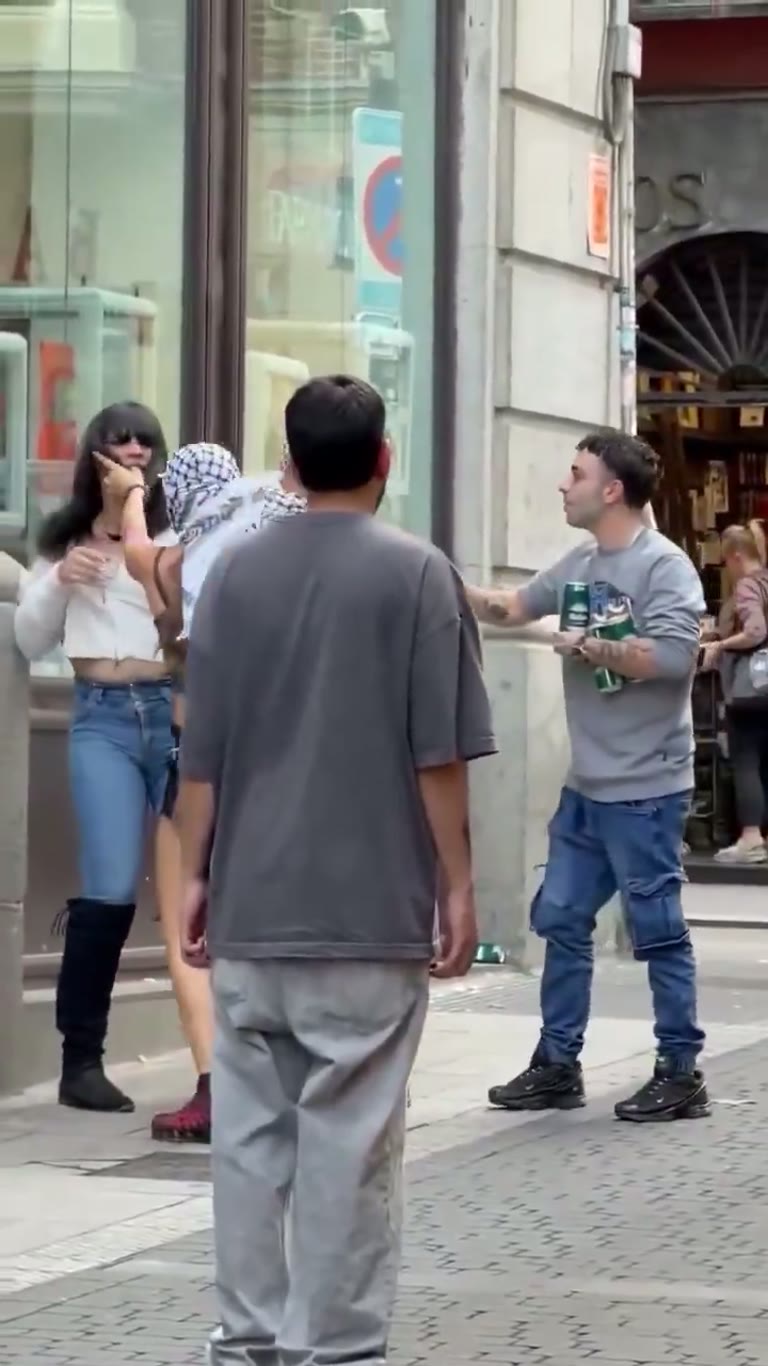
A quiet corner of central Madrid became the stage for a tense public confrontation this week, as a scuffle broke out in broad daylight between two people, one of whom was wearing a keffiyeh. The incident, captured on camera, shows pushing and shoving against a shop wall before a bystander steps in to separate the pair. The footage has since travelled widely online, raising familiar questions about public order, personal liability and what happens when an ordinary street turns into a flashpoint.
Overview of the incident and the key facts
- The incident took place in central Madrid, a busy tourist and commercial district, during daylight hours.
- Footage shows two people in a physical scuffle against a shop wall, with one participant wearing a keffiyeh.
- A bystander intervenes to separate the pair as others watch from a short distance.
- The confrontation drew attention online after the clip was shared widely, with opinions splitting over what triggered it.
- No official conclusion has been issued by authorities, and no charges or identities have been confirmed.
The scene unfolds on a narrow, stone-paved street in the heart of Madrid, where the ordinary rhythm of city life — pedestrians, shopfronts, a parked scooter — is interrupted by a sudden burst of physical conflict. What begins as a tense exchange escalates quickly into pushing and shoving, with two people pressed against the wall of a shop as onlookers pause mid-step. One of the individuals is wearing a keffiyeh, a detail that has fuelled considerable speculation online, though nothing in the footage confirms the reason for the confrontation or the backgrounds of those involved. The audio captures raised voices, with someone shouting repeatedly in Spanish for the pair to stop, and a plea of "¡No me duermas!" cutting through the noise. Within seconds, a man steps forward from the crowd and physically intervenes, wedging himself between the two people in an attempt to de-escalate the situation. The camera keeps rolling as the group stumbles and separates, leaving a knot of bystanders watching in visible unease.
What makes this clip distinctive is not the scale of the violence — no weapons are visible, and the physical contact appears to be shoving rather than a sustained assault — but the sheer ordinariness of the setting. This is a street where tourists stop for coffee and locals run errands, and the sudden eruption of conflict feels jarring precisely because it is so out of place. The footage is short, shot from a slight distance, and offers no clear beginning or end, which is why so much of the online reaction has focused on guesswork rather than fact. It is a reminder that in a city of millions, any corner can become a stage for a moment that no one planned.
For insurance and legal professionals, however, the more interesting questions begin where the video ends. A public scuffle on a commercial street raises a web of potential liabilities: damage to shop property, injury to participants or bystanders, and the thorny issue of who pays when an argument turns physical in a space shared by the public. None of these questions have been answered by the clip itself, and no official statement has clarified whether any property was damaged or anyone was hurt. But the incident offers a useful case study in how quickly an everyday street scene can generate financial and legal consequences that outlast the moment itself.
Location: central Madrid, Spain — a busy commercial and tourist area.
Time of day: daylight, with pedestrians and shoppers visibly active in the background.
People involved: two individuals in a physical scuffle; one wearing a keffiyeh; at least one bystander intervenes.
Audio captured: repeated shouts of "¡Para!" and "¡No me duermas!" in Spanish.
Official status: no confirmed identities, charges or conclusions from authorities.
The moment the street turned tense
Watching the footage, what strikes you first is the speed of it. One moment the street is doing what streets do — people walking, a scooter parked at the kerb, shopfronts glowing with displays — and the next, two figures are locked in a shoving match against a wall. The camera shakes slightly, as if the person filming has been caught off guard, and the ambient sound of the city is pierced by sharp, repeated shouts. The word "¡Para!" — stop — rings out again and again, a verbal attempt to break the momentum before it escalates further. There is a raw, unfiltered quality to the clip: no music, no narration, just the noise of a real confrontation unfolding in real time.
The person in the keffiyeh is the most visually distinctive figure in the frame, and it is unsurprising that this detail has drawn so much attention online. Yet the footage does not show what led to the clash, nor does it establish who initiated it. What we see is the middle of an argument, not its cause. The person at the centre of it — or rather, the two people at the centre of it — remain anonymous, their motivations unclear, their words mostly lost beneath the shouting. The bystander who steps in does so without hesitation, placing his body between the two and effectively ending the physical phase of the confrontation. It is a small act of civic courage, the kind that rarely makes headlines but often prevents far worse outcomes.
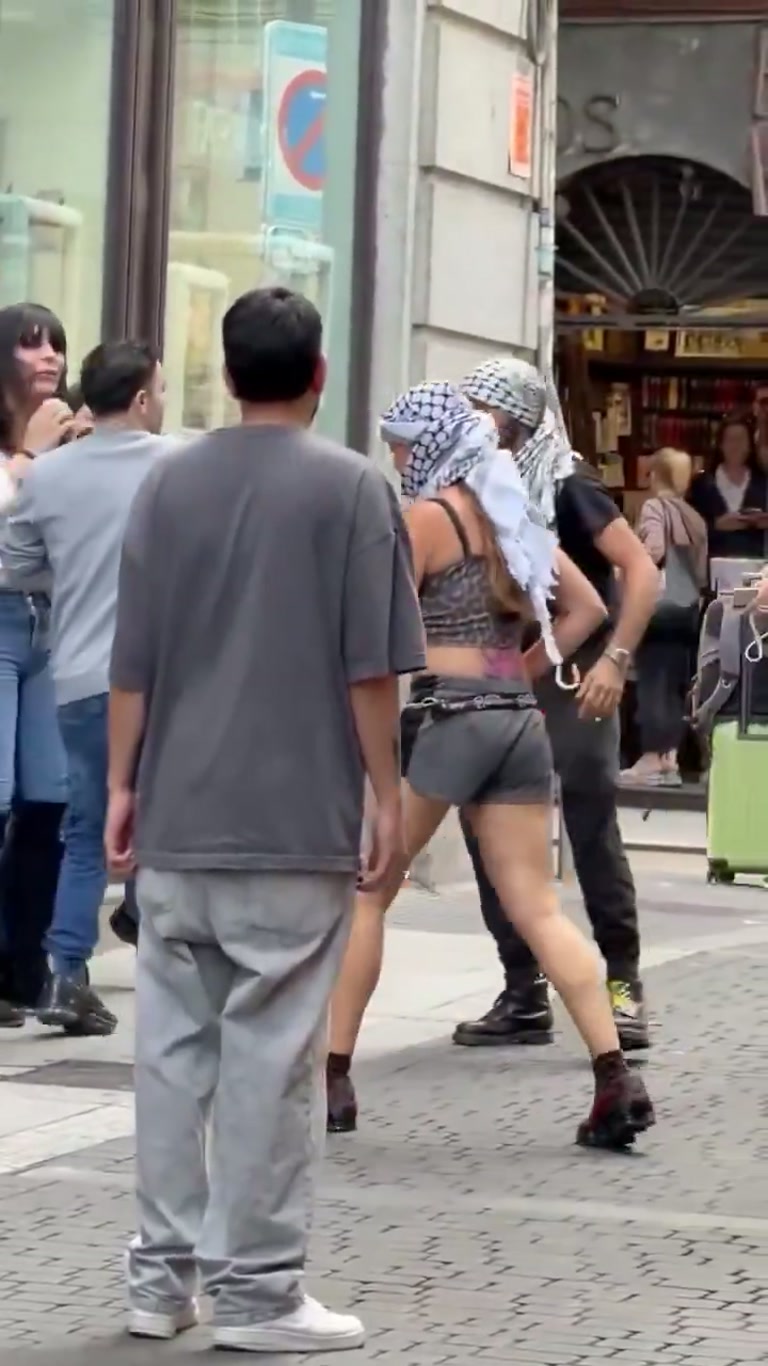
Around them, the crowd reacts in that particular way crowds do — some stop and stare, others keep moving, a few raise phones. The women visible in the background, walking past in light clothing, glance over but do not stop, their body language suggesting a mixture of curiosity and a desire not to get involved. This is the everyday calculation of urban life: when do you intervene, and when do you keep walking? The man who steps in answers that question with his feet, and the scuffle subsides. But the tension does not vanish; it simply moves from the physical to the verbal, and then, eventually, to the digital, where the clip begins its second life.
How a street scuffle becomes a liability question
In Spain, as in the UK and the US, a physical altercation in a public place is not just a matter of public order — it is a potential insurance event. If property is damaged during a scuffle, the shop owner whose wall or window was involved may look to their commercial property policy, which typically covers accidental damage caused by third parties, though intentional acts and criminal damage often sit in a grey area. If a bystander is injured, the question of liability becomes more complex: who was at fault, and does the injured party have a claim against the person who caused the harm, or against the business whose premises were the setting? These are not abstract questions. They are the kind of questions that insurers, solicitors and courts deal with every day, and they hinge on evidence — which is precisely why footage like this matters.
For the individuals involved, the financial exposure could be significant. In the UK, the typical excess on a home contents or personal liability policy might be £100 to £250, while in the US deductibles often run from $500 to $1,000. If a claim is made for injury, the costs can escalate far beyond that, covering medical treatment, loss of earnings and compensation. But here is the crucial caveat: most personal liability cover excludes intentional acts, and a fight is rarely treated as an accident. That means the people involved may find themselves paying out of pocket for any damage or injury they caused, unless a court determines otherwise. For the shop owner, a commercial policy may respond to damage, but the insurer will likely seek to recover costs from the person responsible — a process known as subrogation.
For bystanders, the picture is different again. If someone who intervenes to separate a fight is injured, their own health insurance or travel insurance may cover treatment, but liability for their injury would depend on who caused it. In the US, good Samaritan laws vary by state and generally protect people offering emergency medical help, not those physically intervening in a fight. In the UK, the situation is similarly nuanced: a person who steps in may be acting lawfully to prevent a crime, but if they use excessive force, they could themselves face liability. The man in the footage appears to act as a peacemaker rather than a combatant, which would place him in a very different legal category from the two people shoving each other.
Travel insurance is another angle worth considering, particularly in a city like Madrid that welcomes millions of visitors each year. A tourist caught up in a public altercation — whether as a participant or an innocent bystander — may find that their policy covers medical treatment but excludes claims arising from their own deliberate involvement in a fight. Standard travel policies typically exclude injury sustained while committing a crime or taking part in a riot, and some exclude any claim where alcohol is a factor. The lesson, insurers often say, is simple: walk away. But as the footage shows, walking away is not always easy when tensions flare in a crowded street.
What the footage does and does not tell us
It is tempting, when a clip like this circulates, to fill in the gaps with assumption. The keffiyeh, the shouting, the physical confrontation — each detail invites a story. But the responsible reading of the footage is a narrow one: two people argued, the argument turned physical, a bystander intervened, and the situation appeared to de-escalate. Everything else — who they were, what sparked it, whether anyone was hurt, whether police were called — remains outside the frame. The audio gives us urgency and distress, but not context. The visuals give us setting and action, but not motive. This is the inherent limitation of citizen footage, and it is why official verification matters.
For insurers, the value of such footage lies in what it can establish. If a claim were made — for a damaged shopfront, a broken phone, a injured arm — the video could serve as evidence of what happened and who was involved. Insurers increasingly rely on digital evidence, from CCTV to phone footage, when assessing liability. In the UK, the Financial Ombudsman Service has handled cases where video evidence was decisive in resolving disputes between policyholders and insurers. In the US, dashcam and phone footage is routinely used in auto and liability claims. A street scuffle in Madrid may seem a world away from a claims office in Manchester or Ohio, but the principles are the same: evidence determines outcomes.
There is also the question of public order and policing. In Spain, as in the UK, the police have powers to intervene in public disturbances, and a scuffle in a busy street could lead to charges of public disorder or assault. But the footage does not show police arriving, and no official statement has confirmed an investigation. That absence of information is itself significant. It means the online narrative is running ahead of the facts, and that any conclusions drawn from the clip are speculative at best. For readers, the takeaway is caution: a viral video is a window, not a verdict.
What the incident does illustrate, vividly, is how quickly a moment of conflict can escalate and how quickly it can subside. The man who stepped in did not wait for authorities; he acted. Whether that was wise or risky depends on your perspective, but it is undeniably human. And it is a reminder that in the crowded, shared spaces of a city, the line between order and chaos is often held by ordinary people making split-second decisions.
| Incident parameter | Logged / on-scene information |
|---|---|
| Location | Central Madrid, Spain |
| Time of day | Daylight |
| People involved | Two individuals in a scuffle; one wearing a keffiyeh; one intervening bystander |
| Audio captured | "¡Para! ¡Para! ¡Ya! ¡No me duermas!" |
| Official status | No confirmed identities, charges or conclusions |
| Setting | Commercial street with shopfronts and pedestrians |
Important note: Some details, including the identities of those involved and the cause of the confrontation, remain unverified pending any official statement.
Core questions still unanswered
- What responsibility, if any, should bystanders have when a public argument turns physical?
- If property was damaged during the scuffle, whose insurance should ultimately pay — the individuals or the business?
- How should insurers treat footage like this when assessing liability claims?
Learn more: Man in vest threatens porch in road rage incident
🎥 Watch the video at the bottom of the page 👇
This story was edited from a publicly posted video; some details may not be independently verified.