Robotic missions advance through a long chain of engineering, testing and planning, and each link is a milestone that rarely makes headlines. On 2 September, the European Space Agency reported progress on its lunar-rover programme as it moves from design work towards testing. The update is a development marker, and it does not mean the rover has reached the Moon.
Understanding where a programme sits in that chain is the key to reading such announcements accurately.
What a rover has to do
A lunar rover must survive launch, land safely, move across abrasive terrain, communicate with Earth, generate power through a two-week lunar night, and carry instruments that produce useful data. Each of these is a separate engineering challenge, and they interact: a heavier power system reduces mobility, and a more capable instrument demands more power and data bandwidth.
Why testing is the hard part
Design work can be done on computers and in laboratories. Testing requires facilities that simulate lunar conditions: vacuum, temperature extremes, regolith and reduced gravity. Few such facilities exist, and using them is expensive and slow. Moving from design to testing is therefore a significant step, because it exposes assumptions to conditions that models approximate.
The European context
Europe has developed lunar ambitions through ESA programmes and commercial partnerships, and a rover would be a notable capability. Several European companies and institutes are involved in the supply chain. The programme’s progress matters for Europe’s position in lunar exploration, where the United States, China and others have established programmes.
What testing can reveal
Testing often identifies constraints rather than confirming success. A mechanism that works in the laboratory may fail in vacuum; a thermal design may prove marginal. These findings are valuable and they can change schedules. That is why announcements about testing are usually accompanied by caveats about mission timelines.
Why schedules slip
Space missions routinely take longer and cost more than planned, and lunar missions are especially demanding. Launch windows, funding cycles and technical discoveries all affect timing. A programme that is “moving towards testing” may still be years from launch, and the schedule will depend on what the tests reveal.
The limits of the report
The update does not establish that the rover has been built, tested successfully or scheduled for a specific mission. It describes progress in a development programme. Readers should separate tested capability from planned mission use, which is a distinction that coverage of space announcements often blurs.
The next checkpoints
Technical updates and mission schedules will show progress towards operational readiness. The questions worth following are whether the rover completes environmental testing, whether a landing opportunity is secured and whether the instruments are delivered. Those are the milestones that determine whether the programme reaches the surface.
The landing question
A rover is only as useful as the mission that delivers it, and landing on the Moon remains difficult. Several recent attempts by national agencies and private companies have ended in failure, which shows that the engineering challenge is not solved. A rover programme therefore depends on a lander, and the choice of landing provider is as important as the rover’s own design. That dependency shapes schedules and risk.
What instruments a rover carries
Rover instruments typically include cameras, spectrometers and drills or scoops for sampling. Each instrument serves a scientific question, and the selection reflects the priorities of the mission’s planners. Instruments must survive launch, landing and the lunar environment, which constrains their design. The scientific return depends on the instrument suite as much as on the rover’s mobility.
The commercial lunar market
A market for lunar delivery services has emerged, with companies offering to carry payloads to the surface. This lowers the barrier for agencies and research groups that lack their own landers, and it shifts risk to commercial providers. The market is young, and its reliability is still being established. For a rover programme, using a commercial lander is one option among several.
The science goals
Lunar rovers are used to study geology, search for resources such as water ice, and characterise the surface environment for future human activity. Water ice is of particular interest because it can support life support and fuel production, which is why polar regions attract attention. A rover’s instruments are chosen to address these questions, and the scientific return depends on landing in a place where the questions can be answered.
The international competition
Several countries and companies are pursuing lunar surface missions, and the pace has increased over the past decade. The United States, China, India and Japan have all landed or attempted to land spacecraft, and commercial providers are entering the market. Europe’s programme is one participant among many, and its progress will be judged relative to the field rather than in isolation.
This report draws on European Space Agency.
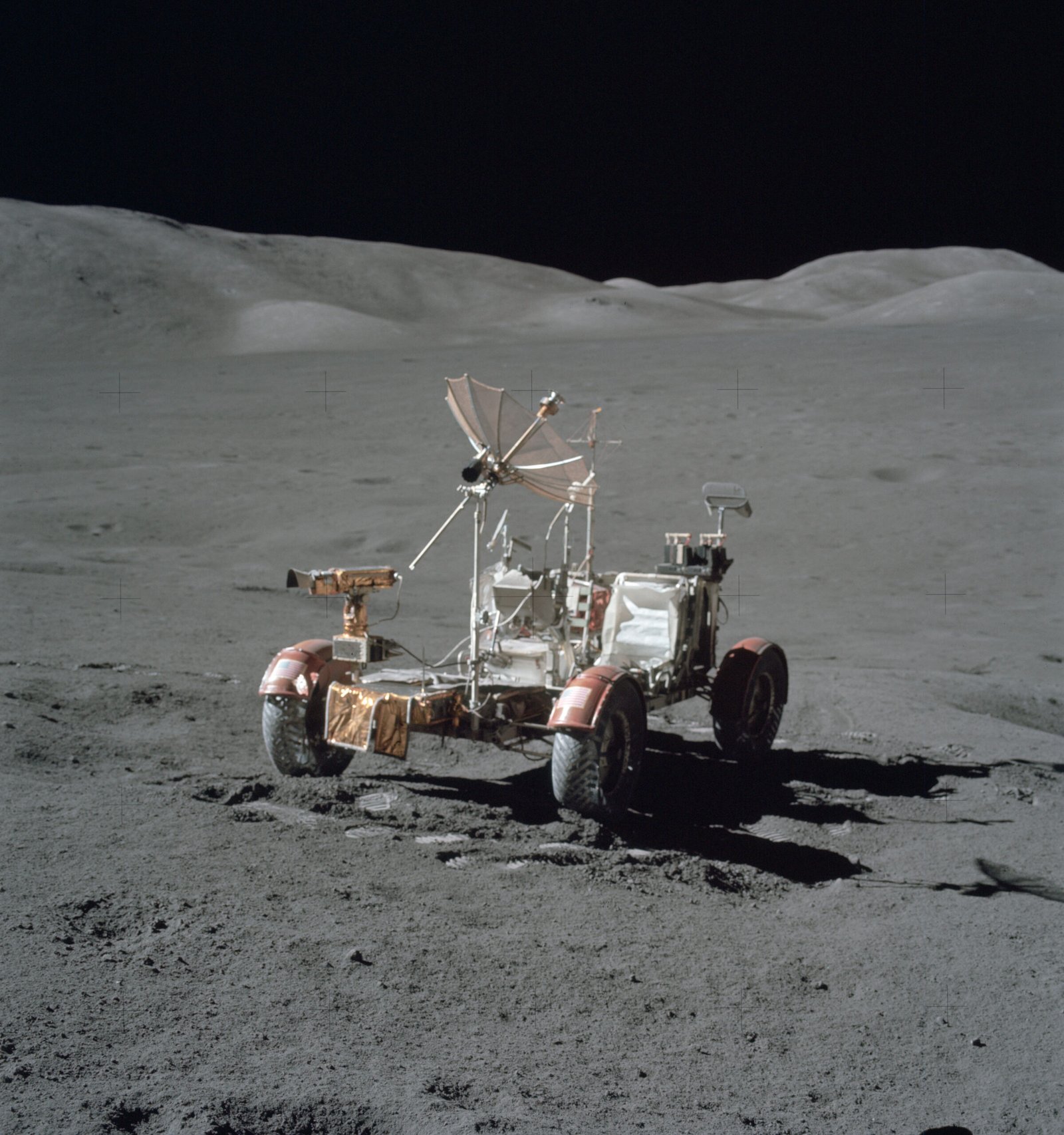
Image: NASA / Harrison H. Schmitt · Public domain · via Wikimedia Commons.