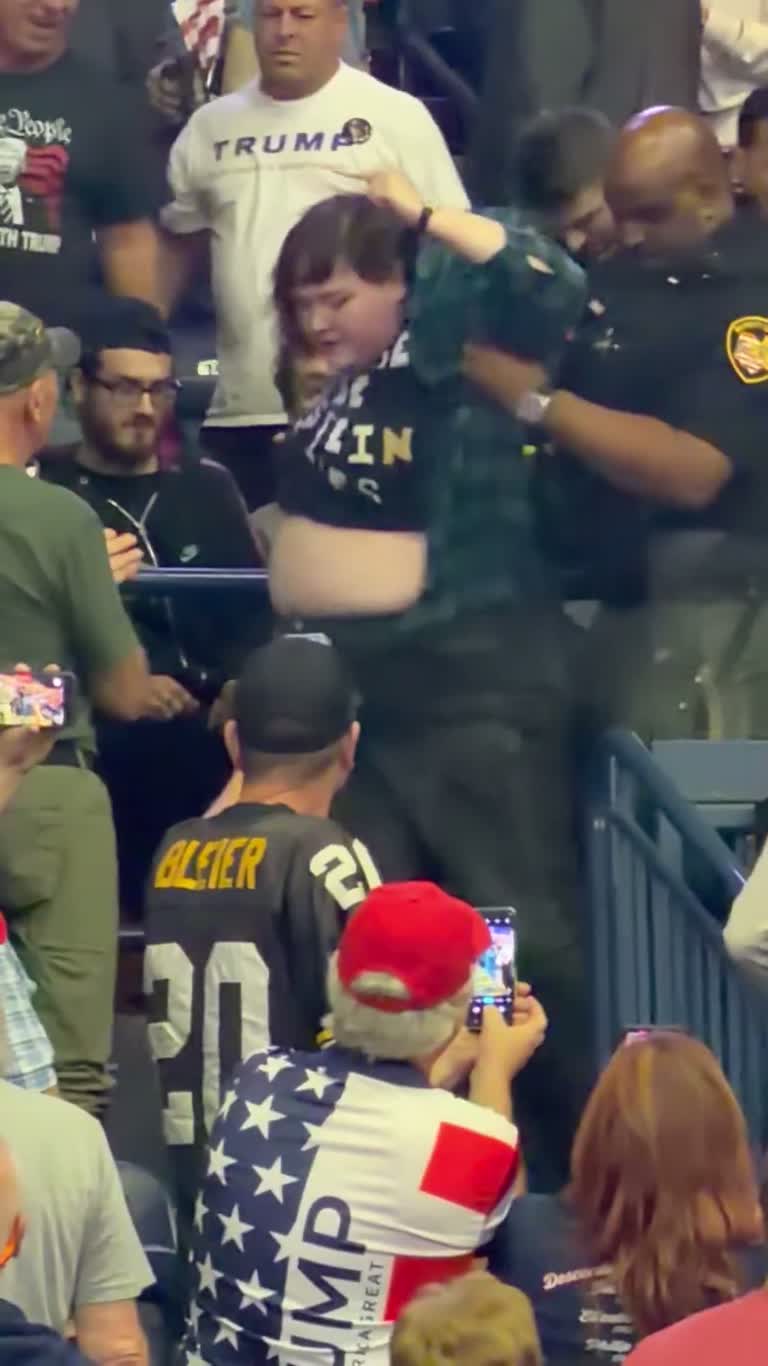
A routine night at a crowded sports arena turned into a tense spectacle when a woman wearing a provocative black slogan shirt was physically removed from the stands by law enforcement officers. The incident, captured on a bystander's mobile phone, shows the woman being lifted and carried up the stairs as surrounding spectators watched, with at least one person heard making a mocking remark about her weight. While the clip has sparked a firestorm online, key details about the arrest — including the exact offence and the woman's identity — have not been officially confirmed.
Overview of the incident and the key facts
- A woman was physically removed from a crowded arena seating area by uniformed officers.
- The woman was wearing a black t-shirt with the slogan "RELEASE THE PISTEIN" in white lettering.
- Video frames show the woman being lifted by her arms and legs and carried up a stairway.
- A bystander is heard on the audio saying, "Don't we love law enforcement? Nobody's got to go on a diet."
- The incident was captured on a mobile phone by a spectator seated several rows below.
- No official police statement or charge sheet has been released regarding the arrest.
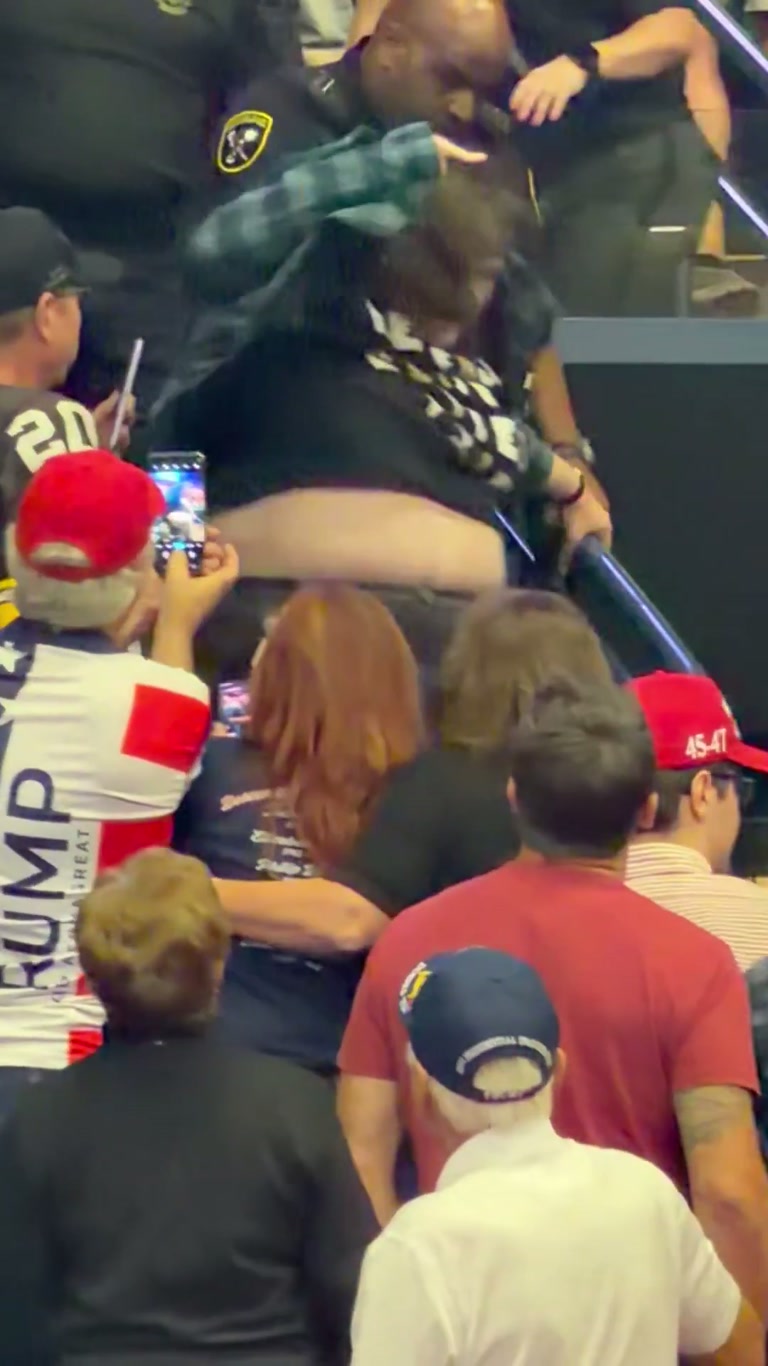
The footage opens on a packed arena, the kind of environment where thousands of people gather for a night of sport or entertainment, the air thick with noise and the collective energy of a crowd. In the middle of the seating block, a woman with dark hair and a black t-shirt bearing the phrase "RELEASE THE PISTEIN" is at the centre of a commotion. She is surrounded by uniformed officers, their dark clothing contrasting with the bright arena lighting and the colourful shirts of nearby fans. The camera, held by someone seated a few rows down, captures the raw, unpolished reality of the moment: the woman is being physically lifted from her seat, her body suspended between two officers as they begin to move her up the stairs. Around her, spectators turn their heads, some pull out their own phones, and the atmosphere shifts from carefree entertainment to uneasy spectacle.
What is striking about the footage is not just the physical removal itself, but the reaction of the crowd. Some people appear to be watching in stunned silence, while others seem almost amused, treating the incident as a break in the evening's proceedings. The camera shakes slightly as the person filming adjusts their grip, and in the background, a voice can be heard delivering a sarcastic remark about law enforcement and dieting. It is the kind of moment that has become increasingly common in the age of the smartphone: a public confrontation, captured in real time, destined to be shared, debated, and dissected by strangers online.
The video does not show what happened in the moments before the officers arrived. There is no footage of an argument, no clear indication of what the woman may have done to prompt such a physical intervention. What we see is the aftermath — the removal itself — which makes it difficult to draw firm conclusions about the rights and wrongs of the situation. The officers appear to be acting in accordance with some form of protocol, but without an official statement, the precise legal basis for the detention remains unknown.
What is clear is that the incident has touched a nerve. The image of a woman being carried out of a public venue by police officers is inherently dramatic, and when combined with the provocative slogan on her shirt and the mocking commentary from a bystander, it becomes a lightning rod for broader cultural and political arguments. The footage has been shared widely, with users expressing a range of opinions, from outrage at the woman's treatment to criticism of her behaviour. In the absence of a definitive account from authorities, the internet has filled the vacuum with speculation, turning a single moment in a crowded arena into a symbol of deeper divisions.
The viral moment and the crowd's reaction
The visual composition of the footage is telling. The camera is positioned below the action, looking up at the woman and the officers as they make their way toward the exit. This low angle makes the officers appear imposing and the woman appear vulnerable, a framing that inevitably shapes how viewers interpret the scene. The woman's face is partially obscured by her hair, but her body language — the way she is being carried rather than walking — suggests a lack of resistance, or perhaps a lack of ability to resist. The officers' grip appears firm but not violent, and there is no visible sign of a struggle.
The crowd, meanwhile, is a mix of faces: some young, some old, some wearing team colours, others in casual clothing. They are packed into rows of blue seats, their attention divided between the event they came to see and the disruption unfolding beside them. A few people are filming, their phones held aloft, and the screen of one device is visible in the foreground, capturing the same scene from a slightly different angle. The ambient sound is a blend of arena noise and nearby conversations, with the distinct voice of a man making a joke that cuts through the tension.
Don't we love law enforcement? Nobody's got to go on a diet.
That single line, delivered with a mix of sarcasm and amusement, encapsulates the complicated public reaction to the incident. It is a comment that could be read as a criticism of police overreach, a jab at the woman's weight, or simply a flippant remark from someone who sees the whole thing as entertainment. In the context of the video, it adds a layer of unease, reminding viewers that public humiliation is often a spectator sport.
The clip ends before we see where the woman is taken or what happens next. The camera follows the group up the stairs for a few moments, then the footage cuts out, leaving the viewer with more questions than answers. This abrupt ending is typical of viral video, which captures fragments of reality rather than complete narratives. It is left to the audience to fill in the gaps, and they do so with their own assumptions, biases, and preconceptions.
The insurance and legal implications of a public removal
Whenever a person is physically removed from a public venue by law enforcement, questions arise about liability, insurance, and the financial consequences that may follow. In the United States, where this incident appears to have taken place, the legal landscape is complex. If the woman was arrested without lawful justification, she might have grounds for a civil rights claim, but such cases are notoriously difficult to win and often depend on the specific facts of the encounter. From an insurance perspective, the arena's liability policy would typically cover claims of negligence or excessive force by security personnel, but police officers are generally protected by qualified immunity, which makes suing them directly a significant challenge.
For the venue itself, the incident raises questions about crowd management and the safety of patrons. Most large arenas carry comprehensive general liability insurance, which covers bodily injury and property damage claims arising from operations. If the woman sustained an injury during the removal — a twisted ankle, a bruised arm, or worse — she could potentially file a claim against the venue's policy. However, the venue would likely argue that the injury was caused by the actions of law enforcement, not by any negligence on their part, leading to a complex legal battle over who bears ultimate responsibility.
On the other side of the equation, the woman herself may face financial consequences. If she is charged with an offence such as disorderly conduct, trespass, or resisting arrest, she could be liable for fines, court costs, and legal fees. In some jurisdictions, a conviction could also affect her ability to obtain certain types of insurance, such as homeowners or renters insurance, particularly if the offence is considered a crime of moral turpitude. While a single misdemeanour is unlikely to result in a policy cancellation, it is a reminder that legal troubles can have ripple effects that extend far beyond the courtroom.
It is important to note that none of this is confirmed. We do not know whether the woman was injured, whether she was charged, or whether any insurance claims have been made. What the footage does illustrate, however, is the way that a brief, chaotic moment in a public place can spawn a web of legal and financial entanglements that neither the participants nor the spectators could have anticipated.
What cover might apply and what usually does not
In both the United States and the United Kingdom, the insurance implications of an incident like this depend heavily on the specifics. For the venue, a general liability policy would typically respond to claims of bodily injury or property damage caused by the negligence of the insured. If the woman was dropped or mishandled by arena staff — as opposed to police officers — the venue's insurer might be on the hook for medical bills and compensation. However, most policies include exclusions for intentional acts, which means that if the removal was deemed deliberate and wrongful, coverage could be denied.
For the woman, if she holds a health insurance policy, any injuries sustained during the incident would likely be covered under her medical plan, subject to deductibles and co-payments. If she was arrested and needed to post bail, that would not be covered by insurance; it would be an out-of-pocket expense. If she lost personal property — a phone, a bag, a piece of jewellery — during the scuffle, she might be able to claim under a homeowners or renters policy, but only if the loss was due to a covered peril, and the deductible might exceed the value of the item.
In the UK, the landscape is slightly different. The police are subject to the Police Reform Act and the Human Rights Act, and claims against them are usually handled through the Independent Office for Police Conduct. Insurance for individuals is less likely to be relevant unless there is a specific policy, such as legal expenses insurance attached to a home policy, that could help fund a complaint or civil action. The excess on such policies is often several hundred pounds, and the process can be slow and bureaucratic.
What is crucial to understand is that insurance is not a magic wand. It does not automatically compensate anyone for every unfortunate event. Policies are contracts with specific terms, conditions, and exclusions, and the burden of proof often falls on the claimant. In a chaotic, fast-moving situation like the one captured in the video, establishing exactly what happened and who was responsible can be extremely difficult — which is precisely why insurers and lawyers spend so much time and money investigating such claims.
The broader financial fallout for those involved
Beyond the immediate medical and legal costs, incidents like this can have long-term financial repercussions. If the woman was employed, an arrest could lead to disciplinary action, loss of income, or even dismissal, depending on her job and the nature of any charges. Even if she is never convicted, the mere fact of an arrest can appear on a background check and affect future employment prospects, loan applications, and insurance underwriting. In the US, where employment-at-will is common, an employer can often dismiss an employee for conduct that reflects poorly on the company, even if no crime is proven.
For the arena, the financial fallout is more about reputation and future revenue. A viral video of a patron being manhandled by police is not the kind of publicity that sells tickets. The venue may face pressure from sponsors, performers, or sports teams to review its security procedures and ensure that such incidents are handled more discreetly. If the woman sues and the case attracts media attention, legal costs could run into tens of thousands of dollars, even if the venue ultimately prevails. That is why many large venues have dedicated risk management teams and carry substantial liability limits — they understand that a single incident can cost far more than the premiums they pay.
For the officers involved, there may be internal reviews and potential disciplinary action, but their personal financial exposure is usually limited by qualified immunity and indemnification by their employer. The same cannot be said for private security guards, who are often employed by contractors and may not have the same protections. If a private guard used excessive force, both the guard and the security company could be sued, and the company's insurance policy would be the first line of defence.
What this case highlights is the interconnectedness of modern life. A moment of conflict in a sports arena can trigger a chain of events involving police, insurers, lawyers, employers, and the court of public opinion. Each party has its own interests, its own coverage, and its own vulnerabilities. The only certainty is that the financial consequences will outlast the viral clip itself.
Insurance and who pays
From an insurance standpoint, the most likely policies in play are the arena's general liability cover, the woman's health insurance, and possibly her renters or homeowners policy if personal property was damaged. General liability would typically cover the venue for bodily injury claims arising from its operations, but it would not cover the police, who are a separate legal entity. If the officers were off-duty or employed by the venue, the analysis changes, but the footage suggests they are sworn law enforcement.
Exclusions are critical. Most liability policies exclude intentional acts, so if the removal was found to be deliberate and wrongful, the insurer could deny coverage. The venue might also have an assault and battery exclusion, which is common in entertainment and hospitality policies. For the woman, her health insurance would cover medically necessary treatment, but she would still be responsible for her deductible and any out-of-network costs. If she was arrested and charged, her legal fees would not be covered unless she has a specific legal expenses policy.
In the UK, the equivalent would be public liability insurance for the venue and possibly legal expenses cover for the individual. The excess on public liability policies is often £250 to £1,000, and claims can take months to resolve. The Financial Ombudsman Service can step in if there is a dispute, but only after the insurer has issued a final decision. In the US, state insurance regulators play a similar role, though the process varies widely.
The steps for making a claim are broadly similar: report the incident promptly, gather evidence (including the video), obtain medical records if there is an injury, and submit a formal claim to the relevant insurer. The insurer will then investigate, which may involve interviewing witnesses and reviewing CCTV. If liability is disputed, the claim may end up in court. Throughout this process, the burden of proof rests on the claimant, and the outcome is never guaranteed.
Important note: Some details in this report, including the woman's identity, the specific charges, and whether any insurance claims have been filed, remain unverified and should be treated with caution.
Core questions still unanswered
- Should venues or police be held financially responsible when a public removal goes viral?
- Would your home or health insurance cover injuries sustained during an arrest at a sports arena?
- Who should pay the legal costs when a viral clip leads to a civil claim?
Learn more: North Carolina fair closes early after teen brawls
🎥 Watch the video at the bottom of the page 👇
This story was edited from a publicly posted video; some details may not be independently verified.