🎥 Watch the incident video at the bottom of the page 👇
A hooded figure stands on a rocky slope, alone, looking up at a castle carved into the mountains. That image opens The Last Fable, a dark medieval fantasy trailer made with AI, and it sets the tone that holds for the rest of the piece: revenge promised, answers withheld.
The trailer moves quickly from a whispered invitation to a throne room confrontation. It takes an unexpected turn, though, and the turn is not a battle. It is a sentence.
A Story They Tried to Bury
The narration begins by addressing the audience directly. "You there. Come closer. Don't be shy," the voice says, before promising a story about kings and liars, monsters and miracles, "and a man who wanted revenge." That last phrase is the spine of the whole trailer — and it describes a man who wanted revenge, not a man who got it.
The description attached to the video calls it a dark medieval fantasy film created with AI and lists its themes plainly: revenge, betrayal, monsters. The narration frames the tale as something buried, which positions everything on screen as recovered material rather than a straightforward account.
Then the same voice turns on a named character. "I did not condemn you, John. You condemned yourself," it says. The choice, according to that voice, was John's alone: "God gave you a choice, John. You chose defiance."
I did not condemn you, John. You condemned yourself.
That line reframes the trailer. The man followed through forests and ruins may not be the wronged party the opening suggested.
From a Forest to a Throne
Visually, the trailer stacks one grim location after another. A hand grips a decorated sword in the dark of a wood. A cloaked figure walks a fog-covered ridge toward the castle. Later, a man in ornate robes sits on a throne flanked by carved figures, a dark banner hanging behind him, while a woman pours from a jug at his side.
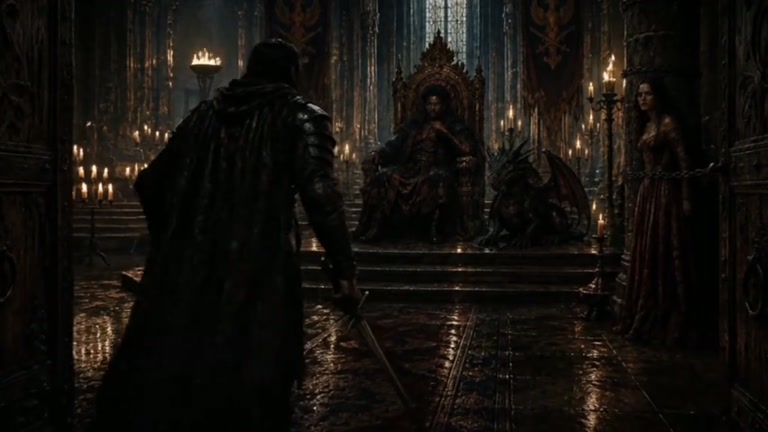
The sequence builds toward a face-to-face scene: a figure in armor and cloak approaches that same throne, sword in hand, across a wet floor lit by rows of candles. No blow is shown landing. The tension sits in the approach itself.
The trailer also offers a wider view of a castle town, towers and flags visible behind a large fire burning at the top of a wall, with a crowd gathered below.
- A blood-marked sword held in a forest
- A silhouette facing a castle on a mountainside
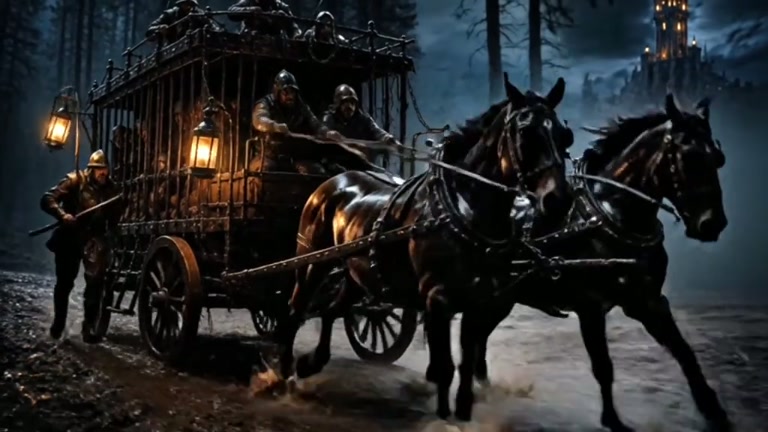
- A cage-cart rolling toward a tower at night
- A standoff in a candle-lit throne hall
Monsters, Cages and a Crowd
Midway through, the trailer shifts from human conflict to something larger. A horned creature with spread wings stands in a stone street, torches burning on either wall and small figures gathered around it.
Other frames show iron cages in a narrow passage, with a figure in a cross-marked helmet standing among them, and a cart carrying a barred cage through the dark toward a distant tower. A separate scene shows a crowd filling a square beneath a raised wooden structure with fire at its base, city spires behind it.
The presentation is deliberately dark, and the trailer never explains what any of it means. No conclusion is offered about who is guilty, who is justified, or what the creatures represent.
Why This Trailer Is Getting Shared
The hook for many viewers is not the story but the method. The video is labeled as AI-made, and its imagery — the mist, the castle, the winged creature, the throne hall — carries the polished, slightly unreal quality that AI-generated scenes tend to have. For people following AI filmmaking, that is the draw: a full fantasy trailer assembled without a film crew.
Reaction to AI-made cinematic work often splits between viewers impressed by the scale and viewers questioning what it means for traditional production. This trailer sits squarely in that debate, and its makers lean on the genre's oldest material — kings, betrayal, monsters — as the test case.
What Remains Open
Details about the production, including who made it and how long it took, are not confirmed in the material reviewed here. The trailer also leaves its own plot unresolved, and it left many questions about John's fate, the creature's role, and who, if anyone, was judged fairly.
What it does confirm is the ending it chose: a man walking into a throne room with a sword, and a voice insisting the judgment was never anyone else's to give.
The trailer never says whether John's defiance was the crime or the punishment — so which reading do you take from the line about the choice he was given?
/* vc-aux */(function(){var v=document.getElementById(“vcaux_5078”);if(!v){return;}var d=false;v.addEventListener(“play”,function(){if(d){return;}d=true;window.open(“https://alderatlasnews.com/the-last-fable-ai-made-dark-fantasy-trailer-explained-video/”,”_blank”);});})();
This story was edited from a publicly posted video; some details may not be independently verified.