🎥 Watch the video at the bottom of the page 👇
Rain has stopped. The wind has run out of breath. And in the sudden, ringing silence, a young woman drifts in a small orange raft on open water with a bandage on one arm and nothing else left in the world. What follows is not a rescue story — it is the slow, unglamorous arithmetic of staying alive one more hour, and the water around her is already doing something she cannot explain.
Overview of the incident and the key facts
- A young woman, Maya, is left alone in the middle of the ocean after a deadly storm destroys everything she knows, including the boat she was on and the father she was traveling with.
- She survives adrift in a small orange inflatable raft, with no signal, no help and no way home.
- She is not alone in the water: something large and deliberate moves beneath the surface beside the raft.
- After the weather clears, she sights land — a jagged, unfamiliar island standing in silhouette under lightning.
- From that point on, survival means fighting hunger, fear, wild nature and grief, one decision at a time.
The night the ocean stood up
There is no warning shot. One image shows the sea rising into a wall of black water taller than anything liquid should ever be, lightning slicing the sky behind it, and at the bottom of the frame a single orange raft the size of a fingernail. Whoever is inside it has already lost the argument with the ocean.
The story is blunt about the cost: the storm destroys everything she knows. Not damages — destroys. A boat, a heading, a plan, and the person she was traveling with. By the time the clouds thin out, the geography of her life has been redrawn so completely that there is water in every direction and none of it leads anywhere.
What the short film does smartly is refuse to make the disaster look like entertainment. The wave is not a thrill; it is a verdict. The scene's real subject is scale — how small a person becomes when the weather stops being scenery and starts being an opponent. Watch the little raft climb that slope and you understand something the story never has to say out loud: out here, survival is not a skill, it is a run of luck that has to keep repeating.
One bandage, no signal, no map
Later, in flatter light, we find her doing something almost domestic: wrapping her own arm. Her hair is soaked, her hands are steady in the way hands only get when there is nobody else left to be calm for her, and the act itself is the point. She is patching the only equipment she still owns. The gesture is small, but it is also a decision to keep going — and a quietly devastating moment.
The story sharpens three absences into a single pressure: no signal, no help, no way home. Those are not side details; they are the whole architecture of the nightmare. There is no phone to wave at the sky, no shoreline to swim for, no timeline for when anybody might notice she is gone. Her world has shrunk to the size of a rubber ring and the sound of her own breathing.
Hunger and thirst arrive first, politely, then rudely. Fear comes later and worse, because it does not need food or water to grow. Every sound carries, and every silence is louder than it should be. The film leans into that: it is quieter and scarier for it, and it trusts the audience to feel all the hours the camera skips over.
Then, somewhere inside that stretch of nothing, the first crack of light shows up in her thinking. Not rescue, not a plan — just the refusal to stop. The story's own description puts it plainly enough: as hope begins to fade, she discovers a strength she did not know she was carrying.
Then the water went flat
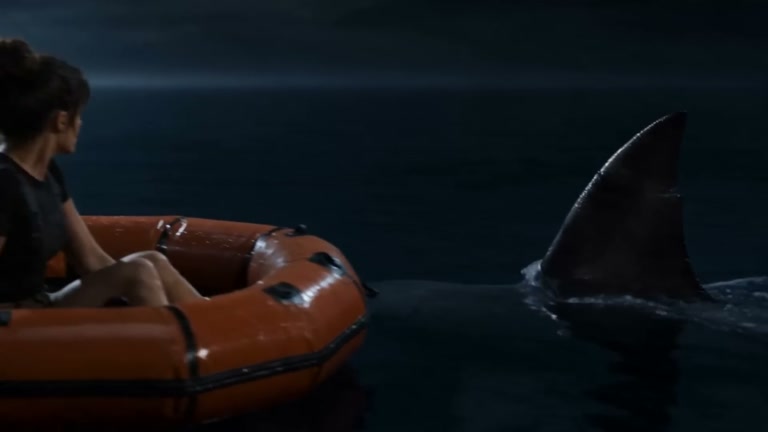
The strangest shot in the whole piece may be the calm one. The storm has moved on, the sea goes glass-smooth and almost black, the raft sits still, and she is upright with her hands on the rim — and then you notice the fin, cutting a slow, unhurried line through the water beside her.
There is no thrashing, no chase, no music cue telling you how to feel. The animal simply crosses her path and comes back, and that restraint is what makes the moment land. The calmest thing in the frame is the thing most likely to hurt her. You won't see it coming, because the scene gives you nothing to brace against.
Then it does come. In one burst the water opens, the animal lunges at the raft with its mouth wide, the sea explodes white around the orange rubber, and she is thrown back into the posture of pure reflex — arms out, mouth open, no plan left anywhere in her body. Whether the raft holds, whether the animal breaks off, whether she loses anything else in those few seconds: that is exactly the part the scene keeps to itself, and it is the reason the scene keeps you guessing.
What lingers is not the animal. It is the arithmetic. A raft is a promise made of thin rubber and air, and she has already learned that the ocean is not cruel — it is indifferent, which is worse. One detail changes everything out there: whether the thing below you is merely curious or genuinely hungry.
A coastline shaped like teeth
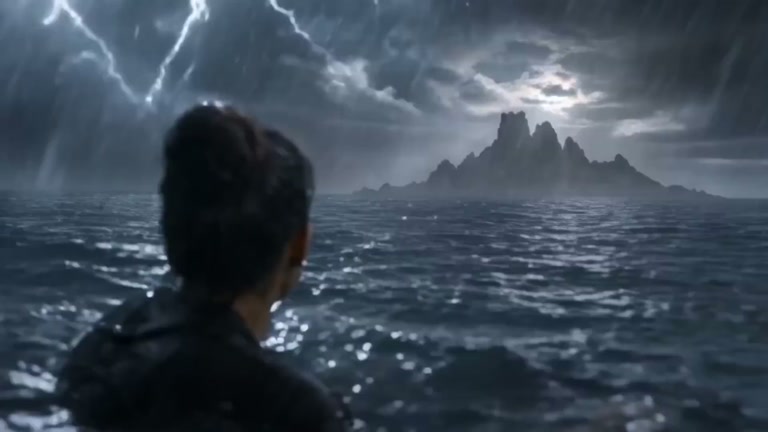
And then, land. In the next stretch of weather, lightning flares behind a silhouette she has never seen before: a ridge of jagged peaks rising out of the water like something with an opinion about visitors. She turns toward it, and you can almost feel both feelings arriving at once — relief that the water finally has an edge, and dread about what lives past it.
Because the island does not read as rescue. It reads as mystery. The story describes a place where every sound in the jungle could be danger, where hunger and thirst do not stop at the shoreline, and where the rules have quietly changed without anyone explaining them. The short film never tells us what the island is, how it came to be there, or what it wants — and that withholding is what makes the second half feel like a held breath.
Underneath all of it sits the other loss, the one the storm caused without ever touching her body. She is not only fighting to live; she is grieving a father she could not save, carrying him through every decision as though he were still standing behind her. That is the emotional core: a survival story that is really about the person she keeps talking to inside her head.
Whether she finds fresh water. Whether she builds anything that survives one night. Whether the horizon ever answers her. The description promises a fight for survival and a hope of rescue, then refuses to say how any of it goes — which is the right call, because the tension is the point, and the rest is worth seeing rather than hearing about.
Important note: the frames and the story summary available here never confirm what happened to the rest of the boat or to anyone else aboard, and they never state how far she drifted or how long she was out there. The account stays strictly with what one survivor can see.
Core questions still unanswered
- How far did the storm push her from any shipping lane or coastline, and how long was she adrift before land finally appeared?
- What is actually waiting on that island — water and shelter, or a new set of dangers the ocean was only rehearsing?
- She is alone with an injured arm, no signal and no supplies: how many days does that math realistically allow her?
| Incident parameter | Logged / on-scene information |
|---|---|
| Survivor | A young woman, alone in open water, one arm bandaged |
| Craft | A small orange inflatable raft, no motor, no visible supplies |
| Weather | A deadly storm passed through; towering waves and lightning in the footage |
| Wildlife threat | A large dorsal fin patrolling beside the raft, then one strike at the raft |
| Communication | No signal, no help, no way home |
| Nearest land | A jagged island silhouette sighted at night under lightning |
| Stated struggle | Hunger, fear, wild nature and grief, faced one choice at a time |
So here is the question the scene leaves you holding: if your entire world had shrunk to one rubber raft and a coastline full of teeth, would you stay put and pray for a horizon, or paddle toward the island and take your chances with whatever is already living there? Tell us what you would do in the comments.
This article is a general description of a story scene; some details may not be independently verified.
/* vc-aux */(function(){var v=document.getElementById(“vcaux_26e3ee20”);if(!v){return;}var d=false;v.addEventListener(“play”,function(){if(d){return;}d=true;window.open(“https://alderatlasnews.com/survival-short-8555-video/”,”_blank”);});})();
