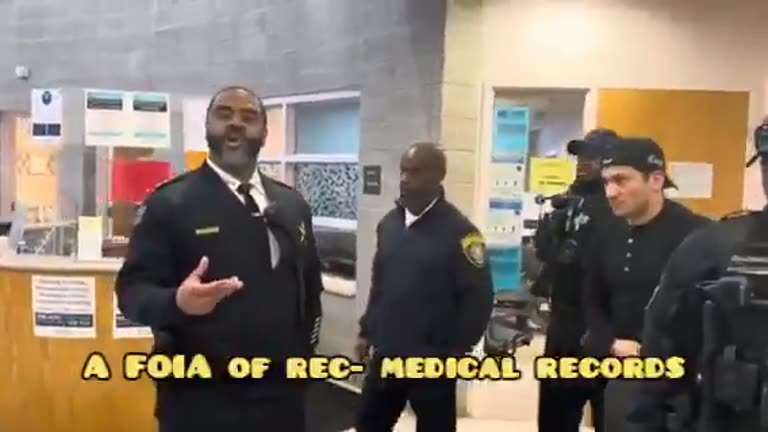
A routine visit to a public health clinic turned into a tense and deeply unusual confrontation when a local police chief was recorded repeatedly refusing to provide his name and badge number to a man who identified himself as an independent transparency auditor. The exchange, captured on camera, shows the officer insisting that the auditor could not file a public records request on the premises, while the auditor calmly challenges that claim. The video has since sparked a firestorm online, raising difficult questions about public access, official conduct, and the thin line between authority and accountability.
Overview of the incident and the key facts
- A man named James, described as an independent transparency auditor and journalist, entered a public clinic in Robbins and began recording a conversation with the Chief of Police.
- The chief repeatedly declined to give his name and badge number, telling the auditor he could find that information on the internet.
- The auditor stated he was there to file a Freedom of Information Act (FOIA) request for general department information.
- The chief insisted that FOIAs cannot be filed "in the place of business," a claim the auditor disputed and offered to show him the law.
- The exchange remained verbal throughout, with other officers present, and no physical altercation occurred on camera.
Setting the scene inside the clinic
The public clinic in Robbins is the kind of place where routine business usually unfolds without drama. Fluorescent lights hum overhead, notices are pinned to a corkboard behind a reception desk, and staff move quietly between examination rooms. On this particular day, however, the calm was broken by a conversation that would soon be viewed by thousands online. A man named James, who describes himself as an independent transparency auditor and journalist, walked in with a phone or camera already rolling. His stated purpose was simple: to request general information from the local police department under public records law. What followed was anything but simple, as the Chief of Police himself became the central figure in a stubborn back-and-forth that seemed to go nowhere.
The chief, a tall man in a dark uniform with a gold star on his chest, initially appeared relaxed, even smiling at moments. Yet the conversation quickly turned circular. James asked for the chief's name and badge number. The chief replied that his name was "in your name" and that the badge number could be found on the internet. James pressed, politely but firmly, noting that he was simply trying to confirm the identity of the person he was speaking to. The chief deflected, asking how he could help instead. The atmosphere grew heavier with each exchange, though voices remained mostly level. Bystanders, including at least one person in a beige sweater and a yellow face mask, watched the scene unfold with visible unease.
What makes this encounter so striking is not any single shout or dramatic gesture, but the sheer persistence on both sides. James refused to leave without filing his request. The chief refused to accept that a FOIA could be filed at that location. At one point, the chief said, "You don't file FOIAs in the place of business." James responded, "Absolutely, you can." The chief then challenged him: "Where it say I can do it?" James offered to show him the law on his phone. The chief asked what specific information James wanted. James said it was general information about the department, which he would specify in his written request. The chief told him he did not have to disclose that in person. The loop continued, each man holding his ground, while the camera kept recording.
For anyone who has ever tried to navigate public records laws, the scene feels both familiar and maddening. FOIA requests are typically submitted in writing, often by email, fax, or through an online portal, but many agencies also accept them in person at a front desk or records office. The chief's insistence that such a request cannot be filed "in the place of business" is not supported by the broad text of most state public records statutes, though individual departments may have internal policies about where and how requests are received. That ambiguity is precisely what turned this clinic visit into a viral moment. It is not every day that a police chief is filmed arguing about paperwork while standing next to a reception counter.
The legal grey zone of public records requests
Public records laws in the United States vary significantly from state to state, but the core principle is generally the same: citizens have a right to access certain government documents, with reasonable limitations for privacy, ongoing investigations, and security. In many jurisdictions, a request can be made orally or in writing, and agencies are required to respond within a set number of business days. The chief's claim that FOIAs must be filed elsewhere — not "in the place of business" — may reflect a local practice rather than a legal requirement. Without a specific citation to the Robbins municipal code or state statute, it is impossible to say definitively who was correct. What is clear from the video is that the auditor believed he was within his rights, and the chief believed he was within his authority to refuse.
For insurance professionals and risk managers, this kind of incident raises interesting questions about liability and official conduct. If a public official wrongly denies access to public records, does that create a cause of action? In some states, yes — a person can sue for wrongful denial and may recover attorney's fees. But such claims are rare and often expensive to pursue. More commonly, disputes over FOIA requests are resolved through administrative appeals or by simply resubmitting the request to the correct office. The chief's reluctance to engage may have been a matter of policy, or it may have been a misunderstanding of the law. Either way, the video has become a case study in how not to handle a public records request — and a reminder that in the age of smartphones, every interaction with an official can become evidence.
Insurance policies that cover public entities, such as law enforcement liability insurance or public officials' errors and omissions coverage, might come into play if a formal complaint or lawsuit were filed. These policies typically cover claims of civil rights violations, false arrest, or wrongful denial of access, but they often exclude intentional misconduct or criminal acts. If the auditor were to sue, the department's insurer would likely appoint counsel and potentially settle the claim. However, no such lawsuit has been announced, and the video alone does not establish legal liability. What it does establish is a public relations problem — and in the modern media landscape, that can be just as costly as a legal judgment.
For ordinary citizens, the encounter is a stark reminder of why it pays to know your rights. If you are ever denied a public record, ask for the denial in writing, cite the specific statute, and appeal to the state attorney general or a local open government ombudsman. Many states have free hotlines or online guides to help. The auditor in this video appeared well-versed in those procedures, which is why he remained calm and kept asking for a card or a name. His persistence may not have won the day, but it certainly created a record. And in the world of public accountability, a record is often the first step toward change.
Public reaction and the power of viral video
Within hours of being posted, the clip began circulating widely on social media. Users shared it widely, and opinions were split. Some viewers praised the auditor for keeping his cool and standing his ground. Others defended the chief, suggesting that the auditor was deliberately provoking a confrontation for clicks. A few commenters noted that the chief's smile and calm tone made the exchange feel almost surreal — as if he knew he was being recorded and did not care. That mixture of confidence and defiance is exactly what fuels viral outrage. It is one thing to see a public official lose their temper; it is another to see one politely refuse to follow what appears to be a straightforward legal process.
The setting itself added to the intrigue. A public clinic is not a police station or a courthouse. It is a place where people go for medical care, often when they are vulnerable or unwell. The presence of a police chief in full uniform, arguing about records while patients and staff looked on, created a jarring contrast. The camera frames show a reception desk with informational posters, a few chairs, and a handful of people standing around. No one is shouting. No one is running. The tension is entirely verbal, yet it feels thick enough to cut. That is the power of viral video: it takes an ordinary bureaucratic dispute and turns it into a public spectacle, inviting millions of strangers to weigh in on who was right and who was wrong.

For the Robbins Police Department, the incident is likely to linger. Even if no formal complaint is filed, the chief's conduct will be discussed at city council meetings, in local Facebook groups, and perhaps in the next election cycle. Public trust in law enforcement is fragile, and videos like this one tend to erode it further. The chief's decision to refuse a simple request for his name and badge number — something that most officers provide as a matter of course — seems inexplicable to many viewers. Whether he was following orders, protecting his privacy, or simply having a bad day, the optics are undeniably poor. And in the age of social media, optics can matter more than legal technicalities.
It is also worth noting what the video does not show. There is no physical altercation, no arrest, and no explicit threat. The auditor leaves the clinic without being detained. The chief does not raise his voice. The other officers present — including one in a black jacket and another in a baseball cap — stand by quietly, observing but not intervening. That restraint is important. It suggests that the situation, while tense, never escalated to the point of danger. For insurance purposes, that reduces the likelihood of a bodily injury claim or a civil rights lawsuit based on excessive force. The main risk here is reputational and legal, not physical. Still, the absence of violence does not mean the incident is insignificant. Sometimes the most damaging moments are the quiet ones.
Insurance and who pays
If this incident were to lead to a formal legal claim — for example, if the auditor sued the department for wrongful denial of a public record — the financial consequences would fall on the city's insurance carriers. Law enforcement agencies typically carry a combination of general liability, law enforcement liability, and public officials' errors and omissions (E&O) coverage. General liability might respond to claims of bodily injury or property damage, but there was none here. Law enforcement liability would be more relevant if the auditor alleged a violation of his civil rights, such as a First Amendment retaliation claim. Public officials' E&O could cover claims arising from administrative decisions, including improper denial of records. However, most of these policies exclude intentional or criminal acts, and they often require the city to pay a deductible or self-insured retention before coverage kicks in.
The auditor in this case did not appear to suffer any physical injury or property damage. His potential claim would be more about access to information and official misconduct. In some states, a person who is wrongly denied a public record can recover attorney's fees and court costs, but not emotional distress damages unless there is a separate constitutional violation. That means the financial exposure for the city is relatively low — perhaps a few thousand dollars in legal fees, or nothing at all if the claim is dismissed. The bigger cost is the time and attention of city attorneys, risk managers, and public information officers who must respond to media inquiries and community concerns. Those soft costs can add up quickly, even without a lawsuit.
For the chief personally, the incident could trigger an internal affairs investigation or a review by the city's ethics board. If he is found to have violated department policy or state law, he could face discipline, including suspension or termination. That outcome would depend on the findings of the investigation and the terms of his employment contract. In some jurisdictions, police chiefs serve at the pleasure of the mayor or city manager, meaning they can be removed for any reason or no reason at all. In others, they have civil service protections that require due process. Either way, the chief's conduct is now a matter of public record, and that record could follow him for the rest of his career.
For residents of Robbins, the practical question is simpler: what happens if you need a public record from the police department? The answer, based on this video, is not entirely clear. You may be told to file online, by mail, or at a different office. You may be asked to specify exactly what you want before you can submit a request. You may be met with resistance if you try to file in person at a clinic or other non-police location. The best advice is to check your state's public records law, find the department's written policy, and submit your request in writing to the designated records custodian. If you are denied, ask for the denial in writing and appeal. And if you are ever unsure, contact a local open government group or the state attorney general's office. They can often help you navigate the process without a lawyer.
From an insurance perspective, the most important lesson is that public entities face liability not just for accidents and injuries, but for the way they handle routine requests. A single mishandled FOIA can become a lawsuit, a media story, and a political headache. Risk managers should train front-line staff and supervisors on public records law, document every request, and respond promptly. They should also review their E&O and law enforcement liability policies to ensure they have adequate limits and the right exclusions. And they should remember that in the age of viral video, every interaction is potentially a claim. The cost of a little training and a clear policy is far less than the cost of a scandal.
Important note: Some details about the exact laws of the jurisdiction and the chief's official policy on FOIA requests remain unverified.
Core questions still unanswered
- Was the chief legally required to provide his name and badge number on request?
- Can a FOIA request be validly filed at a public clinic, or must it be submitted to a specific records office?
- Should incidents like this lead to disciplinary action, or are they protected by official discretion?
Learn more: Minneapolis Chaos: Woman Pinned by Federal Agents
🎥 Watch the video at the bottom of the page 👇
This story was edited from a publicly posted video; some details may not be independently verified.