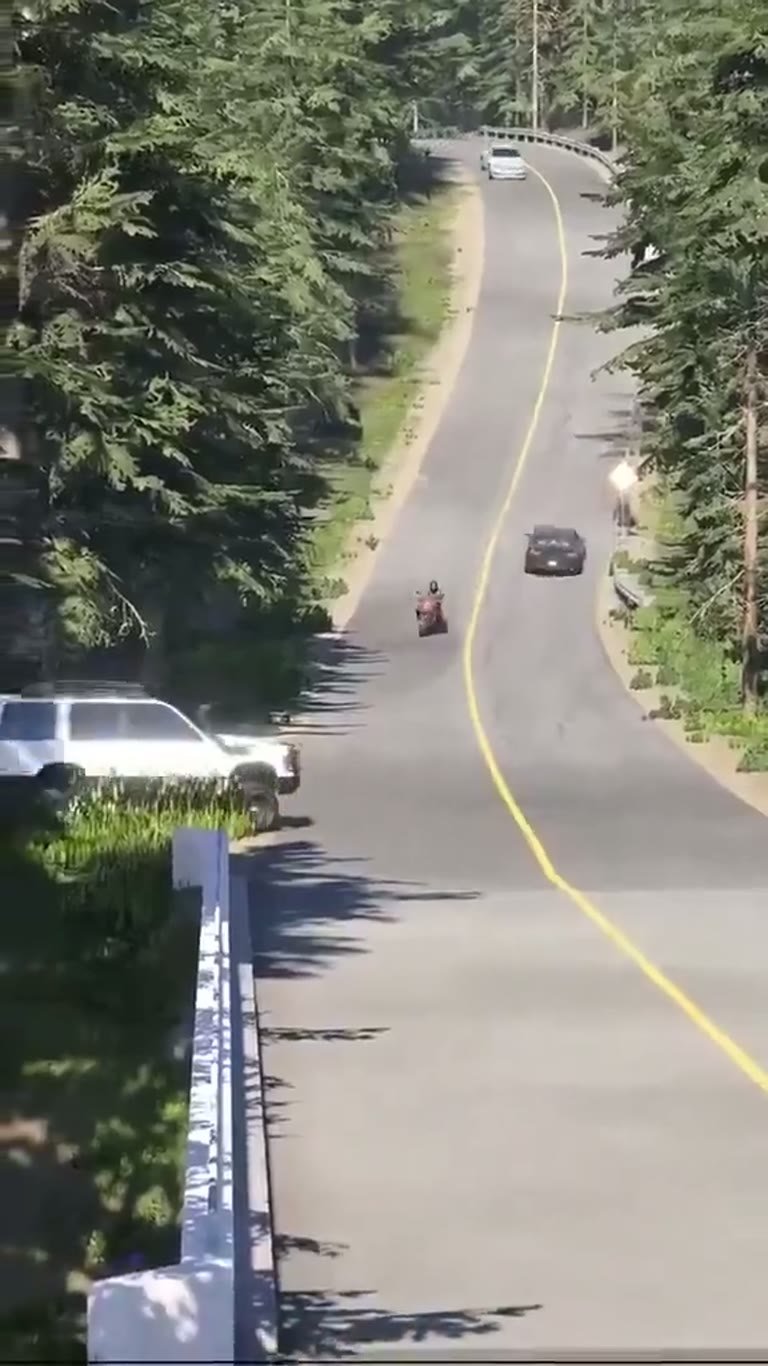
A red motorcycle follows a dark car down a winding two-lane road lined with evergreens. A white SUV swings across the oncoming lane, and within seconds the bike is on the asphalt. Filmed from a fixed position above the curve, the sequence ends with the motorcycle off the road and dust rising among the trees.
A Quiet Stretch of Forest Road
At first, nothing in the frame looks unusual. A paved road with a solid yellow center line sweeps downhill between tall conifers, wide enough for two vehicles but with almost no shoulder on either side. A low concrete barrier runs along the outer edge of the bend at the bottom of the view, and beyond it the ground falls away into forest.
A dark car descends the hill, with a red motorcycle trailing it at a distance. Farther up the rise, a lighter vehicle is visible moving the opposite way. The trees crowd the asphalt and the road bends twice before it reaches the bottom of the frame — the kind of stretch where a driver sees only a short distance ahead.
Then the white SUV appears from the left, near what looks like a driveway or a side entrance. It angles toward the roadway while the downhill traffic keeps closing in.
The SUV Crosses the Lane
The white SUV moves out and turns across the road, its body swinging into the path of the vehicles coming downhill. The motorcycle, still descending, closes the gap in a matter of seconds.
The two meet near the middle of the frame, and the bike goes down. The SUV comes to a stop at an angle, its front end over the lane, as the road behind it clears.
In a shot this wide, small details carry the story: the line of the yellow paint, the shrinking distance between the two vehicles, the moment the motorcycle stops being part of the flow of traffic. Together they mark the turning point of a scene that unfolded without warning.
Down on the Asphalt, Then Off It
The frames that follow show the red motorcycle lying on the ground beside the white SUV. From the camera's height, it is not possible to see what happened to the rider.
A moment later, the motorcycle appears at the right-hand side of the road, close to the barrier. The view then settles on the concrete wall and the wooded slope beyond it, where dust or smoke drifts upward and a red object is visible among the trees.
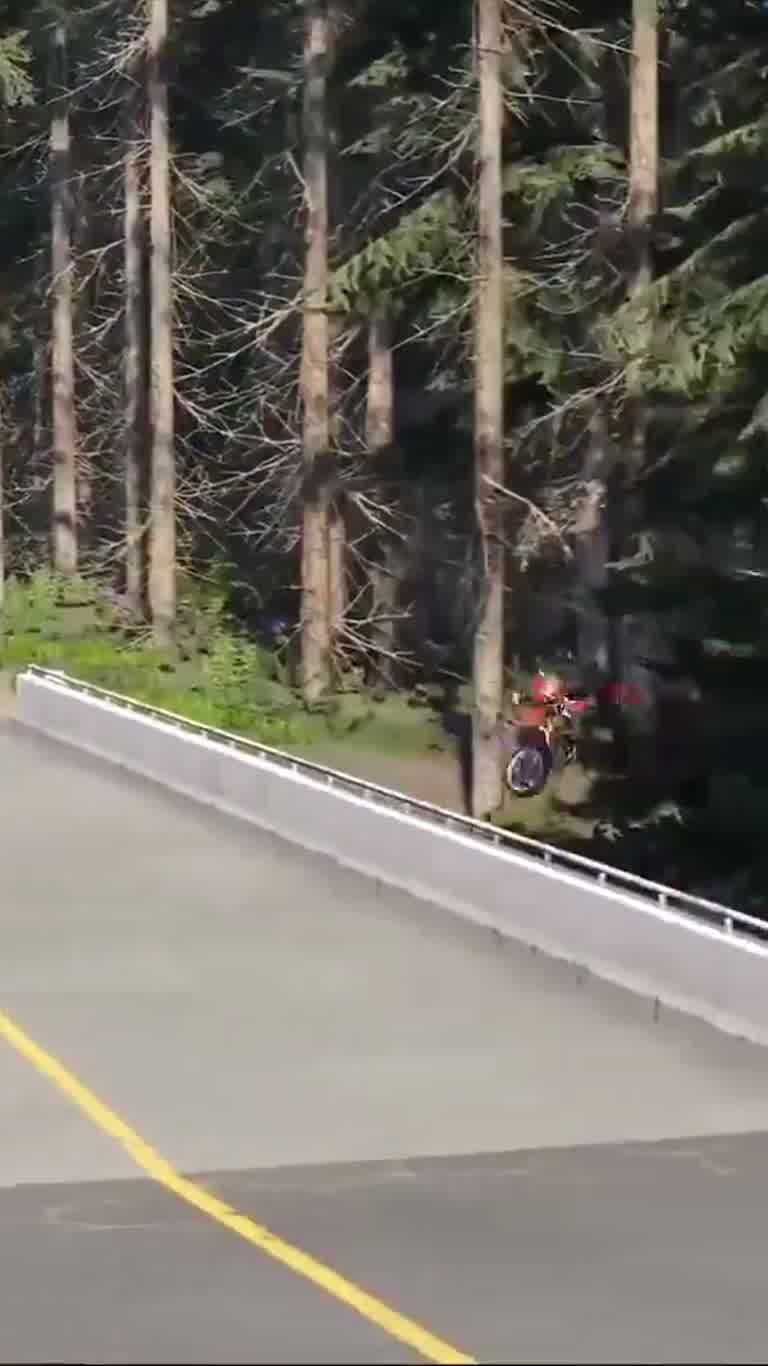
The camera never moves from its position above the curve. By the closing frames, the road is empty again — just the yellow line, the white barrier and the evergreens. Whatever happened at the end of the sequence took place partly out of the camera's clear line of sight.
What the Footage Leaves Open
No official account accompanies the clip, and nothing in the material shows exactly where the road is. What can be traced is the order of events: a descent, a turn across the lane, a collision, and an aftermath the camera only partly captures.
That gap is what makes the sequence linger. Speed is impossible to judge from this height, and the wide angle flattens the distance between the vehicles, so two people watching can reach very different conclusions about how much time anyone had to react.
On a road like this one, a single crossing of the center line removes the space a rider or a driver needs — and the curve hides most of what is coming.
For anyone who drives a stretch like this, the harder question is quieter. How much of a curve can a driver actually see, and how much is left to chance? The footage leaves many unanswered questions, and no authority has attached a conclusion to it.
Some details — the exact location, what happened to anyone involved and whether anyone responded — could not be independently verified.
Until an official account emerges, which second in the sequence stands out most to you?
This story was edited from a publicly posted video; some details may not be independently verified.