🎥 Watch the video at the bottom of the page 👇
A routine morning in Midtown Manhattan turned into a street spectacle when two delivery workers abandoned their vehicles and went at each other in the middle of a crosswalk. What began as a heated exchange quickly escalated into a physical confrontation that drew a crowd of onlookers, slowed traffic, and ended with an unexpected intervention — a passerby offering money to break it up.
Overview of the incident and the key facts
- The confrontation involved at least two delivery drivers who stepped off their vehicles in the middle of a busy intersection.
- A witness can be heard repeatedly calling one of the men "violent" as the scuffle continued.
- Bystanders kept their distance, with some shouting for the men to back up as the situation escalated.
- A cyclist in a dark jacket and sunglasses was seen gesturing and speaking near the edge of the frame.
- The video title states the fight ended when a stranger paid the men to stop.
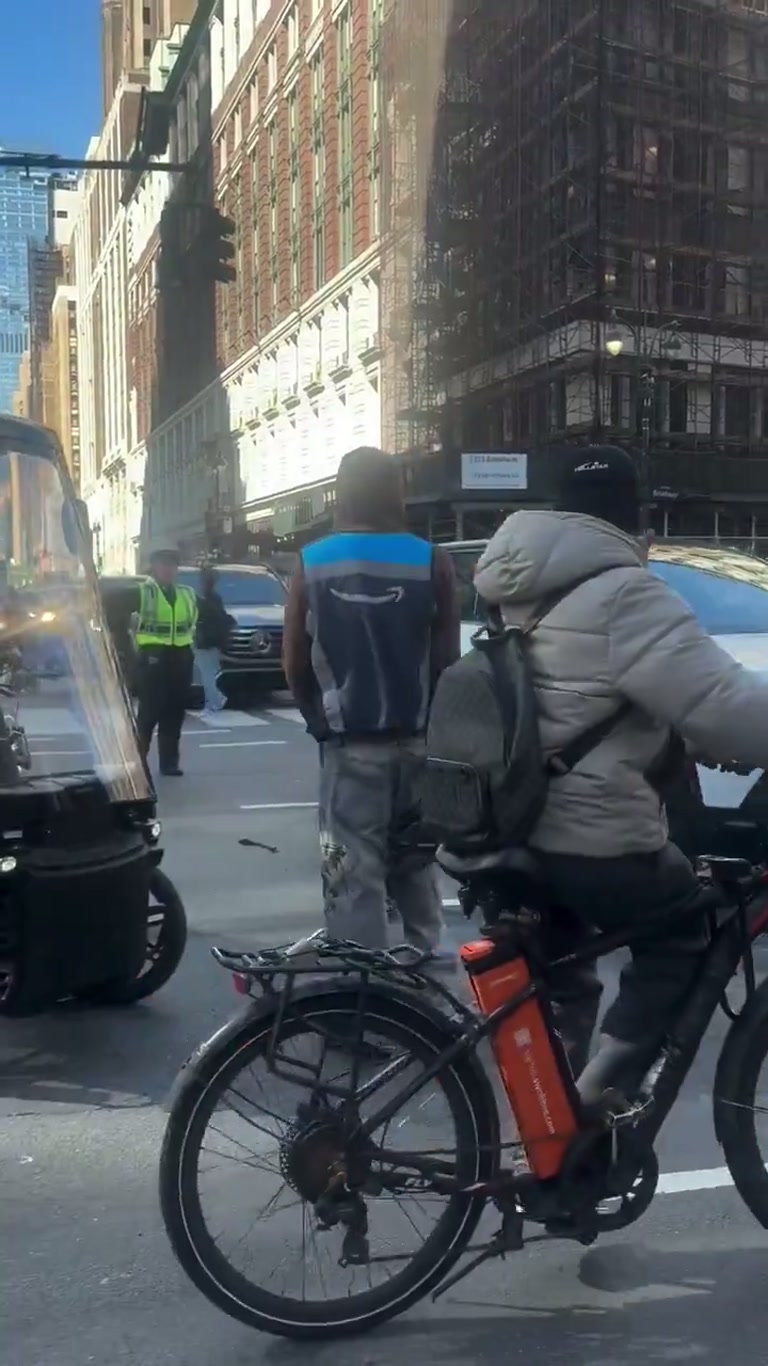
The footage opens with two men in delivery-style vests — one wearing a blue and black Amazon vest, the other in a black hoodie with a reflective safety vest — standing near the middle of a city street.
A white SUV with a yellow New York license plate is parked directly behind the men, its front end close to the crosswalk.
A third man in a white hoodie and dark vest stands to the side, holding a black helmet and watching the scene unfold.
A black electric scooter or moped is visible in the left foreground, with a large delivery bag strapped to its rear.
A person on a fat-tire e-bike with a red battery pack rolls past the scene in the third frame, capturing the odd contrast of daily commuters and open conflict.
The first frame shows the men squared up near the white SUV. One man, wearing the blue and black vest, has his back turned to the camera, his posture tense and rooted. The other, in a black hoodie and orange safety vest, faces him with a stance that suggests neither is ready to walk away. The audio picks up a chorus of "oh, oh, oh" from nearby witnesses, a sound that sits somewhere between shock and nervous laughter. "The violence is violent," one voice says, almost narrating the absurdity of the moment. "Oh, he's violent," another repeats, as if trying to make sense of what is happening in the middle of a crosswalk.
The scene is pure New York: a construction scaffold wraps a building in the background, a street sign for 1313 Broadway hangs above, and the morning sun cuts between the towers. Traffic is stalled. Pedestrians glance over but keep moving. The men are not anonymous in the way of a dark alley — they are on display, surrounded by the machinery of a city that has seen almost everything.
What makes the footage linger is not the punches themselves but the strange social choreography around them. No one steps in. No one calls out for police. Instead, a small crowd forms at a distance, phones probably raised, voices overlapping. "His mans came to help him," someone says, tracking the shifting dynamics. "Back up, back the fuck up," another voice commands, though it is unclear who is being addressed. The fight continues, and the city keeps spinning around it.
The brawl and the voices in the crowd
The audio track is a thick layer of reactions — "oh" repeated like a drumbeat, a woman's voice rising in alarm, a man's voice flatly observing that "this shit is crazy." The language is raw, unfiltered, the kind of thing you hear when people are not sure whether they are watching a fight or a performance. "They're violent," someone says, plural now, as if the violence has become a shared property. "Yo, I fucking hate New York," a voice declares, though the complaint feels less about the city than about the moment — the exhaustion of seeing one more thing go wrong before the day has really begun.
In the second frame, the camera catches the man in the blue and black vest walking away from the SUV, his helmet dangling from his hand. The white SUV has not moved. The man in the white hoodie and dark vest is still standing nearby, helmet in hand, watching. There is no clear winner, no clear ending. The fight seems to be pausing, not resolving. The man in the blue vest — whose vest carries a visible logo — walks with the stiff, deliberate gait of someone still running on adrenaline.
The third frame widens the view: a police officer in a high-visibility yellow vest is now visible in the background, standing near the crosswalk. A cyclist on an e-bike with a red battery rolls through the frame, and a person in a puffy gray jacket and backpack pedals past on a fat-tire bike. The juxtaposition is almost comic — the machinery of urban life continuing undisturbed while the aftermath of a fight plays out in the foreground. The officer's presence suggests that the authorities are aware, but the video does not show an arrest or a formal intervention.
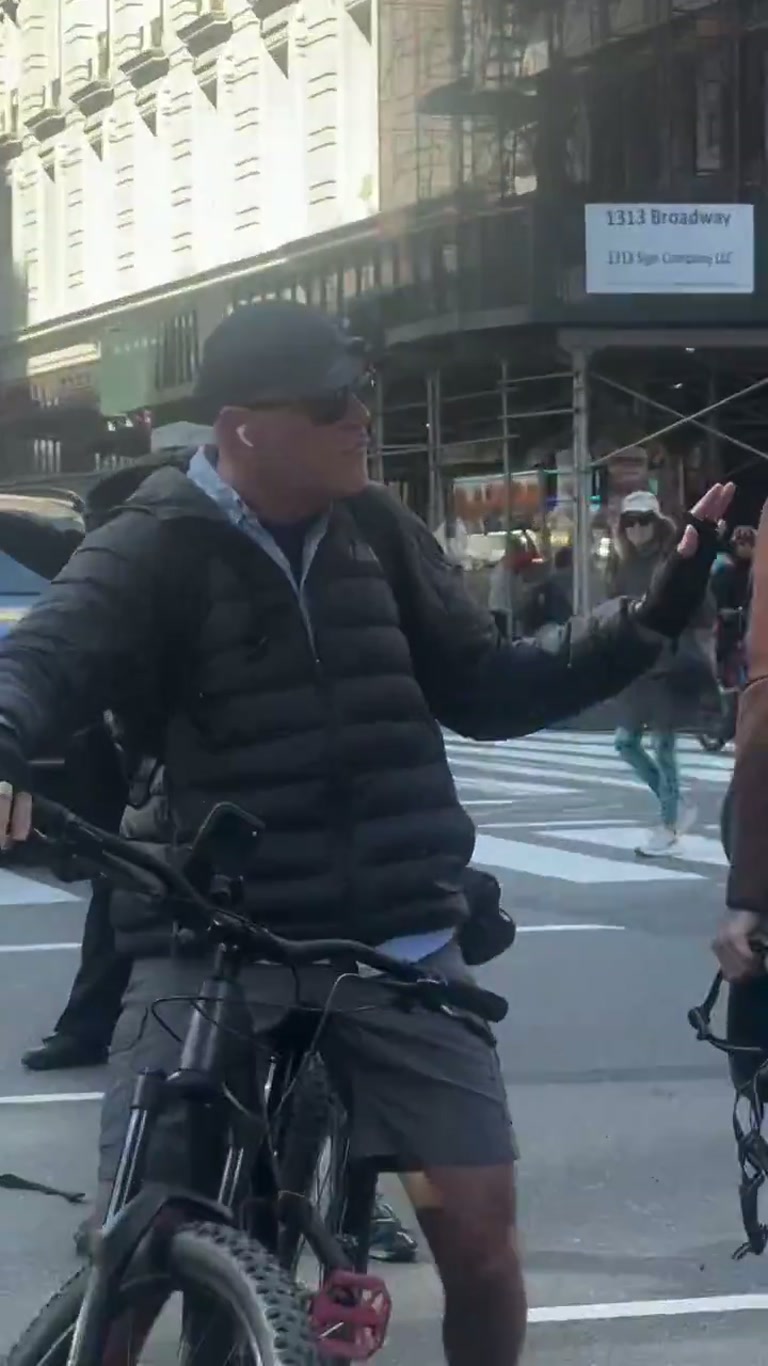
The fourth frame brings a new character into focus: a man in a black puffer jacket, dark cap, and sunglasses, standing astride a fat-tire e-bike with red pedals. He has one hand raised, palm open, as if he is talking to someone off-camera. His posture is calm, almost conversational. It is not clear whether he is the stranger mentioned in the video title — the one who paid the drivers to stop — but his presence adds a layer of ambiguity. Is he mediating? Observing? Directing traffic? The frame does not say.
The fifth and final frame returns to the man in the blue and black vest, now walking away from the camera, helmet still in hand. The white SUV is still there. The man in the white hoodie is still watching. The street is still full of people, still moving, still loud. The fight is over, or at least paused, but the tension has not fully dissipated. The audio ends with a plaintive question — "Why am I so weak, sir?" — and a weary observation: "It's too early in the morning." Then, a request: "Somebody get it over." The voice is tired, almost pleading, as if the speaker has seen too much before breakfast.
The stranger, the payment, and the strange economy of the street
The video title — "This fight started with two delivery drivers going Myles Garrett on each other & ended with a stranger paying them to stop" — introduces a detail that the footage itself does not fully capture. According to the title, the confrontation was resolved not by police, not by a Good Samaritan pulling the men apart, but by a financial transaction. A stranger offered money. The drivers stopped. The fight ended.
That detail, if true, transforms the story from a standard street brawl into something closer to a parable about New York. In a city where everything has a price, even a fight can be bought off. The men were not fighting for money — or at least, there is no indication they were — but they were willing to stop for it. The stranger, whoever they were, understood the logic of the street: if you want to change behavior, you have to speak the language. And in this case, the language was cash.
The footage does not show the moment of payment. It does not show the stranger handing over bills. It does not show the drivers' reactions. What it shows is the aftermath: the men walking away, the crowd dispersing, the traffic slowly resuming. The city swallows the incident whole, as it does with so many moments of public friction. By the time the video ends, the only evidence that anything happened is the lingering tension in the voices of the people who watched.
This is not the first time a public confrontation has been resolved by an unexpected intervention. In New York, strangers intervene in fights all the time — sometimes with words, sometimes with force, sometimes with money. The city has a long tradition of informal mediation, a kind of street-level diplomacy that exists alongside the formal machinery of law enforcement. The man on the e-bike, with his raised hand and calm demeanor, might be part of that tradition. Or he might just be a guy on a bike. The footage does not say.
What the footage does show is the speed with which a fight can become a spectacle. Within seconds, the men are surrounded — not by a mob, but by a loose constellation of onlookers, each processing the scene in their own way. Some laugh. Some shout. Some film. Some just watch. The fight is not private. It is not hidden. It is a public event, staged in the middle of a crosswalk, with the city as its backdrop. And when it ends, the city moves on, as if nothing happened.
The city as witness: traffic, time, and the morning after
The setting matters. This is Midtown, near 1313 Broadway, a stretch of Manhattan where the scaffolding never comes down and the traffic never really stops. The white SUV with the New York plate is a reminder that this is a working street, not a stage. The delivery drivers are working people — their vests, their helmets, their vehicles all speak to a job that involves moving through the city at speed, navigating traffic, meeting deadlines. The fight is a rupture in that routine, a moment when the pressure of the job spills over into something physical.
The time of day — morning, according to the audio — adds another layer. "It's too early in the morning," one voice complains, and the line lands with the weight of recognition. Morning is supposed to be the start of things, not the scene of a brawl. But in a city that never sleeps, morning is just another shift. The delivery drivers have probably been up for hours. The onlookers are probably on their way to work. The stranger on the e-bike might be commuting. Everyone has somewhere to be. And yet, for a few minutes, they are all stopped, watching two men fight in the street.
The police officer in the yellow vest appears in the third frame, a reminder that the city has mechanisms for dealing with this kind of thing. But the officer does not intervene in the footage. The fight ends on its own — or rather, it ends because someone paid it to end. The officer's presence is a kind of background assurance, a sign that the situation is being monitored, but it is not the solution. The solution, if there is one, comes from the street itself.
The video ends without a clear resolution. The men walk away. The crowd disperses. The traffic resumes. The city continues. But the questions linger. What were the drivers fighting about? Was it a dispute over a delivery? A road rage incident? A personal grievance? The footage does not say. The audio does not say. The title does not say. All we know is that two men fought, a crowd watched, and a stranger paid them to stop.
Important note: Some details in this account, including the reported payment and the exact cause of the fight, have not been independently verified and rely on the video title and audio transcript.
Core questions still unanswered
- What could have caused two delivery drivers to abandon their routes and fight in the middle of a crosswalk?
- Would you intervene if you saw a fight like this on your morning commute, or would you keep walking?
- Does paying someone to stop fighting actually solve the problem, or does it just pause it?
Learn more: Bar scuffle erupts as men surround woman in crowd
This story was edited from a publicly posted video; some details may not be independently verified.