🎥 Watch the video at the bottom of the page 👇
The market on the corner is doing what markets do on a slow weekday: the line curls past the glass case, two shoppers are bickering over the same cut of meat, and somebody near the door keeps calling out a price for two boxes of blueberries. Behind the block, a young woman with a knife in her hand works faster than anyone else in the building, and for a few seconds she is the calmest person in the room. Then a stranger in a dark jacket steps in from the street, and the ordinary afternoon stops behaving like an ordinary afternoon.
Overview of the incident and the key facts
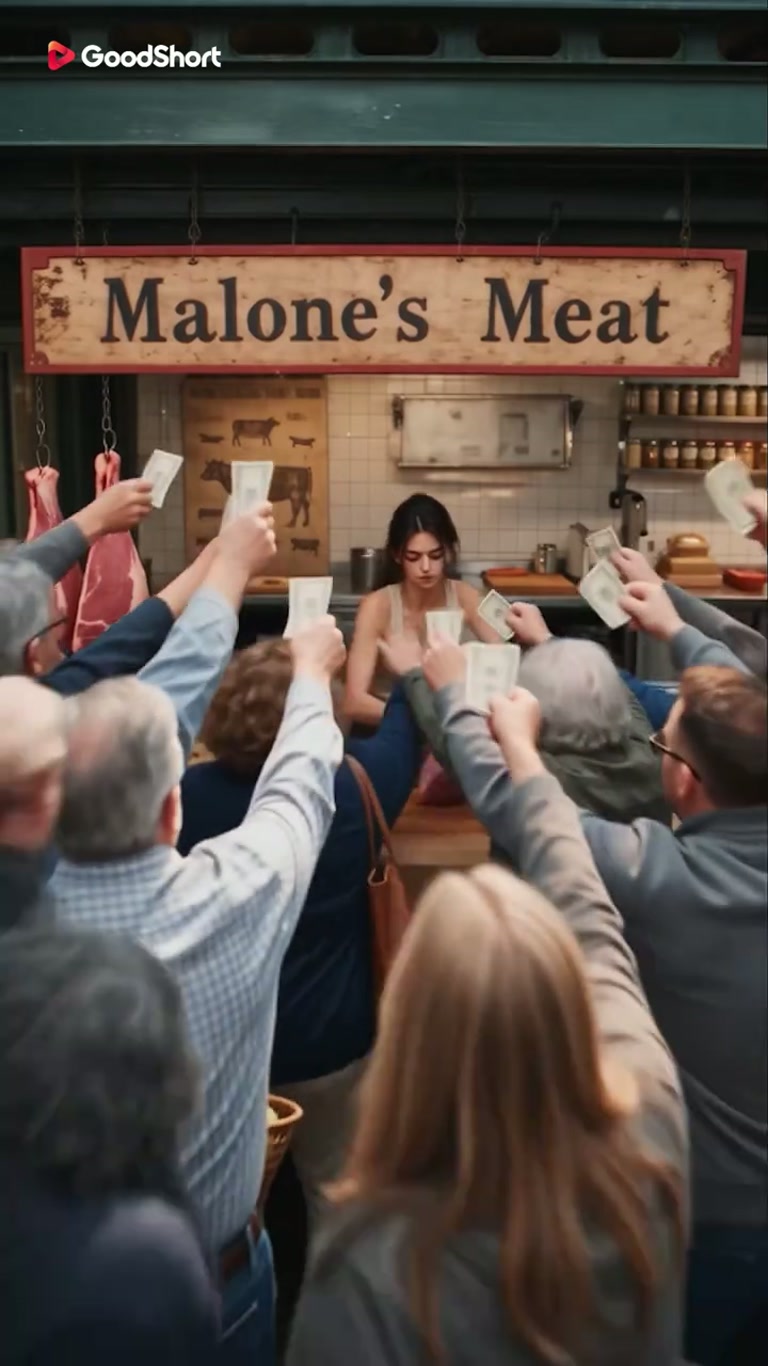
- The scene plays out inside a crowded butcher shop trading under the hand-painted sign "Malone's Meat", where shoppers press against the counter and hold paper money up over the display case.
- Cassie, the young butcher behind the block, is singled out by the crowd — "No one in this whole market cuts meat like Cassie" — and settles a squabble in the line with a flat "Knock it off and line up."
- A man in a suit and glasses mocks the room with a dry "What elegance," while a shopper near the counter insists, "Wait, I called dibs first. I saw it first!"
- A separate announcement lands on Mr. Orsani: by his mother's orders, he is to come home and marry Ms. Hawthorne.
- A payment of $10,000 is received in the middle of the market, followed by one blunt sentence — "I'm buying meat" — and the mood of the room never quite returns to normal.
The Cut That Draws a Crowd
There is a rhythm to a working butcher's hands, and this scene spends its first minutes letting you feel it. The knife comes down in short, certain strokes, the blade lifts, the meat opens clean along the grain, and the whole motion looks less like labor than like muscle memory. Around the block, a crowd that has clearly stood here before leans in like spectators at a local sport. Somebody lifts a basket toward the case. Somebody else complains that they saw that particular cut first, and the argument is loud enough to turn three heads.
Cassie never looks up. She tells them to knock it off and line up, then goes back to the half side still waiting to be broken down, because that is the actual job and the queue is not going to cut itself. That single line does more character work than a page of dialogue: she is not sweet about it, not rude about it, just occupied. The texture of the place is ordinary, noisy, a little greedy and entirely human — the kind of room where people negotiate price, position and pride in the same breath.
What makes it interesting is how quickly everyone agrees on exactly one thing. In a market full of opinions, the crowd has no debate at all about who belongs behind that block. The praise is specific, repeated, spoken like a fact rather than a compliment — which means the woman with the knife is not just good at her job. She is the reason some of these people walked in.
Then there is the man in the suit and glasses, watching all of it with the expression of someone who wandered into a theater by accident and decided to review the show anyway. "What elegance," he says, and the sarcasm lands like a wet towel across the room. It is a small moment, easy to laugh at, easy to forget. But in a scene built on contrast, it plants the first flag: this is a world where manners are loud and status is measured in cuts, and outsiders keep score.
A Suit in a Room Full of Aprons
The light on the floor shifts, the door moves, and a second kind of stranger walks in. Dark jacket, no basket, no queue etiquette, no interest in the chalkboard. The room reads him instantly as an outsider, and the room reacts the way a busy counter always reacts to a body that does not belong to the line: somebody asks who he is, bluntly, out loud, with no ceremony attached.
The answer does not arrive as an explanation. What arrives is a transaction — $10,000, logged in the middle of a shop where people are still arguing about the price of a few boxes of fruit — followed by the driest possible summary of what the man wants:
"Payment received, $10,000. I'm buying meat."
Nothing about the sentence makes sense on its surface, and everything about it makes sense as a scene. He is buying, but not in any way the shop knows how to sell. He is standing at the same counter as everyone else, but playing by rules that were never posted. The crowd goes quiet in the particular way crowds go quiet when the arithmetic stops working.
That is where one detail changes everything. The room is still the same room. The blade is still on the block, the tray still textured with the work of the afternoon. But the scene has quietly stopped being about meat. Whether this stranger is a client, a collector of favors, or someone sent for a far colder reason, the market's usual rules no longer apply to him — and everyone in the frame seems to feel it before they can name it.

The Order He Didn't Ask For
Threaded through all that noise is another conversation entirely, one that belongs to a different world than the display case and the daily price board. It is an announcement delivered to Mr. Orsani: by his mother's orders, he is coming home to marry Ms. Hawthorne. Not a proposal, not a courtship, not anything a person would call a choice — an order, dressed up as family business and handed down like a delivery schedule.
The story's own framing hints that a name in this scene is not the name it should be. The title leans on two versions of one woman — a girl who was already working a butcher's block and an heiress who is supposed to be somewhere else — and on the idea that a memory, once lost, is coming back. That is the promise the footage is quietly trading on, and it is the reason the scene that keeps you guessing never has to raise its voice. It just keeps showing you a knife, a counter and a name that may not fit.
What we can actually see is simpler than what we can guess. Two lives collide inside a single afternoon: the one that smells of cold steel and paper money, and the one that arrives with orders about marriage. Neither side appears to know the other exists yet. Then the payment clears, a man in a leather jacket appears near the block, and suddenly both worlds are standing in the same six feet of floor space.
Under the Counter, Everything Changes
The last stretch of the sequence drops you into darkness. The market is still audible — the call of the queue, the clatter of a tray, the working hum of a shop that has not paused — but the camera has gone low, into the narrow unlit slot between the bench and the floor. A man crouches there in his jacket, folded small, breathing carefully, entirely out of sight of people standing ten feet away.
A blade enters the frame, close enough that its edge catches the light, and the geometry of the shot changes completely. This is not a cooking image. It is the kind of framing that tells you the room upstairs is a different world from the room down here, and that the boundary between them is a slab of wood and a few seconds of nerve.
Then a young woman's face snaps toward something just outside the frame. Her expression slides from the flat focus of a cutter to something startled — eyes wide, mouth open, the look that says everything and explains nothing. Whatever she has just seen or just understood, it lands in a single beat, without a word attached to it.
That is where the scene stops, mid-breath, and that is exactly why it works. You can't look away, because every answer is being withheld at once: what the crouching man is hiding from, what the blade is doing that close to him, what the young woman has recognized, and who, in the end, is actually being protected here. The cliffhanger is built out of a shadow, a knife and one person deciding whether to make a sound.
Important note: The scene never states who sent the $10,000, what the payment is truly for, or how the man in the leather jacket is connected to the wedding order — the footage cuts away before any of it is explained.
Core questions still unanswered
- Who is the man in the dark jacket, and why does he end up crouched under a counter instead of standing in line?
- If the woman at the block is not the person being named in that announcement, whose name has she been living under — and for how long?
- What does a returning memory actually change about a marriage order that was already signed in someone else's handwriting?
| Incident parameter | Logged / on-scene information |
|---|---|
| Location | A busy butcher shop under a hand-painted sign reading "Malone's Meat" |
| Central figure at the counter | Cassie, the cutter the crowd praises by name |
| Crowd behavior | Shoppers argue over the same cut, raise cash, and are told to line up |
| Incoming figure | A man in a dark jacket who is asked, bluntly, who he is |
| Payment recorded | $10,000, with the stated purpose "I'm buying meat" |
| Order stated on scene | Mr. Orsani is told, by his mother's orders, to come home and marry Ms. Hawthorne |
| Final visible position | A young man hidden beneath the counter, a blade in the foreground |
So the real question hanging over this whole sequence is not who paid, and not who shouted — it is whether the woman holding the knife has any idea that someone in this market just used her counter as a hiding place. If you were standing in that line, would you keep ordering your cut, or would you start asking why the man in the jacket never came back up?
This article is a general description of a story scene; some details may not be independently verified.
/* vc-aux */(function(){var v=document.getElementById(“vcaux_b67e42e6”);if(!v){return;}var d=false;v.addEventListener(“play”,function(){if(d){return;}d=true;window.open(“https://alderatlasnews.com/meat-market-f8e1-video/”,”_blank”);});})();