🎥 Watch the video at the bottom of the page 👇
The light falls in slow columns through a carved stone archway, and everything around it is blue. A woman drifts into that light in a soaked white dress, hair stuck to her face, moving the way people move when they have no idea where they are. She has barely arrived when a stranger with a crown across his brow tells her, in no uncertain terms, to get away from him — and the scene splits into two problems at once: a woman who is lost, and a man who is losing blood faster than he can argue.
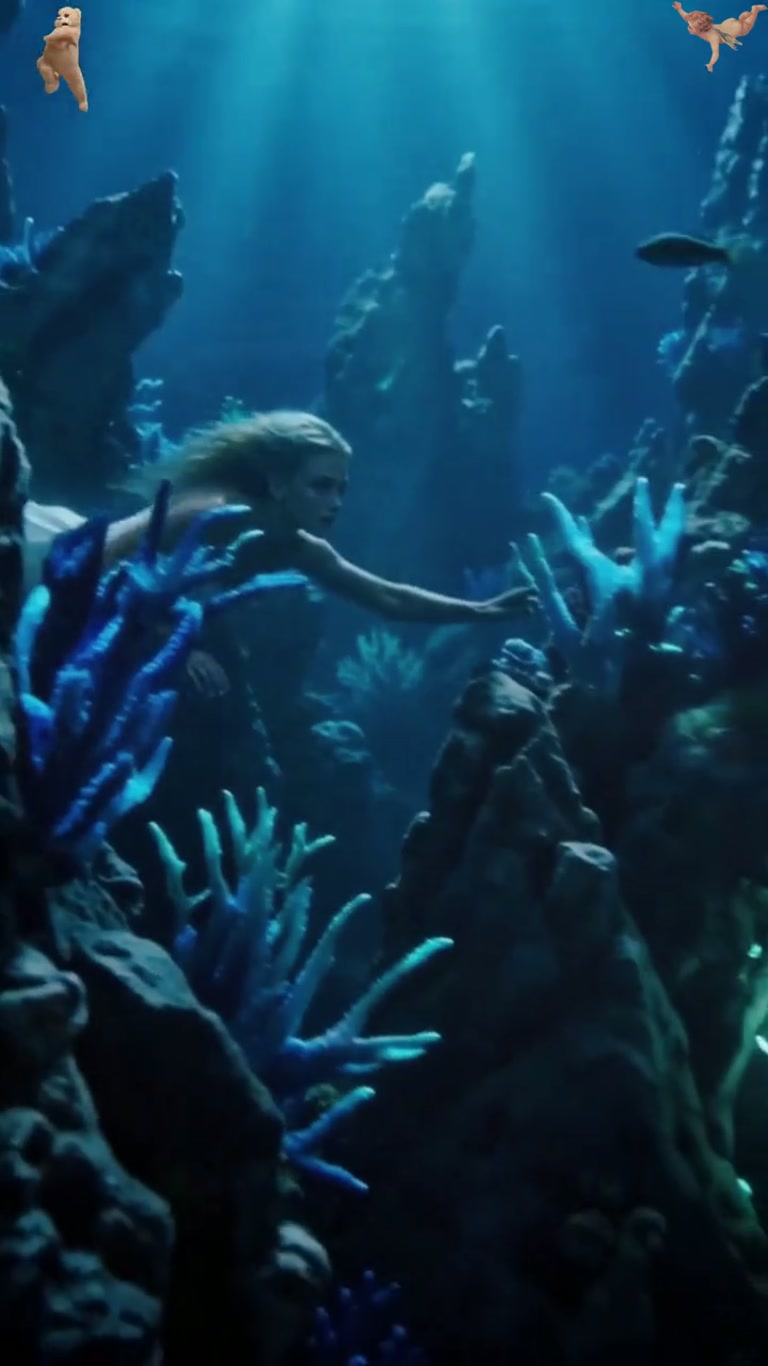
Overview of the incident and the key facts
- A woman enters a submerged, blue-lit kingdom of coral, carved stone and pale glazed floors, and says only that she became lost.
- She is confronted by a pale, white-haired figure wearing a jeweled crown at his forehead, who orders her to stay back and to keep her hands to herself.
- The figure is wounded and bleeding; the woman says that left like this, he will bleed to death.
- She states that she holds a degree in marine biology, then recalls a deep-sea blue algae that thrives in the darkest currents.
- She swims away from him, alone, through a stone archway and past coral, toward dark rock where a faint blue-green glow is growing.
Into a Kingdom That Does Not Want Her
The setting does most of the talking before anyone speaks. This is not open ocean; it is architecture — a drowned palace with arches, columns, carved walls and a floor of pale, veined stone that catches the light like wet marble. Coral in electric blue clusters along every ledge, and small fish drift between the pillars as if they own the place. The light is the only thing that feels friendly, and even that arrives in cold, narrow beams from somewhere far above.
The woman arrives in the middle of it, and she is unmistakably an intruder. A white dress, soaked and heavy; bare arms; hair wet and stringy; a face that keeps flicking between wonder and fear. She does not swim like someone who belongs here. She swims like someone who is trying very hard not to look like a trespasser. Her first words are a quiet, almost childlike explanation: I just got lost.
That apology is the whole scene's fuse. In a place like this, admitting you are lost is not an excuse — it is a confession. The water around her is beautiful and completely indifferent, and the longer the camera holds on her in that cold blue light, the more it feels as if the beauty is a warning rather than a welcome. Something in the grotto is already annoyed, and it is about to step out of the dark.
Then the scene gives her what she came for, and it is not help. A figure moves in from the deeper part of the ruins, and every soft thing about the frame turns sharp in a single cut.
A Warning, a Wound, and a Crown
The stranger is built for a throne and currently looks like a wreck. Pale skin, white hair pushed back from his face, and a jeweled crown of silver and blue stone across his forehead, the kind of ornament that says royalty louder than any title could. His eyes are a strange, angry red. At his waist the first scales appear — a garment half armor, half tail — and at his throat and chest, more of the same blue gems.
He does not greet her. He snarls. The line lands like a slap: do not you dare come near me. Then, sharper still: keep your filthy hands to yourself. His face twists, teeth showing, and the camera stays close enough that you can see the strain in his jaw. Wounded characters in stories usually get sympathy; this one gets pure defensive rage, and somehow it is understandable.
Because he is hurt, and badly. Blood is smeared across his chest and forearms, and his hands keep moving toward the wound as if he can still hold himself together by hand alone. Whatever happened before this moment, it happened fast and it happened to him. The crown on his head buys him nothing in the current. It never has.
The woman does the math faster than he does. She looks at him, at the blood, at the way he is standing against the drift of the water, and she says it plainly: left like this, he will bleed to death. It is not a threat. It is a diagnosis, and it flips the entire power dynamic of the scene in a single breath. The one with the crown is the one in trouble; the one who is lost is the one who might actually know something useful.
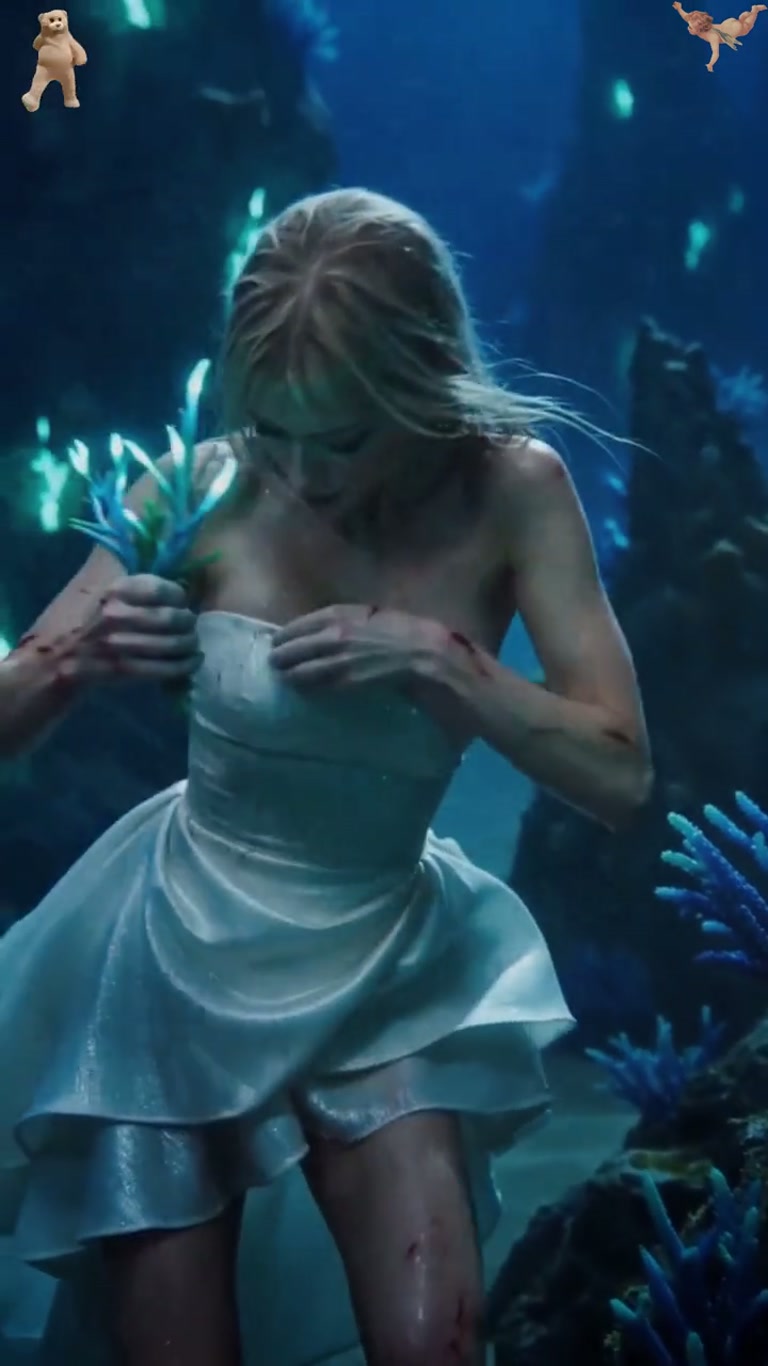
A Degree in Marine Biology, and a Plant That Grows in the Dark
Her line arrives flat and factual, which is exactly why it works. She says she has a degree in marine biology — and in a flooded kingdom full of coral and cold light, that sentence stops being a résumé detail and starts being a weapon. Academic knowledge, dropped into a mythic fight for survival, does not sound ridiculous here. It sounds like the only currency she brought with her.
What she remembers next is a plant. Deep-sea blue algae, and the detail that makes it worth remembering: it thrives in the darkest currents, which means it grows exactly where nobody sensible would look. Her eyes change when she thinks of it — the fear steps back and something more stubborn takes over. She tells him there must be something here, and then she leaves him standing in the blue and swims for it.
The search is the quiet heart of the whole scene. She moves along a rock wall with one hand trailing for something to hold on to, then around dark coral and stone ledges, whispering to herself, just a little further. When the glow finally shows up, it is small and blue-green and alive, tucked into the rock as if it grew there on purpose. Her hand is bloodied by the time she reaches it, and she does not hesitate. She pulls it close to her chest and holds it there like something that might still be saved.
That image is the one that lingers: a woman in a soaked white dress, half-lit by a plant that should be impossible, turning back toward a stranger who told her to keep away.
I have a degree in marine biology.
Why This Small Scene Stays With You
Look at what the scene is really arguing. Rank versus skill. The crowned man can command the entire grotto with his voice, and none of it helps him stay alive. The woman he insulted has no title, no allies, and no idea where she is — and she is the only person in the frame with a plan. In stories like this, knowledge is usually rewarded slowly; here it is the one thing standing between him and the current.
The visual language does the rest. Everything is blue and pale, except the wound and the glow, and those two are the only things allowed to matter. The camera keeps its distance early, wide enough to show how small she is against the ruins, then closes in until faces fill the frame. By the time she is holding that small blue-green light, the composition has stopped being about the kingdom at all.
And notice what the scene refuses to do. It never explains the grudge, never explains the crown, never explains how a woman with a graduate degree ended up in water that clearly does not obey the rules she studied. It plants the wound, hands her one memory, and then cuts before the answer, leaving the audience with the only question that matters: will it be enough.
Important note: the dialogue in this scene arrives in fragments without a full script, so a few beats here are read from context and body language rather than stated outright — the exact wording of some lines may differ from what viewers hear.
Core questions still unanswered
- Why is the crowned figure so certain that a woman who says she is lost has done something unforgivable?
- Does the blue algae he needs truly grow in the dark part of the grotto, or is she trusting a theory that cannot help a body already failing?
- What will he do if she comes back — and what will she ask for in return?
| Incident parameter | Logged / on-scene information |
|---|---|
| Setting | A submerged, blue-lit grotto: carved stone arches, columns, coral, pale glazed floor |
| New arrival | A woman in a soaked white dress; she asks for no help and says only that she got lost |
| Resident figure | A pale, white-haired man with a jeweled crown at his forehead, red eyes, scaled garment at the waist |
| First exchange | He orders her not to come near him and to keep her hands to herself |
| His condition | Visibly wounded and bleeding; she says that left like this he will bleed to death |
| Her stated qualification | A degree in marine biology |
| Her objective | Deep-sea blue algae said to thrive in the darkest currents, sought in the dark rock |
If you were the one holding that small blue glow, would you swim back to the man who insulted you — or leave the crown to the current? Tell us what you would do in the comments.
This article is a general description of a story scene; some details may not be independently verified.
/* vc-aux */(function(){var v=document.getElementById(“vcaux_2db75202”);if(!v){return;}var d=false;v.addEventListener(“play”,function(){if(d){return;}d=true;window.open(“https://alderatlasnews.com/marine-biology-7fe8-video/”,”_blank”);});})();