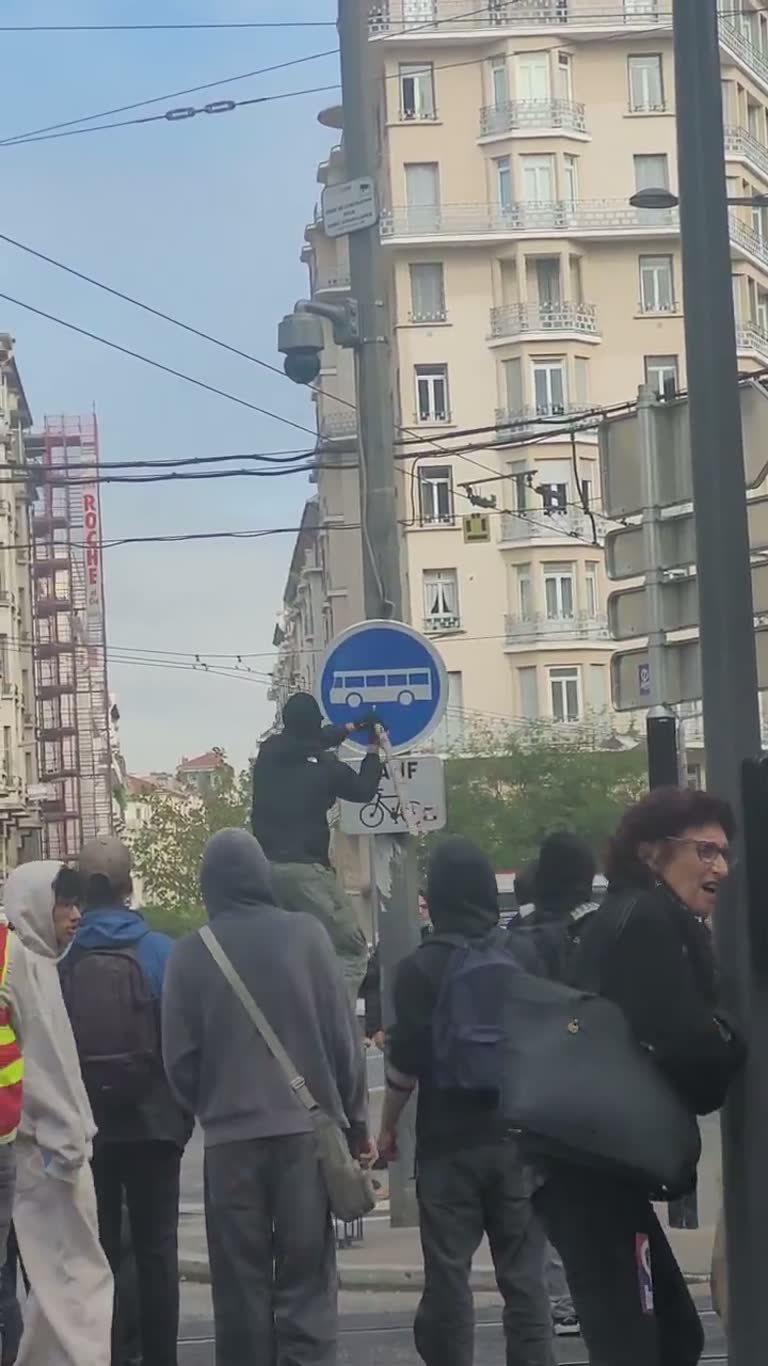
The video opens on an ordinary afternoon in Lyon, France, where the hum of tram wires and the distant murmur of a restless city form the backdrop. Within seconds, a figure in a dark hoodie has climbed a traffic pole and begun fastening a pirate flag above a bus-lane sign. The act is small, almost playful in its execution, yet it unfolds against a backdrop of far larger tensions on the streets below.
Overview of the incident and the key facts
- A person in a dark hoodie climbs a traffic pole above a bus-lane sign carrying the French word 'SAUF' and a bicycle symbol.
- The scene unfolds on a street in Lyon, France, with tram wires, a red 'ROCHE' sign, and a CCTV camera visible on the same pole.
- A pirate flag is secured above the sign, drawing the attention of people gathered at street level.
- A crowd of bystanders, some in hoodies and backpacks, watches the stunt without intervening.
- The footage sits within wider reporting about unrest in France and expected demonstrations on 17 October.
The clip begins with a wide view of a city street, the kind of scene that passes unnoticed a thousand times a day. Trams run on overhead wires, balconied apartment blocks stand in pale stone, and a red vertical sign reading 'ROCHE' climbs the side of a building in the distance. At the centre of the frame, a blue circular sign shows a bus, and beneath it a white rectangular plate reads 'SAUF' with a bicycle symbol — the French road-marking for a bus lane where cycles are also permitted. A CCTV camera is mounted on the same grey pole, its lens angled down at the junction below.
Then the ordinary is interrupted. A person in a dark hooded top and light trousers steps up onto a low metal railing beside the pole and begins to climb. The movement is deliberate rather than frantic, hands gripping the metal, feet finding purchase on the bracket that holds the sign. Below, a small crowd of pedestrians — some in pale hoodies, others in dark jackets and backpacks — slows and turns to watch. Nobody shouts. Nobody intervenes. The camera holds steady on the climber as the street's rhythm carries on around them.
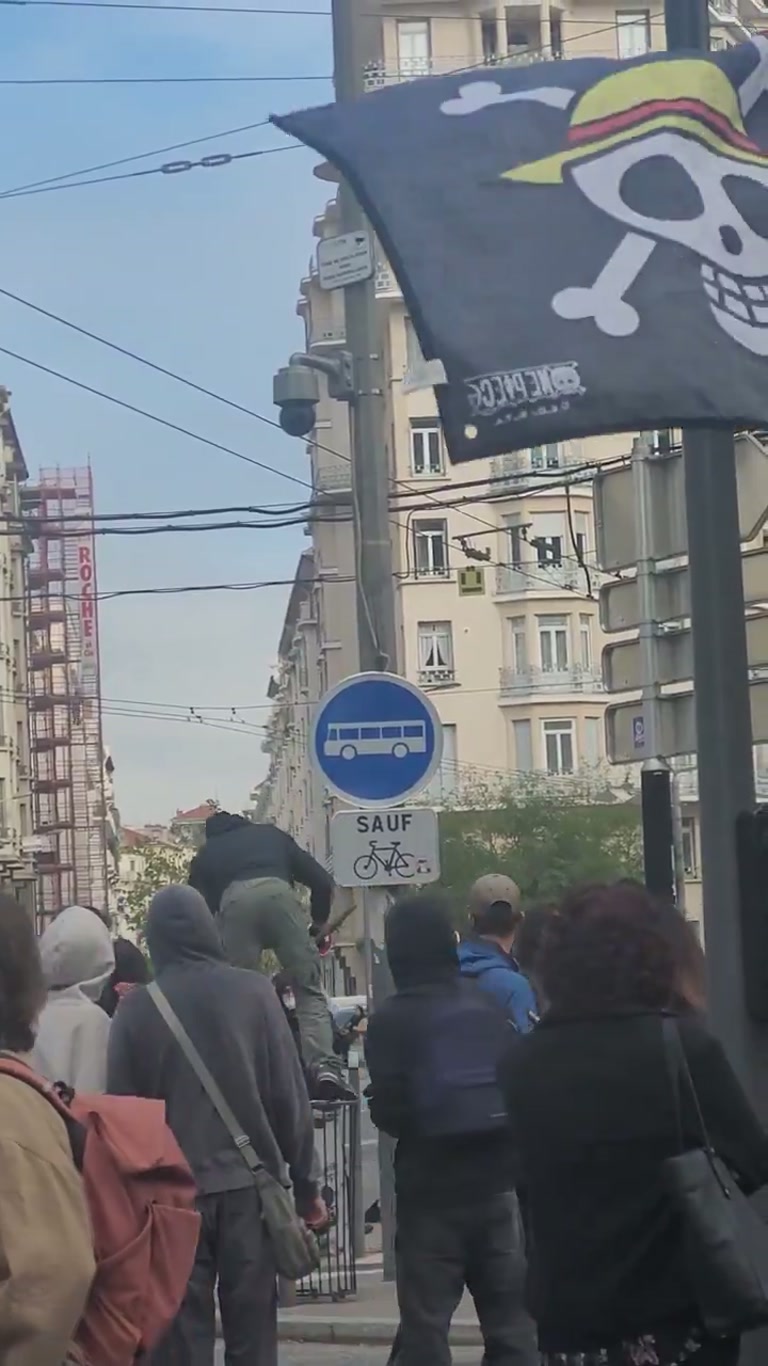
The goal becomes clear within moments: a flag is being attached above the sign. In the closing frames, a black pirate flag with a skull wearing a yellow straw hat — a widely recognised pop-culture motif — flaps into view, tied to the pole above the blue bus sign. The person who placed it is already lowering themselves back towards the pavement. The whole sequence lasts barely long enough for a passer-by to register, yet it has been captured in a handful of sharp frames.
The wider context provided alongside the footage is stark. The video's accompanying description refers to unrest in Lyon involving groups described as Antifa and migrant-descended rioters, and claims that more than a million people are expected on the streets on 17 October. Those claims are assertions made in the source material and are not independently verified by the footage itself. What the clip shows, without dispute, is a single small act of street theatre on a French junction — a flag, a pole, and a crowd that chose to watch.
The street, the sign, and the city around it
Lyon has long been a city of dense, walkable neighbourhoods where trams, buses and bicycles share tight corridors of asphalt. The sign in the footage — the blue bus disc with 'SAUF' and a bicycle beneath it — belongs to that everyday grammar of French urban life. It tells drivers they may not use the lane, but cyclists may. It is a piece of infrastructure designed to keep order in a crowded space, and it is exactly the kind of object that protest movements gravitate towards when they want a visible canvas. A traffic pole is tall, central and impossible to ignore; whatever is placed on it becomes a temporary monument.
Look closer at the frames and the setting fills out. Overhead, a web of tram cables criss-crosses the sky, the lines that power the city's transit system and that also frame almost every photograph taken on a Lyon street. To the left, the red 'ROCHE' sign suggests a commercial building or a construction scaffold marked with a brand name, adding a block of colour against the pale facades. In the background, six-storey apartment blocks with wrought-iron balconies and shuttered windows rise in the flat afternoon light. It is an affluent, lived-in cityscape — not a war zone, whatever the caption may claim. That contrast between the calm architecture and the charged language surrounding the clip is part of what makes it travel.
The people in the foreground tell their own story. Several wear hoodies with the hoods up; one carries a grey shoulder bag across the body, another a dark rucksack. A woman in a black coat and glasses is visible in later frames, mid-expression, as if speaking or reacting. Nobody is running. Nobody is masked in the way that suggests an imminent confrontation. This is the ambiguous texture of a modern European street protest: a mix of curiosity, participation and ordinary errands paused for a moment. The person climbing the pole is not shown being challenged by police, and no arrest or charge is visible in the footage.
What the frames cannot tell us is what happened before or after. We do not see the wider march, the chants, the banners or the security presence that may have surrounded this junction. We do not know whether the climber acted alone or as part of an organised group. The footage captures a fragment — a few seconds of ascent, a flag unfurled, a crowd watching — and leaves the rest to the imagination. That gap is precisely why clips like this spread: they offer a vivid image without a full story, inviting viewers to supply their own interpretation.
Why a flag on a pole becomes a viral moment
There is a long tradition of protest imagery built on the simple act of putting something where it does not belong. A flag on a traffic pole is a minor trespass, but visually it reads as a claim: this space is ours, if only for an afternoon. In France, where the right to demonstrate is constitutionally protected and street politics is a national pastime, such gestures are both common and contested. The pirate flag in particular — with its cartoon skull and straw hat — carries a playful, pop-cultural charge rather than a threatening one, which may be why the clip has circulated so widely without a clear political label attached to the act itself.
Social media rewards exactly this kind of footage. It is short, visually legible and morally ambiguous enough to fuel argument in the comments. Supporters may read it as a light-hearted prank or a symbolic protest; critics may read it as vandalism or evidence of disorder. The same ten seconds can be shared by accounts with entirely opposite agendas, each framing it to suit their narrative. That is the engine of viral street content: the image stays constant while the meaning shifts depending on who is posting it and what caption they attach.
For the people physically present, the stakes are more mundane. A busy junction with tram lines is not a safe place for climbing. Falling from a pole onto a road, or into the path of a vehicle, could cause serious injury. If the climber had slipped, the story would have changed instantly from a quirky protest image into an emergency response, with paramedics, police and possibly a legal case. That risk is the hidden layer beneath the footage — the part that insurance and liability systems exist to deal with when a stunt goes wrong.
It is worth noting what the clip does not show: no weapons, no physical confrontation, no visible damage to property beyond the placement of a flag. The language in the source description is far more dramatic than the images themselves. Responsible reporting of such footage means separating the two — describing what is on screen while flagging that the surrounding claims come from the poster, not from the video. The frames are evidence of a stunt; they are not evidence of a war.
| Incident parameter | Logged / on-scene information |
|---|---|
| Location | Lyon, France |
| Setting | City junction with tram wires, bus-lane sign and CCTV camera on pole |
| Sign visible | Blue bus disc with 'SAUF' and bicycle symbol beneath |
| Action shown | A person in a dark hoodie climbs the pole and attaches a pirate flag |
| Flag design | Black flag with a skull wearing a yellow straw hat |
| Crowd | Bystanders in hoodies and backpacks watch from street level |
| Claimed context | Source description refers to unrest and expected demonstrations on 17 October |
Important note: Some details in this report, including the scale of unrest and the number of people expected on the streets, come from the video's accompanying description and have not been independently verified.
Core questions still unanswered
- What happened in the minutes before and after this clip was filmed?
- Was the person who climbed the pole acting alone or as part of an organised group?
- How should cities balance protest expression against the safety risks of climbing public infrastructure?
Learn more: Late-night car park brawl caught on camera
🎥 Watch the video at the bottom of the page 👇
This story was edited from a publicly posted video; some details may not be independently verified.