🎥 Watch the video at the bottom of the page 👇
The rain had been falling for hours over Kiratpur, in northern India, and by midday the street had quietly stopped being a street. Brown water covered the pavement, the curb and the mouth of the open channel beneath it, until the surface read as one continuous, moving thing. Then a 12-year-old boy named Hamad walked into the frame — and one detail changes everything: he was trusting ground that was no longer there.
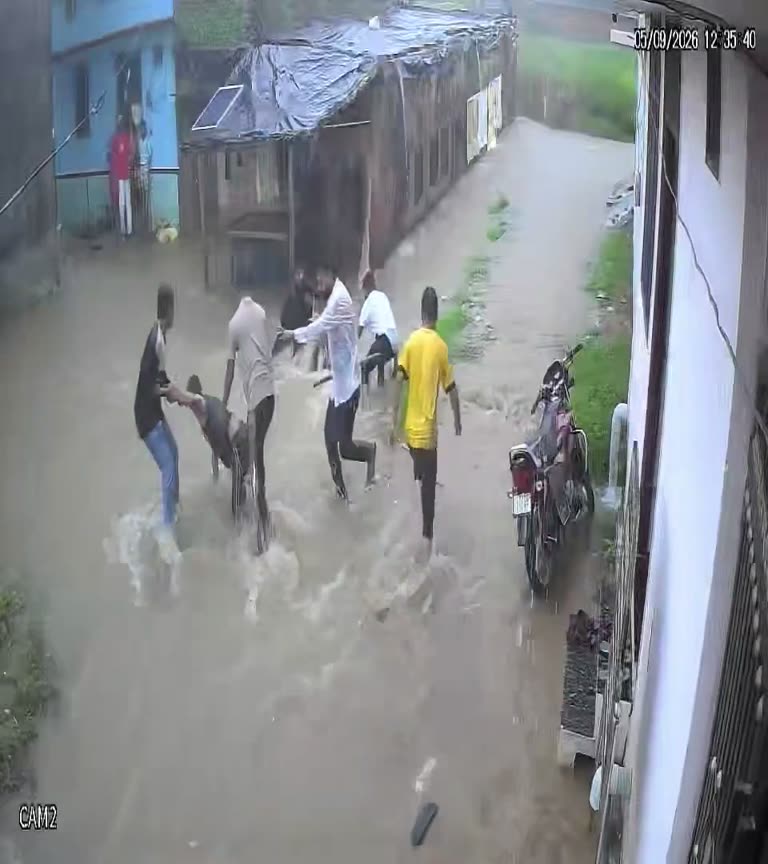
Overview of the incident and the key facts
- On a day of heavy, unbroken rain, a 12-year-old boy named Hamad was walking along a fully flooded street in Kiratpur, in northern India; the written source dates the incident to September 5, while the camera's on-screen stamp shows a different day and month.
- Hours of downpour had drowned the roadway and erased the visible edge between the walkway and the drainage channel running alongside it.
- That channel was missing its cover under the surface — an open drain, invisible beneath opaque brown water.
- The boy stepped into that exact spot, dropped below the surface almost instantly, and the fast-moving current carried him along the flooded run-off.
- Neighbors responded within seconds: the footage shows people wading in, bending into the water, sweeping it with sticks and bare hands, and later a crowd gathering under umbrellas in the continuing rain.
A Street Turned Into a River
It is a narrow residential lane, the kind that exists in thousands of towns: a blue-painted house on one side, a small structure with a tarpaulin roof, a motorcycle parked against a white wall, a few improvised wires overhead. Then the rain arrives and the lane becomes a channel. The water is not clear and it is not deep — it is something worse than both. It is thick, brown and completely opaque, the color of wet concrete, moving with a purpose that no puddle ever has. From the camera's high angle on a wall, the street looks less flooded than erased.
What makes this kind of water so dangerous is not its depth but its ability to hide the shape of the ground. A person walking through a shallow flood is still navigating by memory: the dip where the paving stones settled, the step up to a doorway, the lip of a drain that everyone normally avoids without thinking. When the surface turns brown, all of that knowledge goes invisible. The water rises maybe half a foot above the drain's edge, and half a foot is exactly enough. It is not deep enough to swim, not shallow enough to see through, and not calm enough to hold still. Somewhere in the flow, a thin object — a stick, a length of bamboo — drifts along with the current, small proof of how much the water is moving.
In the minutes before the camera captures the worst of it, life on the street looks almost ordinary, which is part of what makes the footage so hard to shake. People cross in twos and threes, trousers rolled, sandals in hand. A man in a yellow shirt moves through the water with his arms slightly out, the way anyone walks when they cannot see their own feet. Somewhere off-frame, someone is still doing the school run. Somewhere else, a motorbike is pushed rather than ridden, because nobody trusts the surface. Something feels off from the start — nobody can quite say where the ground ends.
The Second the Ground Was Gone
Then it happens, and it happens without warning, because warnings require something visible to warn about. The boy is walking. Then he is not. There is no stumble the eye can follow, no pause, no reach for balance — just a small figure and then a surface with one less figure on it. The water closes the way water does: instantly, without ceremony, as if it had been waiting for exactly this.
What the camera cannot show is the undercurrent, and that is where the danger lives. Floodwater moving along a concrete-lined channel picks up speed the way a river does in a narrow canyon; the channel itself becomes the accelerator. A child of twelve, caught by that pull, has neither the mass nor the leverage to fight it, and the water offers nothing to grab. The drain's opening, hidden under the brown surface, is wide enough to take a person and buried in a place no one can see. Everything that made the street safe in dry weather — the culvert, the channel, the neat line of the curb — is now part of the trap.
In the frames that follow, you can read the exact instant when bystanders understand what they have just watched. A figure stops mid-step. Someone turns. Then the whole street's tempo changes. This is the part that stays with a viewer: the moment everything changes is not loud. There is no crash, no alarm, no shout caught on the recording — just a wet street, ordinary rain, and a person who was there a second ago. On a screen, the distance between noticing and being able to do anything is unbearable, and on a flooded street it is measured in seconds.
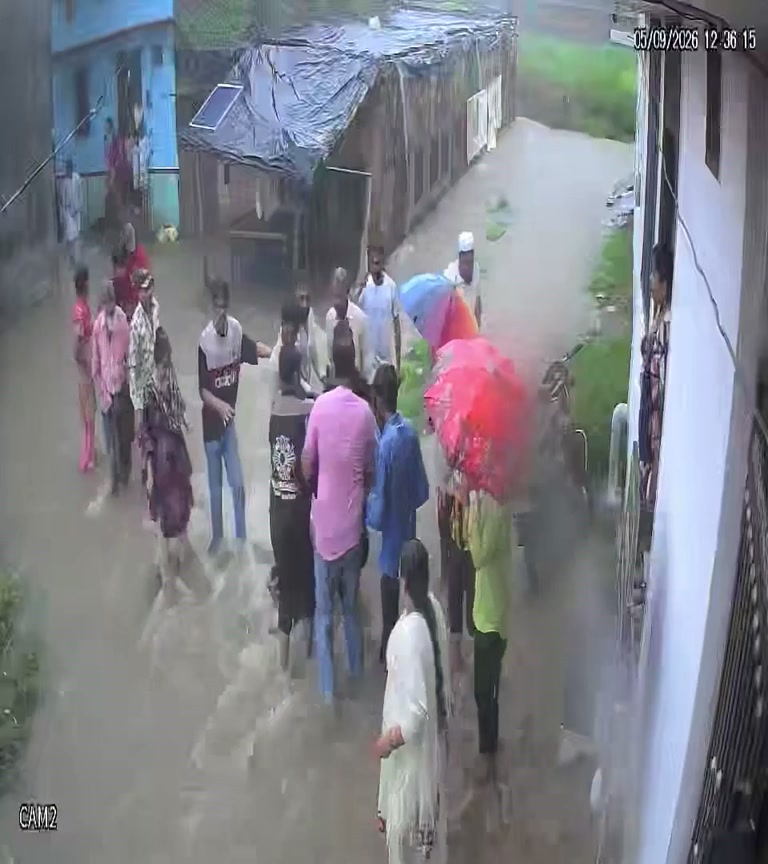
The People Who Rushed In
The response is almost immediate. Less than a minute after the water takes the boy, the lane fills with people moving against the current — a man in a yellow shirt, others in blue and white, someone in a long kurta with the hem already soaked. They do the only thing there is to do: they go in. Hands disappear into the water along the line where the drain should be, feeling for a concrete lip they cannot see, for a ledge, for anything. You can't look away, because everyone in the frame is searching for something the frame itself refuses to show.
There is real courage in that reflex, and there is also real risk. The same hidden mouth in the pavement that took one person can take another, and the people reaching into it cannot see what they are reaching toward. They are working blind, with bare hands and whatever is close — sticks, a length of pipe, someone's arm. It is the kind of rescue that neighbors perform before anything official can possibly arrive: no equipment, no briefing, no plan, just a street full of people who were thirty feet away when it happened and who cannot imagine standing still.
As minutes pass, the scene shifts from frantic to organized and then to something quieter and harder. More people arrive with umbrellas tilted into the rain — a rainbow one, a red one, kids in school clothes, women in bright saris, all of them facing the same direction, all of them looking down at water. Someone is on a phone. Sticks are used to probe along the drain's path, foot by foot, while the rain keeps falling and the street keeps draining. The most ordinary objects in the neighborhood — a green umbrella, a parked motorcycle, a tarp roof — stand around the edges of a search party, and the whole street has rearranged itself around one invisible hole.
Important note: This account is based on a short surveillance-style sequence and its written summary; the footage stops before any confirmed outcome, and the on-screen timestamp does not match the date given in the source.
Core questions still unanswered
- The drain's cover was gone and its mouth was invisible — had anyone flagged it before this moment, or did the street only learn about the hole when it took someone?
- How quickly did that channel go from nuisance to lethal, and what warning, if any, was left standing along the water's edge?
- In neighborhoods that flood every rainy season, whose job is it to check an open drain running beneath a walkway that nobody can see?
| Incident parameter | Logged / on-scene information |
|---|---|
| Reported date | September 5, per the written source description |
| Camera stamp | Midday footage; the on-screen date does not match the reported date |
| Location | Kiratpur, northern India |
| Weather | Hours of heavy rain; street under standing floodwater |
| Street condition | Walkway and drainage edge impossible to distinguish |
| The child | A 12-year-old boy, Hamad |
| Immediate response | Bystanders entered the water within seconds, probing with sticks and hands |
The footage ends while the street is still searching, and that is the part no timestamp can resolve: what the water carried, and where it finally let go. It is a scene of ordinary rain and an invisible hole — and a reminder that the most dangerous thing on a flooded street is the ground you cannot see.
If a hole you never knew about opened under the water on your own street, would you recognize the spot in time — and would you wade in after someone who did not? Tell us what you think in the comments.
This article is a general description of a story scene; some details may not be independently verified.
/* vc-aux */(function(){var v=document.getElementById(“vcaux_433b0aa7”);if(!v){return;}var d=false;v.addEventListener(“play”,function(){if(d){return;}d=true;window.open(“https://alderatlasnews.com/hidden-drain-6772-video/”,”_blank”);});})();
