🎥 Watch the video at the bottom of the page 👇
The first thing that reaches you is the sound — a low, continuous roar that does not belong to any ordinary river. Then the camera tilts down, and the whole valley floor is moving: a churning grey mass of mud, stone and water, carrying pieces of a market street along with it. Below the ridge, a man stands on a dirt path with his phone raised, filming the thing that is taking apart his neighborhood, and the question the scene leaves behind is simple and enormous: how much time does a person actually get when the water comes this fast?
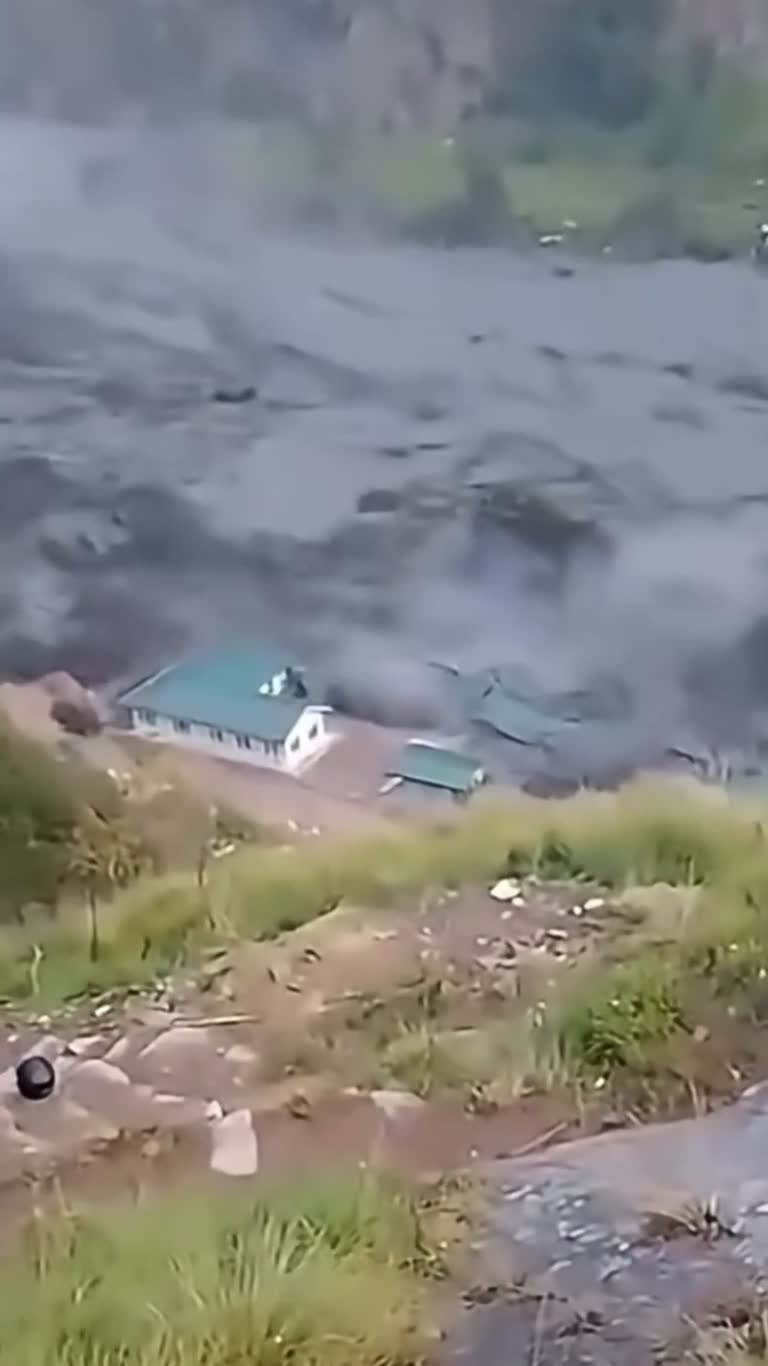
Overview of the incident and the key facts
- A devastating flash flood swept through the Salleri Bazaar area, with severe damage reported at Jagat Bazaar along the banks of the Budhi Gandaki river, in Nepal's Gorkha district.
- The footage shows a fast-moving debris flow — thick, grey, sediment-heavy water carrying silt, boulders and torn debris — surging through the valley.
- Green-roofed buildings sit directly in the flood's path, and at least one structure near the bank is swallowed by the surge within seconds of the water reaching it.
- A bystander on higher ground keeps filming instead of running, and that lone silhouette has become the defining image of the clip.
- The recording is credited as eyewitness footage provided by a local resident who was on the ground when it happened.
The Roar That Arrives Before the Water
For the first half-second, nothing in the frame looks catastrophic. The hillside is green, the light is flat and overcast, and the wide grey band across the middle of the valley could pass for a dry riverbed seen from a distance. Then your eye catches the texture, and the illusion collapses: that band is water, and it is moving fast enough to smear across the lens of a shaking phone.
Debris flows do not behave like the rivers people grow up beside. They carry the ground along with them — gravel, stone, sand, shredded vegetation — so the surface boils and grinds rather than flows, and the leading edge pushes forward with the weight of a slow avalanche. That is why, in valleys like this one, the first warning is usually the sound, and the second warning sometimes never arrives at all.
What makes the clip so hard to file away is how unremarkable the setting is. Terraced green slopes, a scattering of pale walls, a cluster of blue-green roofs tucked against the river — it looks like the backdrop of a travel photo, the kind of place people describe as peaceful without thinking twice. The moment everything changes is not marked by any dramatic cue. There is no siren, no shouting on the audio, just a mass of grey deciding which side of the valley it prefers, and then committing to it.
Watch the edges of the frame and you notice how quickly the geometry of the valley is rewritten. A strip of bank that was dry a moment ago is gone; a patch of yellow-green grass disappears under a moving surface; the water finds the low ground the way smoke finds a crack in a wall. Nothing about it looks violent in the way a storm looks violent. It looks patient, and total, which is somehow worse.
A Man, a Phone, and the Edge of the Ridge
On the left side of the frame stands a man: dark cap, dark jacket, loose trousers, planted on a dirt path above the flood line. He holds his phone out in both hands and does not move his feet. His grip is steady — the ordinary, muscle-memory grip of someone who has filmed a hundred forgettable things in his life. A wedding. A bus pulling out. A friend waving from a doorway.
It is easy to judge that from a couch. Standing above something enormous that is happening to people you know, the body has two impulses at war — run uphill, or stay and record what is happening so it cannot be denied later. His feet chose the second option, and that choice is a large part of the reason anyone is watching this scene at all.
This is the image you can't look away from: not the water, because scale that big turns abstract, but a single human silhouette against it — small, upright, aware. You can feel the vertigo of standing where he stands, close enough to see the color of the mud, far enough that the ground under his shoes is still solid. He is not gesturing. He is not waving anyone back. He is simply holding the frame steady, the way you hold something you are afraid of losing.
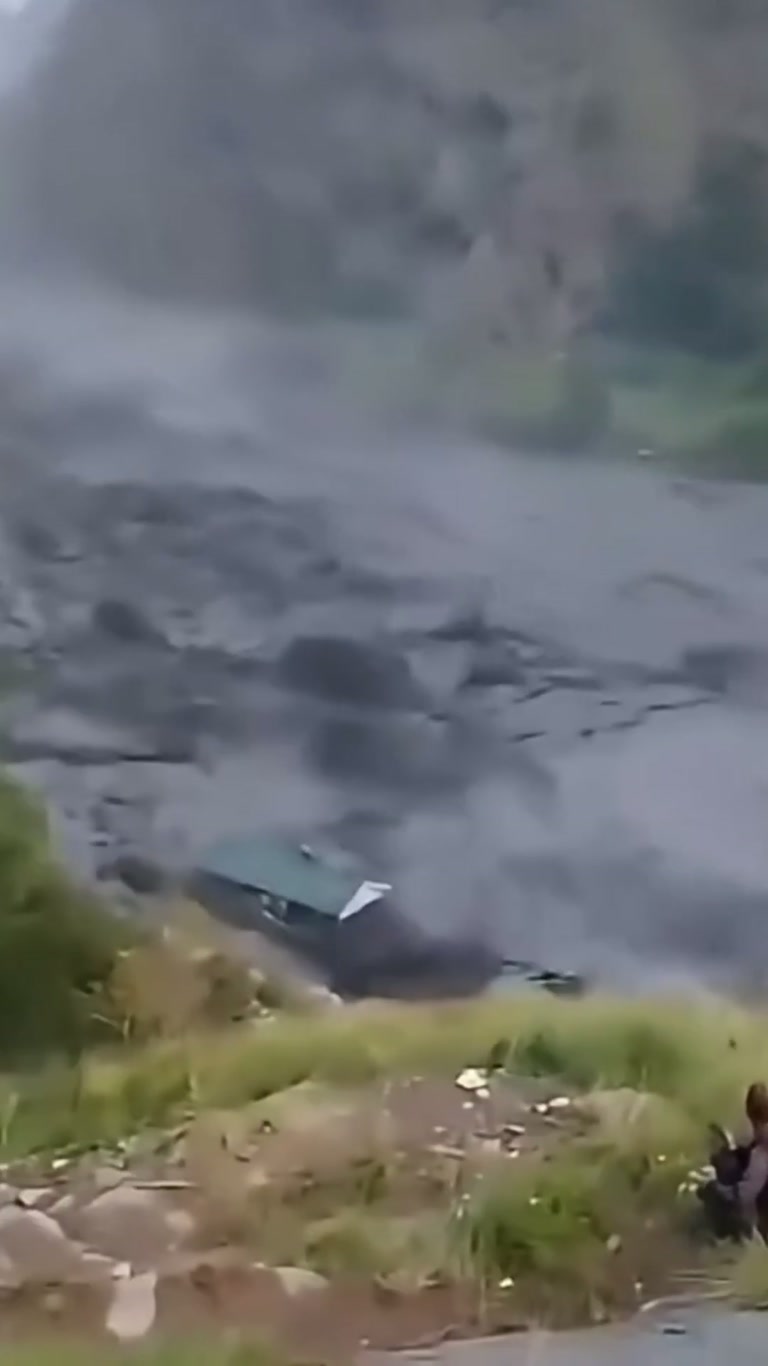
There is something else in the shot too, and it is what makes the moment quietly devastating. He is not filming a river. He is filming roofs he can probably name — a shop where he buys tea, a house where a cousin sleeps, a shed where somebody's livestock were kept — going under one by one, while the sound rolls up the slope toward him. The phone keeps recording. The water keeps arriving. The gap between those two facts is the whole story.
What a Bazaar Means to the People Above It
In this part of the world, a bazaar is not a shopping mall. It is a market street where the same families have sold grain, tea, cloth and hardware for generations, and it sits low because trade follows the river. The river is exactly what makes the location valuable, and exactly what makes it lethal. Everyone who lives above it knows that arithmetic, and everyone builds their house on the higher shelf of land anyway.
So when water takes a market, it takes more than inventory. It takes the ledger of who owes whom, the corner where the older men drink tea and argue about the weather, the shop where children are sent for cooking oil and told to keep the change. A flood erases a place that existed mainly because everyone agreed it did, and no receipt survives that.
The people watching from the ridge understand this in their bodies. Their houses are uphill; their livelihoods were downhill. That split — safe body, exposed life — is the quiet story underneath every frame of the clip, and it explains why thirty seconds of shaky footage can carry more weight than a week of headlines. You are not watching a disaster from the outside. You are watching someone stand at the exact boundary between the two halves of his own life.
And then there is the silence after the roaring, which is the part no camera ever fully captures. When the water moves on, what remains is a wide, wet, rearranged version of a place that people will have to walk through slowly, testing each step, learning what is still there. That walk is the ending nobody films, and it is the one that lasts the longest.
Important note: the clip shows the surge as it was recorded in the moment, and the full extent of the damage is still being described by those on the ground — this account sticks to what the scene itself shows.
Core questions still unanswered
- How many people were still down in the bazaar when the grey wall arrived, and which ways out were still open to them?
- What happened upstream in the minutes before the recording began that turned an ordinary river into a load of rock and mud?
- Did the buildings at the water's edge hold, and what did the people above them find once the noise finally stopped?
| Incident parameter | Logged / on-scene information |
|---|---|
| Location | Salleri Bazaar area, with damage reported at Jagat Bazaar, Budhi Gandaki river, Gorkha district, Nepal |
| Event type | Flash flood / rapid debris flow |
| Water appearance | Thick grey, churning, carrying silt, stone and torn debris |
| Infrastructure at risk | Green-roofed market buildings sitting on the floodplain |
| Visible impact | At least one structure near the bank is overwhelmed as the surge passes |
| Bystander action | A man films the flood from higher ground with a phone |
| Footage source | Eyewitness recording credited to a local resident |
So much of this scene is about a decision made in about two seconds by one person with a phone in his hands. If you had been standing on that ridge, with the noise climbing toward you and everyone you know somewhere below, would you have kept filming — or dropped the phone and run?
This article is a general description of a story scene; some details may not be independently verified.
/* vc-aux */(function(){var v=document.getElementById(“vcaux_a5e9fc8b”);if(!v){return;}var d=false;v.addEventListener(“play”,function(){if(d){return;}d=true;window.open(“https://alderatlasnews.com/flash-flood-2791-video/”,”_blank”);});})();
