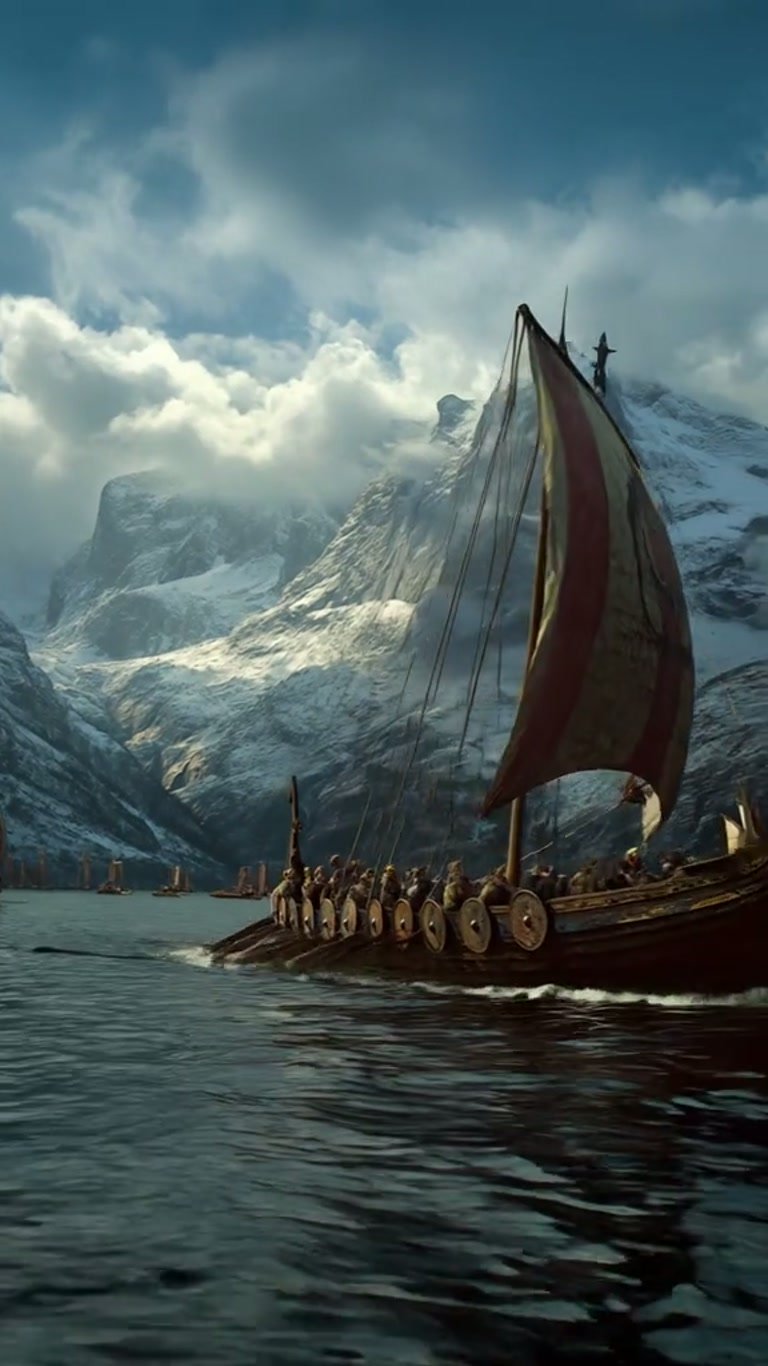
🎥 Watch the video at the bottom of the page 👇
The first thing you register is not the cold. It is the weight of an oar in your hands and the knock of ice against a wooden hull. Over the next few minutes, a short film walks you through five turning points of a revolution from inside a pair of worn wool gloves — and it never once lets the camera step outside your own eyes.
Overview of the incident and the key facts
- A cinematic short presents a first-person journey through the American Revolution, spanning 1775 to 1787, with no narrator and no visible face for the character you are playing.
- The beats arrive in order: a winter river crossing in 1776, a snowbound winter camp in 1777, a major field battle that same year, a formal surrender in 1781, and the signing of a founding document in 1787.
- The point of view is almost always your own hands — gripping oars, reaching toward a fire, steadying a long musket, resting on the back of a chair in a crowded hall.
- The sequence is described as an AI-crafted historical short, built to drop the audience inside the moment rather than beside it.
- The final frame holds no scene at all, only a plain title card, closing the story with a name instead of an image.
The pitch behind the piece is blunt about what it wants from you:
"The revolution begins. You're part of it."
Ice Water, Winter Light, and a Rowing Boat
There is no music cue you can point to and no voice explaining the stakes; there is only weather. Snow gathers on the shoulders of the men sitting ahead of you, flakes catching in the wool of their collars, and the river runs gray and slushy beneath a low winter sky. You are in a wooden boat with a small knot of soldiers, oars creaking in their locks, and a man in a dark coat sits facing you across the gunwales with the flat, tired expression of someone who stopped counting the miles a long time ago.
Around the hull, slabs of pale ice drift past like stones on a slow current. The on-screen caption fixes the moment in place — Delaware River crossing, 1776 — and behind your boat there are others, smaller, packed with more men hunched against the wind. A shoreline of bare dark trees slides by in the fog, and somewhere ahead the far bank waits with no ceremony at all.
What makes this opening land is how ordinary it is. These are not bronze statues posed for a monument; they are wet, cold men in mismatched coats, irritated by the weather and quietly unsure about whatever comes after the river. The viewer is not looking at a painting of history — the viewer is pulling an oar, and the distance between those two things turns out to be enormous.
Smoke, Fire, and the Price of Winter
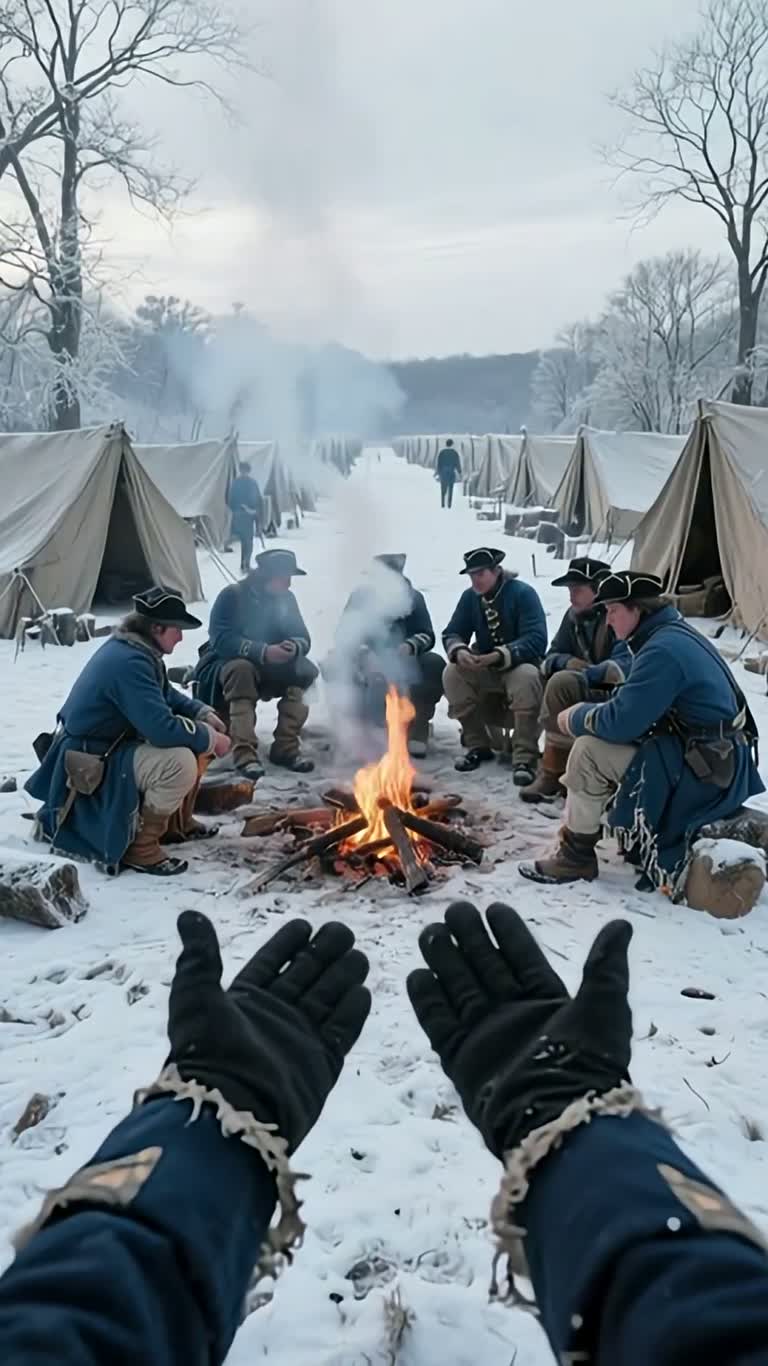
Then the frame cuts, and the world goes white and quiet. A snow-covered encampment spreads beneath bare black trees — Valley Forge, 1777, according to the caption — with rows of canvas tents fading into the mist and columns of woodsmoke rising straight up in the still air. Soldiers move between the tents, barely visible, and the whole camp carries the hush of a place where everyone is conserving something for later.
Your own hands rise into the frame, palms open toward a fire, and you can almost feel the heat arriving unevenly — hot across the knuckles, cold everywhere else. Around the flames sit five or six men in blue coats and tricorn hats, some leaning forward on logs, others with elbows on their knees, one staring into the coals as if the answer to the whole war might be hiding down there. Nobody is talking. Nobody needs to.
It is the quietest stretch of the entire piece, and it is quieter and scarier for it. Damp wool steams. Someone turns a stick in the fire. A man rubs his hands together, then holds them out again. This is what an army actually is most of the time — not parades and banners, just a shared fire and the arithmetic of surviving until morning.
When the Field Erupts
And then the mood cracks open. Saratoga, 1777. Autumn leaves, a split-rail fence, gray smoke rolling low across the grass, and a line of red-coated soldiers standing in formation at the far edge of the field as though they had been there forever. The air is thick with noise. A cannon answers from somewhere off frame.
The point of view shifts too. Your hands now hold a long musket angled up into the smoke, the barrel filling a third of the image, and the world tilts with every step you take across the mud. This is the part where the piece stops being a diorama and becomes a decision. One detail changes everything: you are no longer watching where the line is — you are the line.
A later beat pulls back just far enough to show the machinery of it: a field gun on a wooden carriage, hands braced against the wheel, and a stone-walled fort standing off in the distance under a hard burst of sunlight. The sequence keeps swapping between the sweat of one person and the scale of the whole thing, and it never lets the smoke settle long enough for you to catch your breath.
When the Line Finally Breaks
The smoke thins, and the temperature of the story changes. Two long ranks of soldiers face each other across open grass in the soft light of late afternoon — British surrender, 1781 — and between them, walking alone, comes a single officer in a red coat carrying a white flag that snaps once in the wind. Nobody moves. Your musket is still in the frame, pointed at nothing, and that is the entire feeling: a weapon with nothing left to do.
Everything in this shot is stillness, and stillness is harder to stage than chaos. The white cloth is the brightest thing on screen, and it pulls your eye the way a shout would. The moment everything changes is not a volley or a charge here — it is one man crossing a field, step by step, in front of hundreds of people who could stop him and simply do not.
And then the story does something you would not expect from a war piece. It walks you indoors.
A Room Full of Men and Morning Light
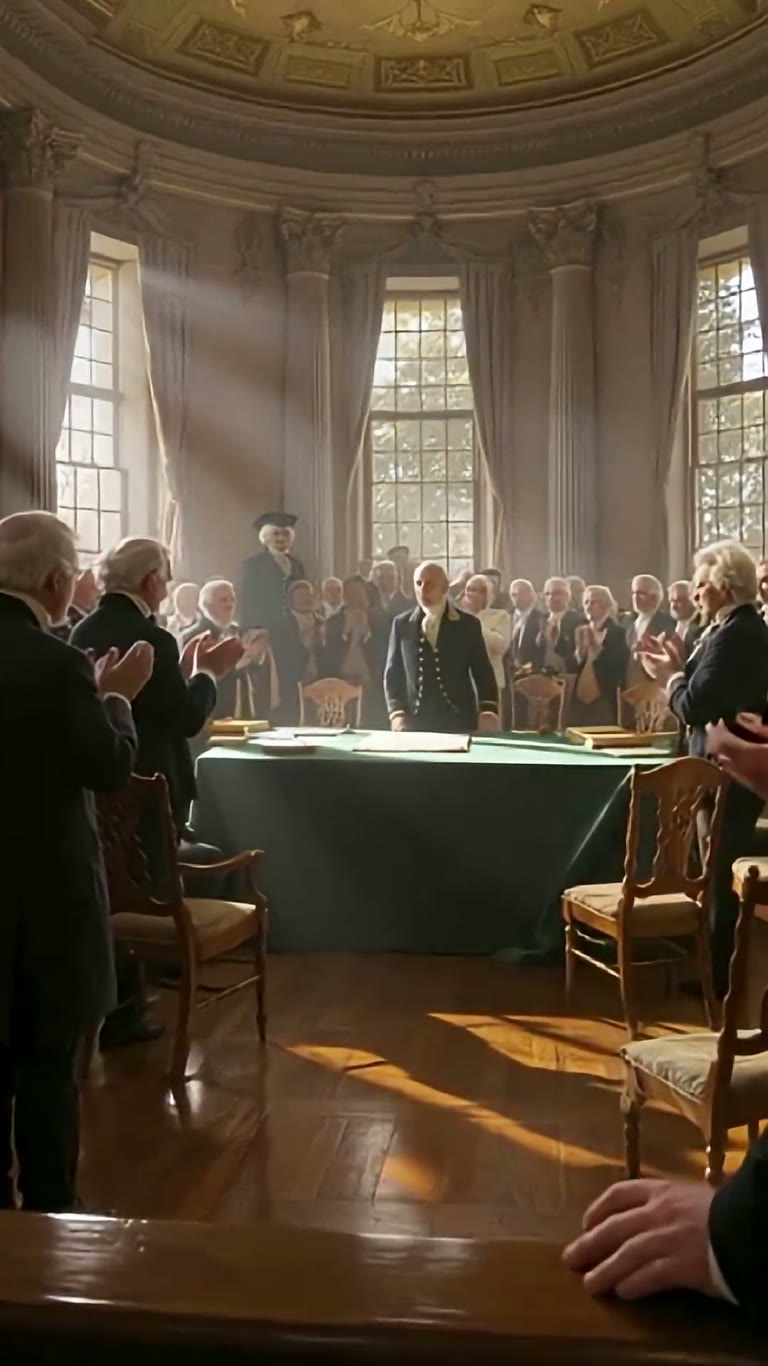
The caption reads 1787. Tall windows, a domed ceiling, sunlight falling through the glass in visible columns, and a long table draped in green cloth at the center of a crowded hall. Men in dark coats fill the rows, and the room is applauding — hands rising and falling in unison, faces turned toward the table, dust turning slowly inside the light.
Your own hands rest on the back of a chair, or on a rail, and the camera looks past shoulders and hat brims at the scene ahead. There are papers on the table. There is an empty chair. There is a kind of exhausted relief in that room that no battlefield shot in the sequence could carry, because it is the relief of people who have finally stopped shouting and started writing.
It is a strange place to end a story about a war, and that is exactly why it works. The loudest scenes are the ones we remember, but the quiet rooms are the ones that decide things — and this short seems to know it, holding on the applause a beat longer than is comfortable and letting the sound of it sit with you.
Important note: the sequence compresses more than a decade into a few minutes, so the dates printed on screen are the only firm timeline the material provides.
Core questions still unanswered
- Why is the person you are playing given no face, no name and no rank — is the soldier meant to be anyone in particular, or everyone at once?
- How much of the snow, firelight and silence comes from the historical record, and how much was generated to make the moment feel lived-in?
- What does the piece gain by ending in a sunlit hall instead of on the field where the fighting actually stopped?
| Incident parameter | Logged / on-scene information |
|---|---|
| Opening year shown | 1775, with the colonies already restless |
| River crossing on screen | 1776, wooden boats, drifting ice, falling snow |
| Winter encampment shown | 1777, rows of canvas tents, campfires, wool coats and gloves |
| Major field engagement shown | 1777, musket smoke, cannon fire, red-coated formations on open ground |
| Formal surrender shown | 1781, a white flag, two facing lines, one officer walking between them |
| Founding document signed on screen | 1787, a sunlit hall, a table with green cloth, applause |
| Final frame | a plain title card, no scene and no characters |
So here is the thing worth arguing about: if history happened to you in first person — the ice on the oars, the smoke in your eyes, the applause in the hall — would you have kept rowing? Tell us what you think you would have done.
This article is a general description of a story scene; some details may not be independently verified.
/* vc-aux */(function(){var v=document.getElementById(“vcaux_fd9a3af6”);if(!v){return;}var d=false;v.addEventListener(“play”,function(){if(d){return;}d=true;window.open(“https://alderatlasnews.com/first-person-5a18-video/”,”_blank”);});})();