🎥 Watch the video at the bottom of the page 👇
From a balcony above a Brussels crossroads, an ordinary street disappears behind a slow wall of white smoke. Below, a white water-cannon vehicle marked 28 creeps between police vans while the voices behind the camera work out, in real time, what is drifting toward them. The clip lasts less than a minute; the argument it started is still going.
Overview of the incident and the key facts
- Where: a crossroads in Brussels, Belgium, filmed from a balcony or window above street level.
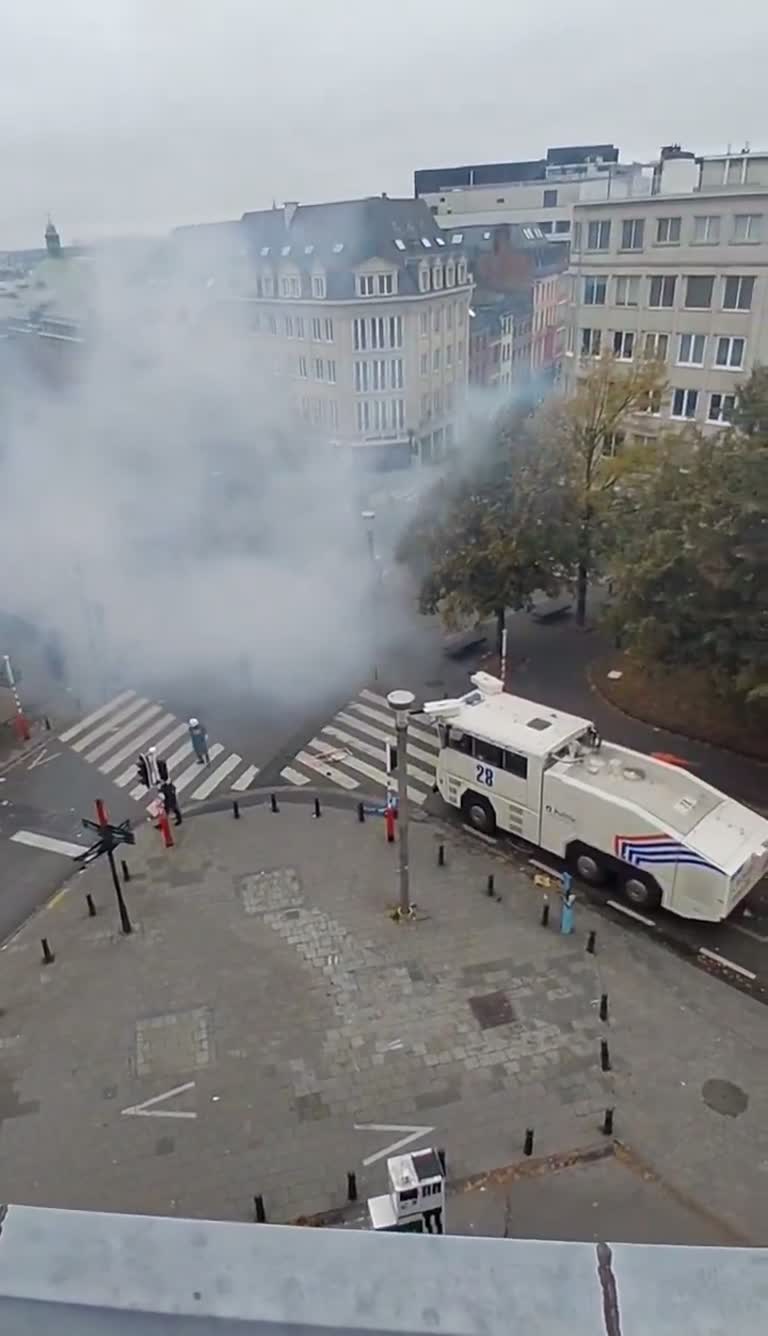
- What is visible: thick white smoke across the intersection, a white water-cannon vehicle marked 28 with blue and red stripes, white police vans, and officers in dark uniforms.
- What is heard: French-speaking voices identifying the smoke as tear gas and warning that it is about to reach them.
- What is claimed: the post sharing the clip says protests and unrest paralysed parts of the city, and attaches a political reading the footage itself does not show.
- What is missing: no official statement, and no confirmed figures for injuries, arrests or damage.
A quiet street, then a wall of white
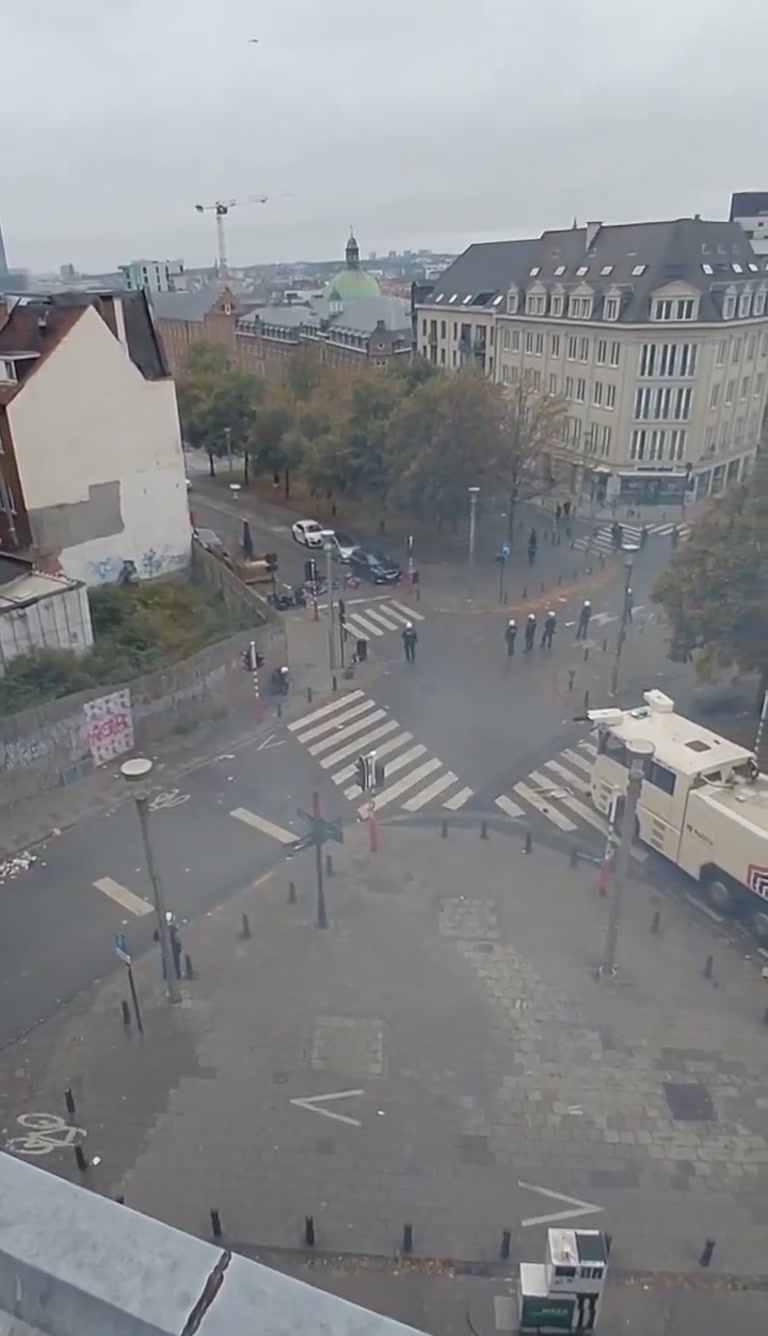
The setting could hardly look more ordinary. Pale stone facades frame a broad junction; one block across the way wears long horizontal bands of windows trimmed in pink and red; the trees along the curb still hold green and yellow leaves. The pavement is a patchwork of small stones and painted road markings, a zebra crossing on each side of the open square, a few bollards, a bench — the kind of city furniture nobody notices until a camera is pointed at it. A grey parapet cuts across the bottom of the frame, the ledge of the balcony the person filming is leaning over. That detail matters. This is a resident watching their own street, not a crew sent to cover it.
For a beat or two, nothing moves at all. Then the smoke arrives, and it does not billow upward like a house fire. It rolls: low, dense, patient, spilling between parked cars and erasing the far pavement, the markings and the trees one by one. The white mass thickens until the junction looks less like a street and more like a room with the walls removed. Someone in the flat spots a bicycle on the pavement below. A police van sits with its doors shut. The city looks as though it has been switched off mid-sentence.
At the centre of the frame is the machine doing the work: long, angular, painted white, marked with the number 28 and blue and red stripes along its flank, moving at walking pace. Around it, officers in dark uniforms stand in loose knots near the crossings — not running, not scattering, simply watching the air. That stillness is what makes the scene feel heavy. Nobody is sprinting; the danger in this street is chemical and invisible, and the people standing in it have clearly met it before.
Voices from a balcony
The audio tells the story from a different angle, and it is all French, fast and overlapping. "Ah putain, mais qu'est-ce que c'est?" — the question everyone asks first. Then recognition lands: "C'est une bombe lacrymogène, ça." A tear gas grenade. And then a phrase that captures the sheer scale of what is rolling down there: "C'est un train de gaz" — a train of gas, as if the smoke were cargo arriving along a track.
The humour that follows is small and human. "On va pleurer, maintenant," someone says — we are going to cry now — half a joke, half a weather forecast. Someone apologises for crossing in front of the microphone; someone mentions they are filming from inside a flat. Then comes the line that explains why the camera is not entirely steady: the wind is pushing the gas toward the building. The people recording are not spectators at a comfortable distance. They are standing in the path of it.
Anyone who has lived through a demonstration knows this particular fear, and it is not really about the protest. Crowd-control gas is engineered for a street, but it does not read street signs. It drifts into doorways, climbs stairwells and settles in the flats of people who had no part in whatever happened at that junction, leaving them to close windows, hang wet towels over the gaps and wait for the air to clear.
The claim that travelled with the clip
The caption attached to the post is far more sweeping than anything this footage shows. It insists this is not a war zone and not a bombardment but Brussels, and claims that an alliance of left-wing and Islamist groups has paralysed the city with violent protests, generating fires and rioting in several locations, before asking whether this is the brand of progressivism Europe had long boasted about. The images support only part of that sentence. They show smoke, crowd-control vehicles and officers at one junction on a grey day. Fires, the size of any demonstration, and the identity or motives of anyone involved are simply not visible from this window.
That gap did not slow the clip down. It was shared widely, and it fueled heated debate online, with users splitting along familiar lines — some reading the smoke as proof of a city spinning out of control, others pointing out how little a single view from a single balcony can establish. This is how unrest travels now: a chaotic scene unfolded on one street, and within hours it became an argument everywhere else. A caption, after all, can describe a whole city; a camera can only describe what it can see.
What a short clip can and cannot settle
What the record does show clearly is speed. A street that looked permanently ordinary — trees, crossings, bollards, a parked car — becomes unrecognisable in the time it takes to boil a kettle. Whatever the politics behind it, that is the practical lesson of the view from above: civil calm is a thin layer, and it sits on top of machinery most residents never see until it is deployed beneath their windows.
Residents in that position face a smaller, more immediate calculus that has nothing to do with the debate online: seal the windows or leave them open, step back from the balcony or keep filming, go down to help a neighbour or stay put. None of it is heroic. All of it is what living in a big city sometimes asks of ordinary people.
It left many questions, and no official conclusion is attached to this footage in the material available. The clip captures one intersection, one direction of view, and the reactions of a handful of people behind a camera. It does not capture what was said before the gas, what was thrown, who made the call, or how the day ended.
Important note: The footage confirms smoke, police vehicles and officers at one Brussels intersection; it does not confirm who was protesting, what triggered the deployment, or any official account of the day's events.
Core questions still unanswered
- What triggered the deployment of a water cannon and tear gas at this particular crossroads?
- How many people were on the street when the smoke arrived, and was anyone hurt or detained?
- Did the gas reach nearby homes and businesses, and how long did the disruption last?
| Incident parameter | Logged / on-scene information |
|---|---|
| Location shown | A crossroads in Brussels, Belgium, filmed from a balcony or window above street level |
| Conditions | Daytime under an overcast sky, with trees still holding green and yellow leaves |
| Crowd-control equipment | A white water-cannon vehicle marked "28" with blue and red stripes, plus white police vans |
| Officers visible | Groups of officers in dark uniforms positioned around the intersection |
| Hazard visible | Dense white smoke spreading across the road and pavement |
| Audio description | French-speaking voices calling it a tear gas grenade and a "train of gas" |
| Official confirmation | None included in the source material |
Some details in the material — the exact date, the number of people involved, and the wider scale of any unrest that day — cannot be independently verified from the clip alone, and the political framing belongs to the person who posted it rather than to anything visible on the street.
Which raises the quieter question that outlasts the smoke: if a single junction can vanish behind gas in under a minute, what would it take for the people living above it to be told, plainly and quickly, what actually happened below their windows?
/* vc-aux */(function(){var v=document.getElementById(“vcaux_eabff502”);if(!v){return;}var d=false;v.addEventListener(“play”,function(){if(d){return;}d=true;window.open(“https://alderatlasnews.com/brussels-tear-e78d-video/”,”_blank”);});})();
This story was edited from a publicly posted video; some details may not be independently verified. According to Carlo Martin.