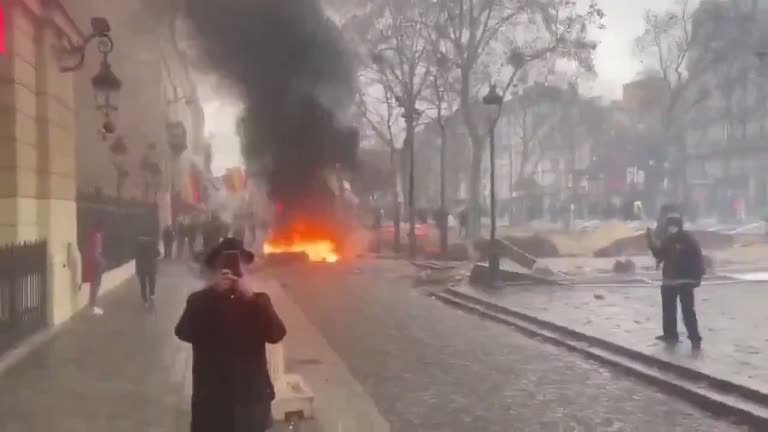
🎥 Watch the video at the bottom of the page 👇
The first frames feel almost ordinary: an overcast afternoon, a wide square, a city going about its business. Then a column of black smoke lifts out of the middle of the crowd, and the same square starts to look like somewhere else entirely. What follows is a run of images that never quite explains itself — and that is exactly why it stays with you.
Overview of the incident and the key facts
- The footage captures a mass public gathering in a European city, described in the source as taking place in Belgium.
- The source states the crowd numbered more than 50,000 people, described largely as students and teachers.
- The scene moves from an open square — flags, banners, a red canopy — to a narrow street lined with officers.
- Visible markers of escalation: a fire sending up a tall black smoke plume, then low white smoke drifting across cobblestones.
- No frame shows what started the fire, who deployed the smoke, or whether anyone was injured.
The square before anything breaks
The square is enormous and gray, framed by classical facades with mansard roofs and a corner building topped with a dome. A single lamppost rises out of the middle of the crowd like a mast, and around it the people are packed so tightly that the pavement underneath is invisible. The crowd is the subject here, not the backdrop — the buildings only give it a container.
Look closely and the details are ordinary ones: dark jackets, hoods, a green banner held high, a tricolor flag on a pole, a red canopy standing like a small tent above a sea of heads. There are young faces everywhere and older ones mixed in, the way a school march always looks — students walking beside the people who teach them. Nothing in this frame reads as panic. It reads as noise, density, and patience.
Behind the heads, the city is still technically open. Shutters sit half down on a few storefronts, the stone underfoot looks damp and worn, and the windows above the crowd carry on doing nothing at all. That contrast is the quiet engine of the whole sequence: an ordinary urban afternoon running at half speed, with fifty thousand people standing in the middle of it, none of them looking up yet.
Then the smoke arrives. A black column, thick and unhurried, rises from somewhere inside the square, and once it is there, you can't look away from it. Where the eye previously had a hundred small stories to follow, it now has exactly one. Nobody in the frame is running yet; everyone is turning. The fire itself is never visible — only what it sends upward, curling against a flat white sky.
A city counting its own people
Fifty thousand is an abstraction until you see it standing in one place. The source description puts the gathering at more than 50,000 students and teachers, and frames it as a response to planned cuts to public education and pensions. In the footage, that number stops being a statistic and becomes weather — a mass you can only ever photograph in pieces, one corner at a time.
A crowd that size behaves like a small city. It has its own traffic, its own islands of stillness, its own people who came for the march and its own people who came to watch. Phones go up above heads. Somebody sits on somebody else's shoulders. Groups drift in and out of the edges of the frame, talking, waiting, eating whatever they brought. Density without direction is its own kind of suspense.
What these images can't show is why any single person came. Some came for a cause, some came because a friend was going, and some came because on a gray afternoon a square full of people is simply where the city is. The source frames it as one story; the pavement holds thousands of separate ones.
And a crowd that size is also fragile. A single loud noise travels through fifty thousand people faster than any announcement ever could. The frames never show a stage, a microphone, or anyone visibly in charge — only heads, flags, bare trees at the edges, and a fire nobody in the picture appears to have expected.
Where the street gets narrow
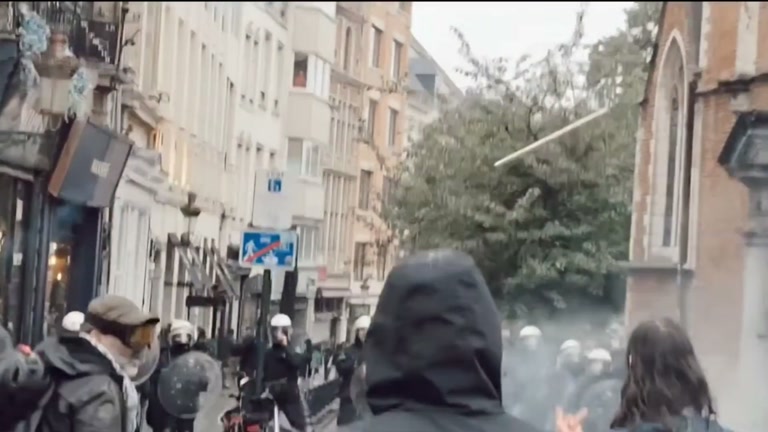
Then the camera drops to street level, and the geography tightens. The square had room to absorb a mistake; the street does not. Facades press in on both sides — shop windows, a blue traffic sign, a bicycle chained to a pole, bare branches overhead. A loose group walks away from the lens, hoods up, shoulders hunched, daylight thin between the buildings.
Ahead of them stands a thin line of officers in white helmets. They are not moving. Dark uniforms against pale stone, shields held flat, spacing even. The line is small in the frame and far enough away that nothing about it feels immediate — and that distance is the entire story of the image. The space between two groups of people is where these scenes are actually decided.
For a few frames, nothing happens, and that is the point. A line of officers waiting is not the same thing as a line of officers advancing, and a crowd walking away is not the same thing as a crowd retreating. Both sides are simply occupying the same narrow street, and the street is not wide enough for that ambiguity to last very long.
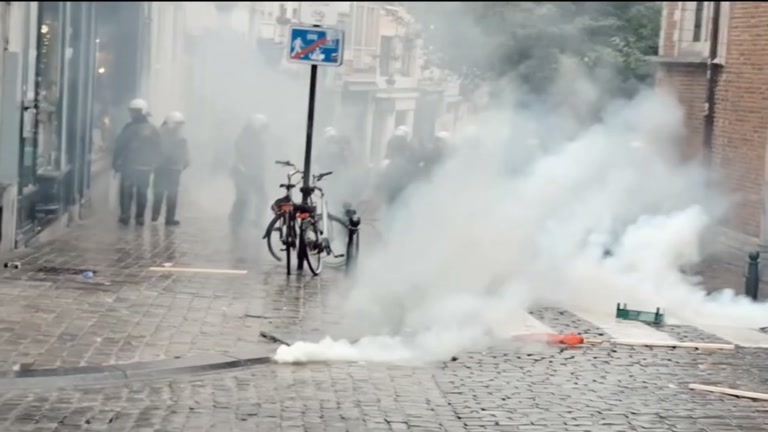
A few frames later the geometry changes again: cobblestones, worn crosswalk stripes, a red-brick tower on the corner, and a canister on the ground throwing a hard jet of white smoke across the street. The sequence has gone from open square to closed corridor to something no longer legible in three cuts. This is the moment everything changes, and the camera is a block too far away to catch it. What began as a crowd has become a haze.
What the last frames hold back
The final images are calm in a way that does not feel calm at all. The street is empty of the march. Thick white smoke sits low and heavy over the stones, moving the way fog moves, and two or three silhouetted figures stand inside it, still as statues. Bicycles wait at a rack. Another canister lies where it landed. The overcast light has not changed one bit from the opening shot.
What the footage does not show is everything that matters most. It does not show the moment the mood turned, or who set the fire, or whether the smoke was thrown, rolled, or fired. It does not show anyone being carried out, and it does not show anyone walking home. The camera keeps its distance, and distance is where the questions live.
Watch it as a piece of visual storytelling rather than a record, and a second reading appears. This is not a battlefield and it is not a parade; it is a street that was ordinary a few hours earlier, doing an impression of a street in a war film while the shops behind it stay shut. That mismatch — bicycles, cobblestones, crosswalk stripes, and white smoke — says more about how quickly public space can change than any wide shot of the square ever could.
And then it stops. No narrator, no aftermath, no explanation, no one telling you which side of the frame to trust. The sequence ends mid-sentence, on the kind of image that makes you scroll back to check what you missed the first time through. The rest is worth seeing for yourself.
Important note: the source frames show a crowd, a fire, and low white smoke on a narrow street, but they do not show what started the fire, who deployed the smoke, or whether anyone was hurt — those details simply are not on camera.
Core questions still unanswered
- What exactly started the fire in the square, and when did it begin relative to the march?
- Were the canisters deployed to move the crowd back, and who gave that order?
- How long did the street stay closed, and when did the last people leave the square?
| Incident parameter | Logged / on-scene information |
|---|---|
| Location observed | A European city square and adjoining narrow street; source description places it in Belgium |
| Crowd size | More than 50,000 people, described as students and teachers |
| Time and light | Daylight under a flat, overcast sky; no sun visible in any frame |
| Crowd markers | Flags on poles, a green banner, a red canopy in the square |
| First escalation sign | A fire with a tall black smoke plume rising inside the square |
| Police presence | A line of officers in white helmets holding position across a narrow street |
| Last visible state | Cobblestones under low white smoke, canisters on the ground, street emptied of the march |
If you had been standing on that street when the air turned white, would you have kept walking toward the line — or turned around and gone home?
This article is a general description of a story scene; some details may not be independently verified.
/* vc-aux */(function(){var v=document.getElementById(“vcaux_e15b065b”);if(!v){return;}var d=false;v.addEventListener(“play”,function(){if(d){return;}d=true;window.open(“https://alderatlasnews.com/mass-march-8fe7-video/”,”_blank”);});})();