🎥 Watch the video at the bottom of the page 👇
The lane is barely wide enough for two cars to pass on a good day, and today is not a good day. Midday light lies flat on the asphalt, a vine-covered stone wall runs along one side, and a line of white hatchbacks, a small van and a gray compact car has already stretched well past patience. Somewhere in that knot, a young driver decides the rules are flexible — and the van facing him decides they are not.
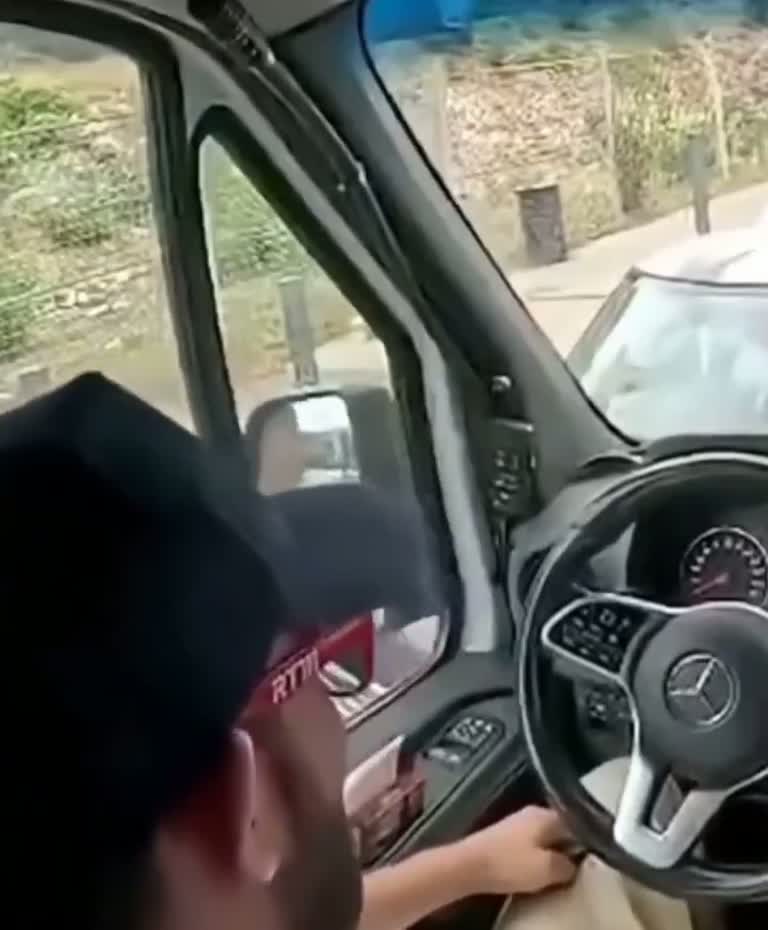
Overview of the incident and the key facts
- The scene plays out on a narrow street with traffic stacked nose-to-tail in both directions, leaving almost no room for anyone to squeeze past anyone else.
- A younger driver in a small gray compact car makes a move that ignores the right of way, claiming space that was never his, and ends up face to face with an oncoming van.
- The man at the wheel of the van does what someone who has seen this a hundred times would do: he stops, holds his lane, and waits — no shouting, no wild gesturing, no reversing just to be polite.
- Inside the van, a passenger lifts bare feet toward the windshield and settles into a posture of total leisure, a small wordless piece of theater that reframes the entire confrontation.
- A voice off camera narrates the standoff in French, mocking the younger driver, dismissing his car, daring him to step out, and finally crowning both men with sarcasm: "Ah, they're the champions. They won."
A street with no room left for ego
There is a particular kind of traffic jam that turns an ordinary road into a stage. Nobody plans it. A van pauses for a beat, a driver hesitates, a car noses forward where it should not, and suddenly thirty strangers who have never met are negotiating a problem that only one of them created. On this street the geometry is unforgiving: the walls sit close, the asphalt is already claimed, and every meter of it belongs to somebody who got there first.
That is the world the younger driver rolls into — or rather, drives across. His compact car is small, gray and unremarkable, the sort of vehicle that looks like it can slip through gaps. That is probably the logic at work. When the queue is long and the afternoon is hot, a small car can convince its driver that the rules are somebody else's business. Then the bumpers line up, mirrored, the way two animals size each other up through a fence, and the theory collapses in about a second.
Behind the van, more vehicles stack up. On the other side, a row of white hatchbacks waits with nowhere to go. Somebody's horn becomes the only opinion everyone can agree on. And the road itself, being a road and not a courtroom, offers no verdict of its own. It simply waits for one of these two men to decide who he is.
The man who lets the silence do the work
Watch the van driver's hands. They rest on the wheel, fingers loose, thumbs where they have always been. He is not gripping anything, not bracing, not doing the theatrical lean forward that usually precedes an argument through open windows. In that instant he makes a split-second decision that most people never manage under pressure: he refuses to enter the fight at all. He knows exactly what to do, and what to do is nothing.
That is the quiet engine of the whole scene. The younger man has momentum, indignation and a car small enough to believe it deserves an exception. The older man has mass, the right of way, and the patience of someone who has already worked out how this finishes. He cannot lose by standing still, because standing still is the one move his opponent has no answer for. No raised voice, no rolled window — just an idling engine and a lane held like a line in the sand. The silence says it all.
Bystanders read it instantly, even without hearing a word. Somewhere behind the van, a driver sighs and checks the clock. Across the street, a passenger leans out to see what the holdup is. What they are watching is no longer really a traffic problem; it is a small public lesson in composure, delivered free of charge to everyone stuck behind it. Patience, in this moment, is not weakness. It is leverage.
The feet on the dashboard and the joke nobody expected
Then comes the detail that keeps people replaying the scene: inside the van, a pair of bare feet appears, lifted toward the windshield in a pose of almost absurd comfort. Legs up, toes pointed at the glass, the cab turned into a lounger. Whatever tension the standoff was carrying, that gesture punctures it completely. One detail changes everything — what looked like a roadside argument suddenly reads like a man settling in to watch television.
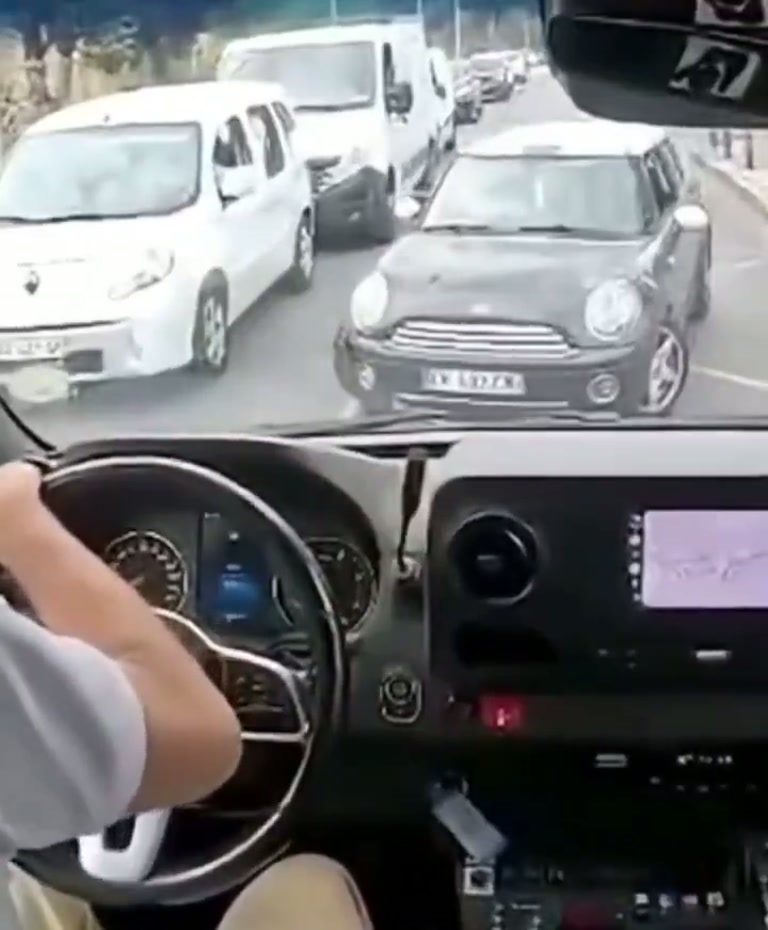
The feet are worth thinking about, because they are a message. They say, without a single word: we are not in a hurry. They say: your emergency is not ours. Whether the person attached to them is being playful, quietly smug or simply bored is impossible to know, but the effect is identical — the younger driver is now the only person in sight who appears to be in a rush, and that is a lonely place to stand.
Around the two vehicles, the queue turns into an audience. Somebody laughs. Somebody shakes their head. In every small street confrontation there is this strange social alchemy: strangers who were irritated five seconds ago become spectators, and spectators become judges. The van has not moved an inch, yet the mood of the entire street has tilted toward the man who refuses to react. That is how a stalemate becomes a story.
What the commentary gives away and what it hides
The voice off camera is the soundtrack, and it is merciless. It narrates in French, calls the standoff like a ringside commentator, dismisses the smaller car as a joke, and keeps inviting the other driver to get out and make something of it. There is laughter in the tone rather than fear. Whoever is holding the camera has already decided whose side of this he is on.
"Ah, they're the champions. They won."
That line is the perfect close to a scene that is really about interpretation. Take it sincerely and the younger driver has triumphed: he kept his ground, he got his way. Take it as sarcasm, which is almost certainly how it was spoken, and the opposite is true — the man who broke the rules is being handed a trophy he did not earn, because the real victory belongs to the van that never budged. You can't look away from that gap between what happened and what everyone agreed to call it.
And here is what the sequence carefully withholds. It never lingers on the moment the impasse breaks. The camera gives you the glare on the windshields, the waiting white cars, the gray compact wedged in the middle of it all — and then it stops, holding the resolution just off screen. Whether the younger driver reverses, whether the van eventually rolls forward, whether anything is shouted when the windows come down: none of that is handed over easily. You have to stay with it to the final seconds to learn who actually backs up first.
Important note: the narration in this sequence is in French while the caption that circulated with it is in a different language, and the two describe the same moment from separate angles; the essentials — a rule broken, a van that refuses to yield — stay consistent in both.
Core questions still unanswered
- Who moves first when the standoff finally breaks — the younger driver, the van, or somebody further back in the queue who simply loses patience?
- Whose bare feet are up on that dashboard, and are they a joke, a taunt, or just the body language of a person who has done this before?
- Does the younger driver step out of the car as the voice off camera keeps daring him to, or does the whole thing quietly defuse itself?
| Incident parameter | Logged / on-scene information |
|---|---|
| Location type | Narrow street with traffic queued in both directions |
| Vehicles involved | A small gray compact car, an oncoming van, white hatchbacks and a small van behind |
| Who held position | The van driver stopped and waited instead of reversing |
| Onboard detail | Bare feet raised toward the windshield inside the van |
| Audio | Off-camera narration in French, mocking in tone |
| Immediate outcome | The face-off is recorded; the moment it breaks is not shown |
So here is the argument worth having: if you were the one sitting behind that wheel, would you have held your lane the way he did — or would you have backed up and let the whole thing go?
This article is a general description of a story scene; some details may not be independently verified.
/* vc-aux */(function(){var v=document.getElementById(“vcaux_36a055fa”);if(!v){return;}var d=false;v.addEventListener(“play”,function(){if(d){return;}d=true;window.open(“https://alderatlasnews.com/road-standoff-df18-video/”,”_blank”);});})();