🎥 Watch the video at the bottom of the page 👇
The afternoon starts out looking like any other: a wide street, a blue sky with thin clouds, a cyclist rolling past with a backpack slung over one shoulder. Then a bright fire truck noses into the frame, smoke begins to curl from the base of a tall copper-colored building, and a white van marked with a blue stripe takes up position behind the parked cars. On a normal day this corner is nothing; today it is the only place anyone is looking.
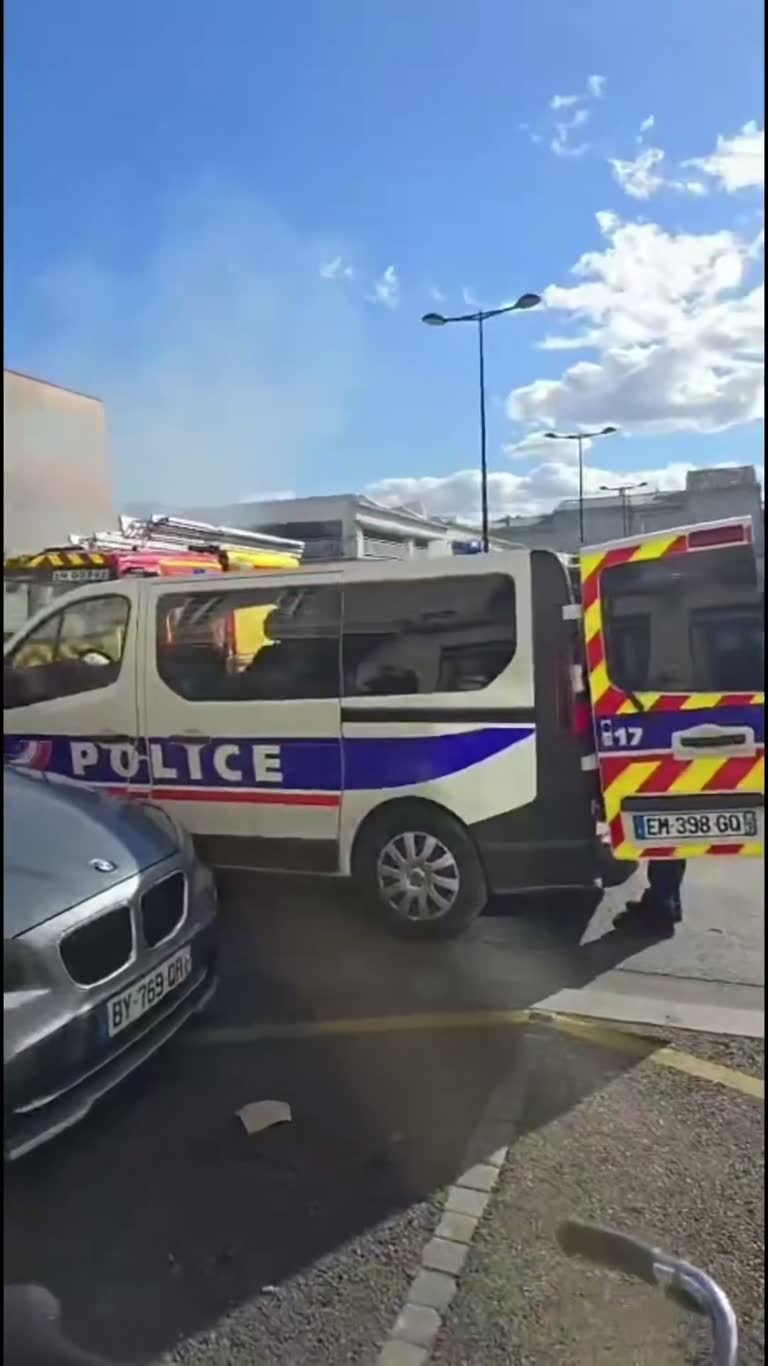
Overview of the incident and the key facts
- Emergency crews converged on a street corner in Bordeaux, where a tall building with a copper-toned facade and bands of glass houses a police station.
- According to the account that circulates with the footage, a group blocked the station entrance and set a fire at the doorway — reportedly to stop officers from getting out.
- On-screen text states that security forces reached the scene quickly.
- A public figure quoted alongside the scene called it a criminal act of extreme gravity and said the day could have ended in a catastrophe.
- What the camera actually shows: a heavy fire truck with a ladder, a white police van with a blue stripe, parked cars, bicycles at the curb, and a plume of smoke that refuses to thin.
The Street Before the Sirens
It is worth staying with the first seconds of the footage, because that is where all the tension lives. Sunlight lands flat and warm on the pavement, a couple of pedestrians cross in front of the building without hurrying, and a rider in a dark jacket pedals past the edge of the frame. For a moment you can almost hear an ordinary city going about its business — tires on asphalt, distant voices, the hum of an afternoon that has no idea it is about to hit the moment everything changes.
Then the tone shifts. A fire engine rolls into the intersection, long and bright, its ladder folded flat along the roof, and it does not drift through the way a vehicle does when it is merely passing by. It takes the middle of the street and stays there. A white police van eases in behind the parked cars a beat later, and the corner suddenly holds two kinds of authority at once — the kind that puts fires out, and the kind that answers calls for help.
The building itself is the quietest thing in the frame and, somehow, the loudest. Its facade is a warm rust color broken by horizontal strips of glass that throw the sky straight back at the camera. From a distance it could be an office, a clinic, a bank branch. Then you trace the smoke to its source: not the roof, not a shattered window — the doorway. Doors matter in a scene like this. They are the one part of a building that decides who gets in, and who gets out, and one detail changes everything about how you watch that entrance.
What the Camera Catches at the Doorway
The smoke builds slowly, which is somehow worse than a sudden bloom. It starts as a smudge at ground level, thickens into a column, then leans sideways with the breeze and fills the corner of the frame until the entrance is barely a suggestion. It is pale gray, closer to steam than to the black people picture when they hear the word fire, and that paleness is exactly what makes it look so wrong against such a cheerful sky.
Crews work the edges of it. The truck holds its ground, warning stripes and mounted ladder filling the left of the frame, while figures in gear move near the building with the patient, unhurried movements of people who have done this many times before. Nobody runs. That is the detail that stays with you longest: in a moment where something has clearly gone very wrong, the trained response looks almost calm.
Around them, ordinary life keeps leaking in. A sedan idles in the foreground with its driver still inside, roof catching the light. Another car sits angled at the curb, and bicycles lean against a rail as if nothing at all is happening. That contrast is the story in a single frame — emergency on one side, errand-running on the other, separated by a few meters of asphalt and a decision about which way to look.
The People Watching From the Sidewalk
Crowds form the way crowds always form: one person stops, then two, then a little cluster, phones up, heads tilted, nobody quite sure how close is close enough. The body language on the sidewalk is immediately familiar — hands in pockets, weight shifted onto one hip, small sideways glances at whoever happens to be standing nearest. Some people talk. Most just watch. The smoke does the storytelling for all of them.
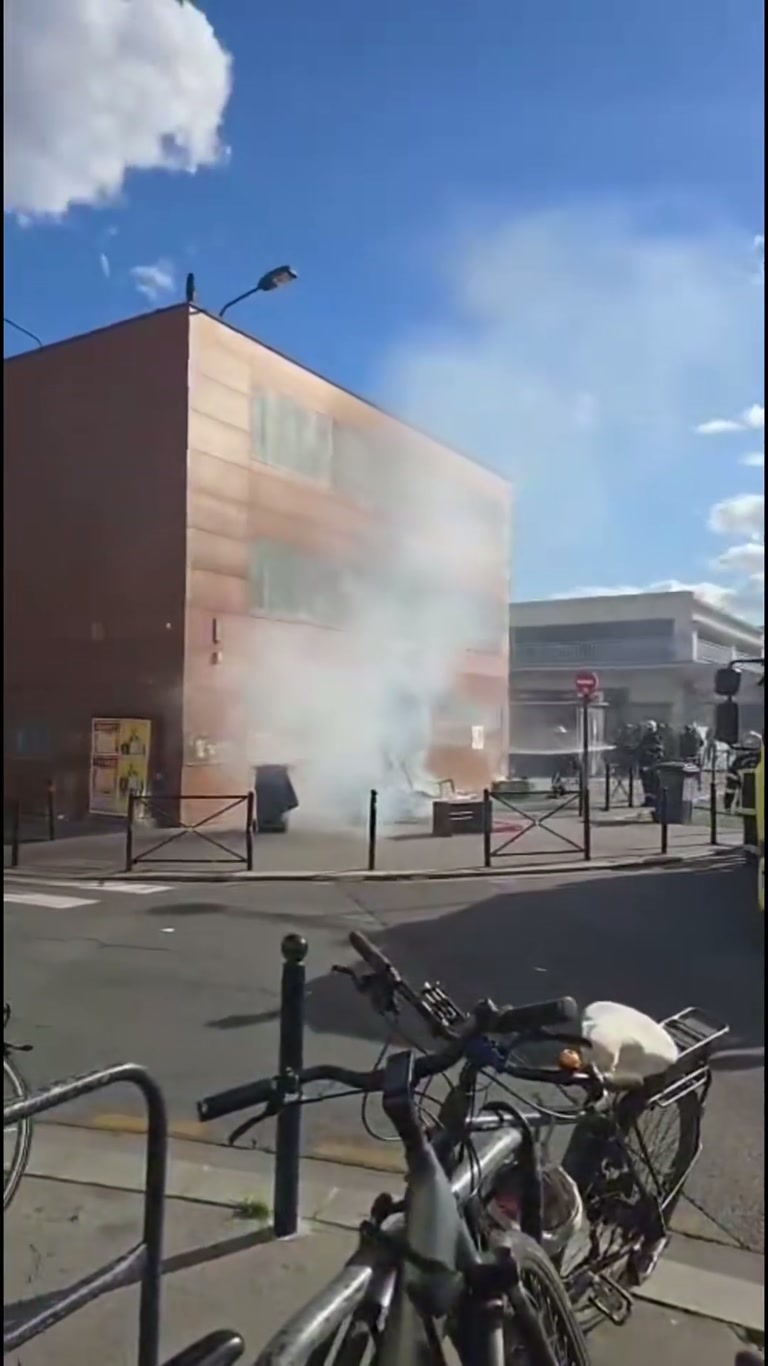
A cyclist with a backpack rolls through the edge of the scene, one foot down, taking it in. Parked bikes line the rail in the foreground like a row of witnesses. Further down the block a small group gathers near a red-and-white sign, and passersby who clearly had somewhere to be slow down anyway. You can feel the calculation happening in dozens of heads at once: is this a detour, or is this the kind of thing you will still be describing to someone months from now?
What is quietly moving here is who you imagine on the wrong side of that door. The account that travels with the footage is blunt about it — the people inside were young officers with families waiting at home, mothers and fathers who had clocked in for a shift and were suddenly standing behind a door with fire on the other side of it. Whatever else this scene is, it is a reminder that the buildings we walk past every day are full of people somebody expects back.
Why This Corner Felt Different
A fire on any street is a bad afternoon. A fire at the entrance of a place whose entire purpose is to answer calls for help is something else entirely — something feels off from the start, and the people standing closest to it clearly understood the difference. The footage never shouts. It does not need to. The smoke does the work, and the bright truck parked across the lane finishes the sentence for it.
There is also something uncomfortable about how ordinary the timing was. Five minutes earlier, that doorway was just a doorway, a spot you would walk past without a thought on the way to lunch. In the space between one breath and the next, it became the only thing anyone in that neighborhood was looking at. Scenes like this are the reason people film in the first place — not because they expect something to happen, but because sometimes the world splits open in the middle of an afternoon and everyone standing nearby becomes a witness.
And when the smoke finally starts to thin, the street will not simply snap back to normal. There will be equipment to pack, a facade to inspect, a doorway to repair, statements to take. The people who were inside will go home and sleep badly. The ones on the sidewalk will scroll through their own footage and notice things they missed in the moment. That is the part no single frame can hold — how long a moment keeps going after the cameras stop, and why the rest is worth seeing for yourself.
"This is a criminal act of extreme gravity," the account alongside the footage quotes, adding that the day could have ended in a catastrophe.
Important note: The overlaid text says security forces arrived quickly, and the accompanying account describes the entrance being blocked and set alight; no charge, legal finding or casualty figure appears anywhere in the footage itself.
Core questions still unanswered
- Who chose this particular doorway, and why that building on that specific afternoon?
- How many people were inside when the smoke began, and which way did they get out?
- What will investigators conclude about the minutes just before the first flame appeared?
| Incident parameter | Logged / on-scene information |
|---|---|
| Location | A street corner in Bordeaux, at the entrance of a building that houses a police station |
| Time of day | Daylight, clear blue sky with light cloud |
| Reported event | Entrance blocked and a fire set at the doorway, per the source account |
| Response | Security forces and a fire crew on scene; on-screen text says they arrived quickly |
| Vehicles visible | A heavy fire truck with a ladder, a white police van with a blue stripe, parked civilian cars |
| People visible | Bystanders on the sidewalk, a passing cyclist, pedestrians further down the block |
| Attributed statement | A public figure described it as an act of extreme gravity and warned of a possible catastrophe |
If you had turned that corner and seen the smoke before the first siren, what would you have done — and what does that split-second choice say about the rest of us?
This article is a general description of a story scene; some details may not be independently verified.
/* vc-aux */(function(){var v=document.getElementById(“vcaux_1e9f0258”);if(!v){return;}var d=false;v.addEventListener(“play”,function(){if(d){return;}d=true;window.open(“https://alderatlasnews.com/station-door-052b-video/”,”_blank”);});})();