🎥 Watch the video at the bottom of the page 👇
A class is running in Tulancingo, Hidalgo, the way classes run everywhere — a voice at the front, chairs scraping, phones resting face-down on the desk. Then one student leaves his seat, and an ordinary afternoon stops being ordinary. By the time a phone camera lifts, the distance between the front of the room and the seats has already closed.
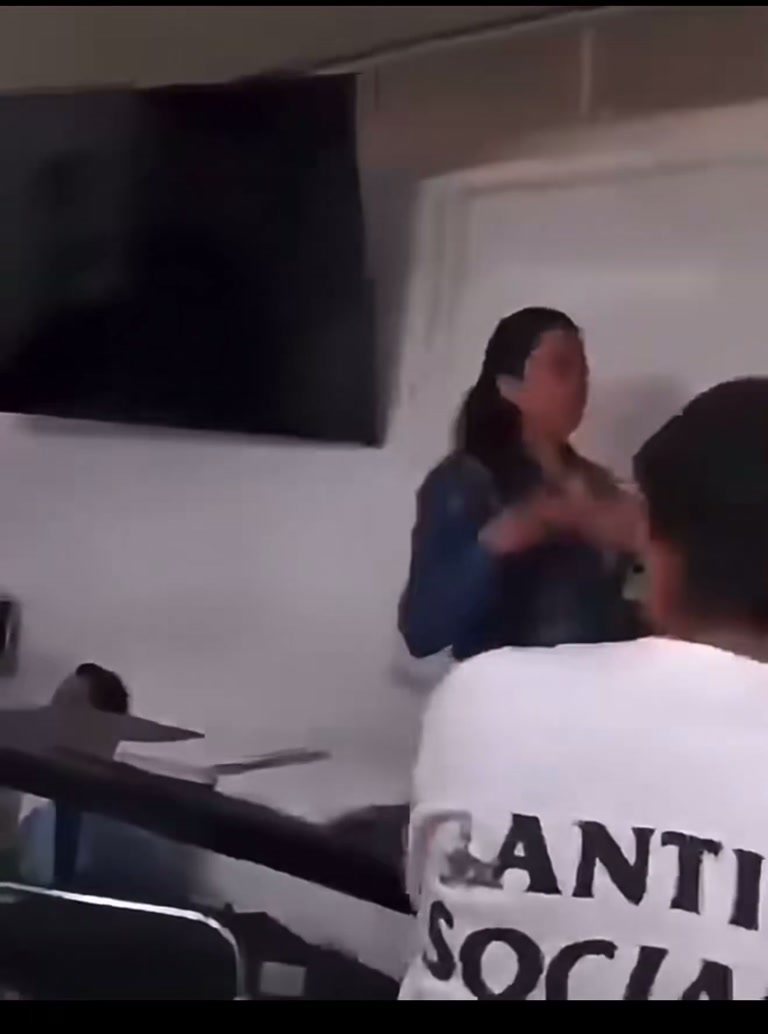
Overview of the incident and the key facts
- A male student physically confronted an instructor during a class session at a polytechnic campus in Tulancingo, Hidalgo, in Mexico.
- The recording shows a plain classroom: white walls, a low ceiling with rectangular light panels, long dark tables, and chairs dragged out of their neat rows.
- Several classmates are visible, including a young woman in a blue jacket who crosses the shot with a phone in her hand, and students in white shirts with printed lettering across the back.
- The audio carries one voice repeating a challenge about being laughed at, plus a first name and a mention of going to the administration office — nothing that sounds like a lecture.
- The clip begins mid-argument and ends mid-motion; nothing in it shows the class before that minute or anything after the camera stops.
A Classroom Like Any Other
White walls, a low ceiling of rectangular light panels, long dark tables lined up along the room, chairs pushed out of formation. A backpack slumps against a chair leg, a small yellow bag sits on a desk edge, a dark screen hangs high on the wall above the tables. It is a room built for routine — the kind of space where the most dramatic thing that happens on a normal afternoon is a handout nobody reads. Nothing in the frame announces that anything is about to go wrong.
The light sits flat and even, the way institutional light always does. What you notice instead is the sound: a room that has stopped talking all at once, which is never a comfortable noise. A chair leg drags on the floor. Someone shifts their weight and then thinks better of it. A young woman in a blue jacket is already on her feet near the front, phone in hand, turning toward the trouble before most of the room has decided what the trouble is. Somebody in that room understood a beat early that this was not going to stay verbal.
For a few seconds, it could pass for two adults having a bad day in a public building. That is exactly what makes the next minute so jarring. Nothing about the room has changed — the tables, the screen, the pale afternoon — except the one thing that everyone inside it is now looking at.
The Voice That Would Not Stop
The audio does most of the storytelling here. The recording picks up a single voice, running one line into the ground — a dare to laugh one more time, repeated until it stops sounding like an argument and starts sounding like a countdown. There is a name attached to it, thrown out again and again. There is a line about consequences. There is even a plan for where to take the matter next, a mention of walking into the administration office together, as if the fight could be finished somewhere with better paperwork.
Laugh at me one more time — I dare you.
What is missing from that soundtrack matters just as much. No second voice answers it. No one shouts back. The same phrase simply loops, which tells you more about how long this had been building than any explanation could. Anger in a public room rarely starts in that room — the words keep pointing backward, to something that clearly began long before anyone thought to lift a phone.
And that steadiness is the unsettling part. A person who is shouting can still be talked down. A person repeating the same sentence in the same tone, in front of an audience, is not negotiating anything — they are performing a decision they have already made. Something feels off from the start, and it is not the volume. It is the calm.
The Split Second the Room Splits
Then it moves. A figure in a pale tank top crosses the front of the room, a chair slides out of line, and a second person steps in to close the gap. In the frames, arms come up and the image smears into motion the camera cannot resolve — the kind of blur that tells you everything happened faster than the person holding the phone expected. The moment everything changes does not announce itself. It just takes the room's attention and keeps it.
The people around it behave exactly the way people behave. Nobody runs. Nobody screams. The classmates nearest the lens keep their backs turned and stay seated, and a young woman in a blue jacket moves through the middle of it, half-documenting, half-deciding what her hands should do. You can't look away, and you can also feel how badly everyone in that room wants someone else to be the one who steps forward first.

That is the part of the scene the camera records without meaning to: not the confrontation itself, but the two seconds of hesitation wrapped around it. A safe place is supposed to have a protocol for this. A classroom has a person at the front whose job is to keep order, and a building full of staff a corridor away. When the order breaks anyway, everyone in the room learns something about how thin the arrangement always was.
What the Camera Never Shows
The clip opens in the middle of an argument and stops in the middle of a movement. Whatever explains it — the minutes before, the reason for the dare, whether this was a first time or a pattern — sits outside the frame, and the person filming never turns the lens toward the door to show who else was coming. What you get instead is a room, rearranged: a bag where it fell, a table tilted out of its line, a screen still reflecting the ceiling lights. Then the video is over.
Clips like this one travel fast, and they travel stripped. Viewers inherit the middle of a story and quietly build the rest out of guesswork, which is how a ninety-second file becomes an argument about an entire generation, an entire profession, an entire country. The footage does not support that much weight. It supports one room, one afternoon, one voice that would not stop.
Important note: the recording captures only a fragment of a longer event, so the moments before and after it remain outside what the footage can confirm.
Whatever followed the last second — a report, a meeting, a decision about what comes next — happened after the phone went down, off-screen, in rooms with closed doors. The clip is short enough that the beginning feels missing and long enough that you want the part that never got filmed. The rest is worth seeing, and the rest is precisely what nobody recorded.
So the scene lands where scenes like this always land: a small room, a loud minute, and a question much bigger than either of them. What does a school owe the people inside it when a disagreement stops being a disagreement? And what does a room full of students owe the one person standing alone at the front of it? Those questions do not fit in a phone screen, which is probably why the clip keeps getting passed around anyway.
Core questions still unanswered
- What happened earlier that day — or earlier that term — to turn a routine class period into a confrontation with an audience?
- Who, if anyone, stepped in to separate the two, and how long did it take before an adult reached the front of the room?
- What came of the promise to take the matter to the administration office, and what the institution did afterward remains outside the footage.
| Incident parameter | Logged / on-scene information |
|---|---|
| Location | A polytechnic campus classroom in Tulancingo, Hidalgo |
| Setting | White walls, low ceiling with light panels, long dark tables, loose chairs |
| People seen | Students in white printed shirts, a young woman in a blue jacket, an instructor |
| Voices captured | One voice repeating a dare to laugh one more time, plus a first name |
| Mentioned next step | Going to the administration office |
| Camera position | Handheld phone, shot from inside the room, image blurring during movement |
| Recorded aftermath | None — the clip ends before the situation resolves |
The uncomfortable thing about this footage is how ordinary the room looks, right up until it doesn't. If you had been sitting in that classroom, phone in your pocket, watching it start — what would you have done in those two seconds?
Some details of this scene could not be independently confirmed from the available material.
This article is a general description of a story scene; some details may not be independently verified.
/* vc-aux */(function(){var v=document.getElementById(“vcaux_90cdf446”);if(!v){return;}var d=false;v.addEventListener(“play”,function(){if(d){return;}d=true;window.open(“https://alderatlasnews.com/classroom-confro-8214-video/”,”_blank”);});})();