🎥 Watch the video at the bottom of the page 👇
Snow falls over the rooftops like static on a dead channel, thick enough that the mountains simply disappear. In a valley of timber houses and steep shingled roofs, a village is going quiet — shutters latched, windows glowing, the lane filling in drift by drift. What makes the scene stick, though, is not the storm. It is the moment a gloved hand pushes a burning torch into the snow and lets go.
Overview of the incident and the key facts
- A small mountain village of timber houses and steep roofs is caught in a heavy, relentless snowstorm after dark.
- Snow falls through the entire opening stretch — over rooftops, balconies, the cobblestone lane and the drifts stacked against the walls.
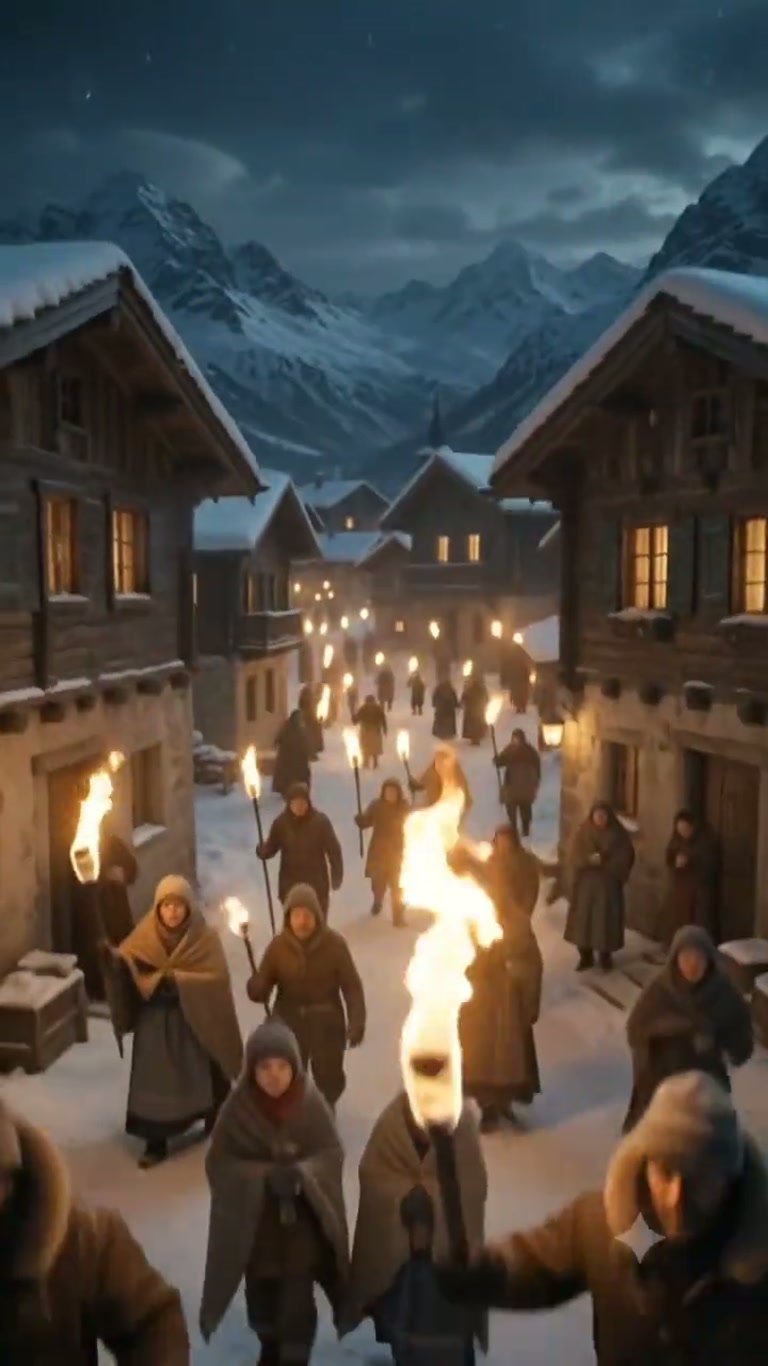
- Villagers step out of their homes into the street; several carry lit torches, and one torch is planted upright in the snow, left burning on its own.
- Mounted riders enter the village through the storm, holding lanterns that swing with every step of their horses.
- The sequence later shifts to daylight over the same valley and the same crooked lane, and the mood of the story turns completely.
The torch that nobody holds
It is the small things that carry the weight here. A hand tilts a torch, the flame catches, and the light throws gold across the drift — you can watch individual flakes spin through the beam before they vanish. Then the hand opens, the torch drops upright into the snow, and the village keeps moving behind it. Nobody stops to stamp it out. Nobody picks it up.
That single object does an enormous amount of quiet work. A fire burning on its own in the middle of a frozen lane is a strange, almost formal thing: part announcement, part marker, part promise. It says people are awake. It says they are not hiding. It says someone decided that darkness would not get to be the whole story tonight. The way the flame stands there, balanced and patient, feels deliberate — and deliberate is exactly what you want when the weather turns hostile.
Around it, the village becomes a study in ordinary human behavior under pressure. The snow is deep enough that walking is real work, and the packed trail of footprints tells you this is not a road but a path beaten down by neighbors. People in heavy coats and headscarves stand in loose knots near the doorways, breath visible, hoods up, hands tucked together. Warm light spills from upper windows where the people who are not outside are watching. The silence says it all: no shouting, no panic, and that is precisely what makes the situation read as serious.
The social logic underneath the image is older than any of the architecture. In places where winter can genuinely kill, going outside together is a form of safety, and standing alone is a risk you take knowingly. So the frame is not really about weather. It is about the arithmetic of a small community — how many hands, how much fuel, how long the pass stays closed.
Lanterns coming down the mountain road
Then the tone shifts again, and the street gets busier without a single line of dialogue. Riders come through the drifts on horseback, big coats furred at the collar, lanterns lifted in their fists like small moons. The horses breathe steam. Their hooves punch through the crust and leave round, wet holes in the snow. The lantern light slides along the timber walls as they pass, and for a few seconds the whole street is moving with them.
Who they are is left for you to decide. They could be a rescue party, neighbors from a hamlet further up the valley, or the people who make the long trip only when the route is open. The story never labels them, and that restraint is smart. What it does instead is let geometry do the talking: three lights advancing against a dark, snow-filled street is one of the oldest pictures in the world. Help arriving — or at least the shape of it.
There is craft in how patient this passage is. The view drops low, down to the level of boots and hooves, and the ground itself becomes the subject: a thin crust, a packed track, cold blue shadows pooled between the prints. It slows your pulse. It makes the world feel physical and heavy, which is exactly what a storm does to a person.
And it quietly raises the stakes. If riders are still moving through that kind of snowfall, something outside the frame is more urgent than comfort. Or something inside it is.
A village that refuses to sit still
By the time the whole street fills, the scene has flipped from weather report to procession. Torches move down the lane in a long, wavering line, dozens of small flames held at shoulder height, cloaked figures walking together with their heads down against the snow. From a balcony above, it would look like a river of light threading between the houses.
Here is the part worth sitting with: torchlight in a settlement like this is not decoration. Fire is the only thing that argues with the dark, and it is also the one resource everybody shares. So the image of an entire community carrying it down one narrow street carries meaning beyond atmosphere. It is a shared supply, moving at walking speed, passed from neighbor to neighbor.
Then the camera pulls back and the whole valley comes into view — snow-capped gables, a church spire, lit windows scattered like dropped coins, a black belt of pines, and ridges fading into the night above it all. The scale lands hard. Whatever is happening down in that lane, it is happening to a very small number of people in a very large landscape.
The story holds its answer back, and it holds it well. Is this a search, a gathering, a decision about who goes up the mountain first? The film lets the flames ask the question and refuses to hand you the reply.
The light changes and the story changes with it
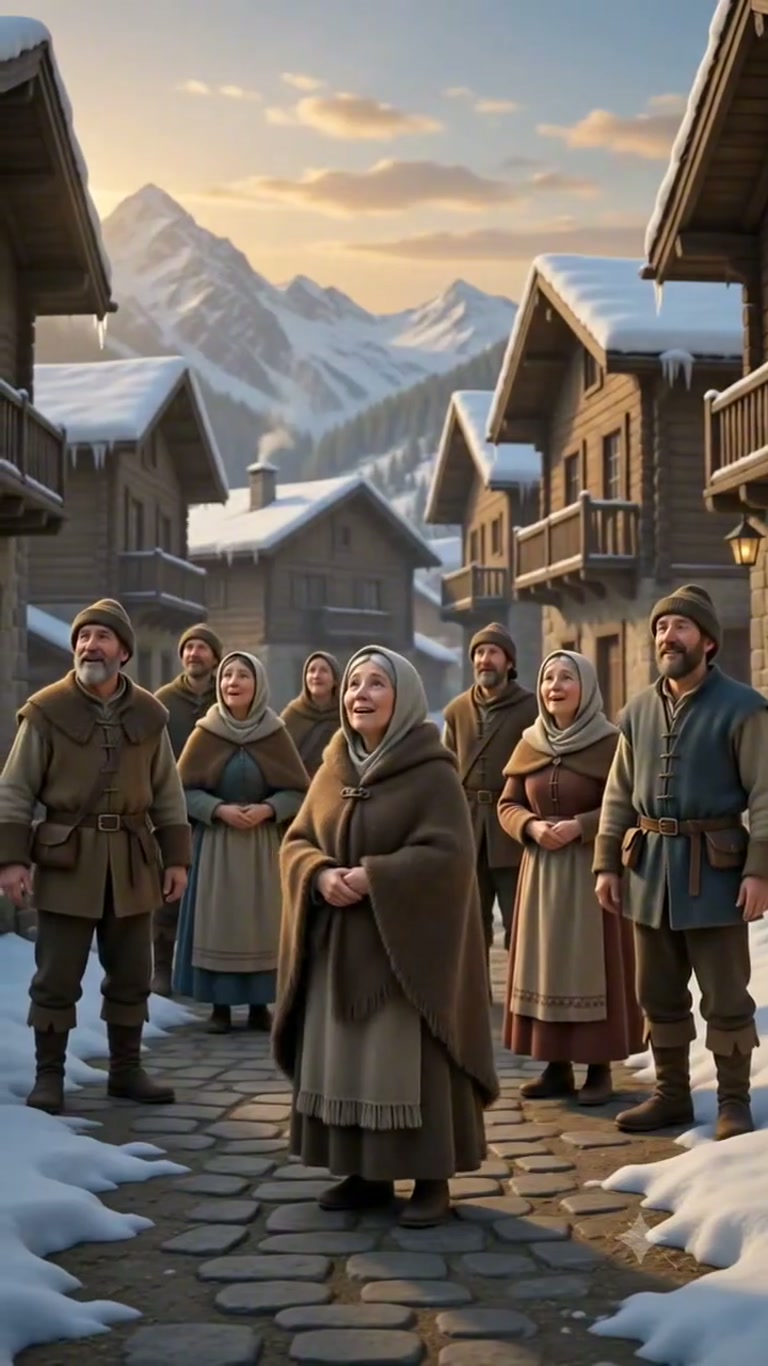
And then, without much warning, the sequence breathes out. The same valley appears under an open sky, the peaks catching hard gold light, clouds stretched thin, every roof wearing a clean white cap. The lane is still the lane. The cobblestones are still there. But the world around them reads entirely differently, and the shift is genuinely startling after so much blue darkness.
Villagers stand in the street in daylight, shoulders loose, faces turned toward one another — the kind of unposed group that forms when people finally get to stand still at the same time. It is a quieter kind of drama than the storm, and in some ways a heavier one, because everything you watched overnight is suddenly in the past tense.
What works here is contrast, not spectacle. The same crooked street that felt like a trap an hour earlier now looks like the most ordinary place on earth, and the movie seems to know that. The rest is worth seeing for the way it earns that change rather than announcing it.
Important note: this is a short, stylized cinematic piece rather than a documentary record, and the material available does not name the village, the riders, or the people moving through the lane.
Core questions still unanswered
- Who planted the torch in the snow in the first place, and why leave it standing there instead of carrying it?
- Are the mounted riders arriving to help, to collect someone, or to move on before the weather closes again?
- What exactly changed between the snowbound night and the bright morning over the same rooftops?
| Incident parameter | Logged / on-scene information |
|---|---|
| Setting | A small mountain village of timber houses in a snowbound valley |
| Time of day at the start | Night, during active snowfall |
| Weather | Heavy, continuous snow; deep drifts along the lane |
| Villagers' activity | Gathering in the street, several holding lit torches |
| Object left behind | A torch burning upright in the snow, unattended |
| New arrivals | Mounted riders carrying lanterns |
| Later condition | Daylight over the same valley and lane |
If a storm sealed your street and the only light left was the one in your own hand, would you walk out with the others — or watch the lane from the window? Tell us what you would do.
This article is a general description of a story scene; some details may not be independently verified.
/* vc-aux */(function(){var v=document.getElementById(“vcaux_ab487a22”);if(!v){return;}var d=false;v.addEventListener(“play”,function(){if(d){return;}d=true;window.open(“https://alderatlasnews.com/deadly-snowstorm-4b94-video/”,”_blank”);});})();