🎥 Watch the video at the bottom of the page 👇
Snow lands on a pair of pale eyes and stays there, melting slowly at the corners. That's the first thing the camera chooses to show — not a skyline, not a room, not another human being, just a face pushed so close you can count the flakes resting above the brow. Pull back, and the world behind him turns out to be nothing at all: a flat gray-white plain that runs to the horizon and keeps going.
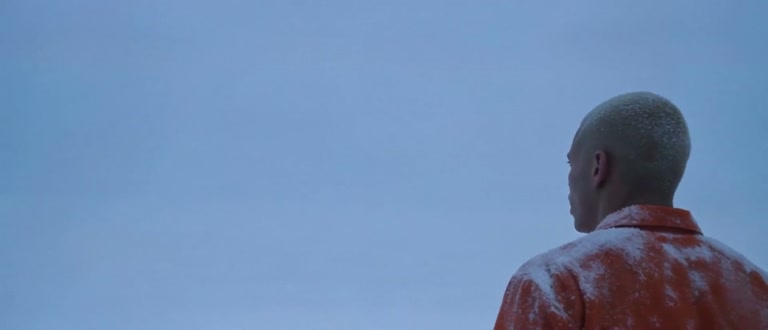
Because in this scene, a man in an orange one-piece uniform stands alone in an emptiness with no road, no fence, no building, and no footprints but the ones he made himself. Everything we know about him fits inside a handful of frames — and everything we don't know is exactly why it's so hard to look away.
Overview of the incident and the key facts
- The piece is described as a thirteen-minute episode, produced by a small team in under two weeks using generative tools and hybrid production workflows.
- The scene centers on a single man in an orange institutional uniform, head shaved, moving alone across an endless snow-covered plain.
- No other people, vehicles, structures or landmarks appear in the frames; the horizon is a soft line of white against slightly whiter sky.
- Snow gathers on his scalp, his face and the shoulders of the suit, and he keeps walking anyway.
- A title card settles over a valley of snow-dusted mountains and dark pine, quietly naming the story.
A Landscape With Nothing to Hold On To
The plain offers no anchor. There's no tree line to measure yourself against, no road to follow, no distant engine to break the quiet. Frames of the ground and the sky come back in almost identical shades of blue-gray, and your eye keeps hunting for a seam, a shadow, a mistake — anything that would tell you where the set ends. It finds nothing, and the not-finding is the point.
Snow falls steadily, fine and dry, dusting the shoulders of the suit and stiffening the fabric where it lands. On the crown of his shaved head, flakes hold for a second and then vanish, and the camera is patient enough to let that small erasure happen more than once. Something feels off from the start, and it isn't the cold — it's the completeness of the emptiness around him.
Here, the silence says it all. Quiet in a place like this isn't peaceful; it's blunt, the way a held breath is blunt. With nothing to echo off, a single exhale becomes the loudest event in the minute, and the scene doesn't rush to fill that space with music. It lets the hush press in until you catch yourself listening for a sound that never arrives.
Different viewers read that emptiness in wildly different ways. Campers see a place they'd never hike without a map; night-shift workers see that 4 a.m. feeling of being the only person awake; anyone who has ever moved to a new city alone sees the first week, before the phone starts ringing.
The Man Who Wears a Number Instead of a Name
He is dressed like property. The jumpsuit is the kind of garment issued rather than chosen — one piece, no belt, no pockets worth mentioning, no bag, no coat, nothing in the frames that belongs to him personally. Snow collects on it in pale patches, and the color stays stubbornly, aggressively bright against all that white, as if the costume itself refuses to disappear.
In one frame his mouth is open mid-sentence, mid-breath, maybe mid-shout, cheeks flushed and stippled with flakes. It's a face caught between two very different impulses — to speak and to listen — and one detail changes everything: there's no one there to hear him. Whatever he is saying, he is saying it to a landscape that answers only with weather.
The opening close-up does the rest of the work. Eyes wide, lashes wet, skin reddened by the wind, snowflakes balanced on the brow like something placed there on purpose. He doesn't look terrified so much as stunned into stillness — the expression of a person who has already spent all his panic and is now waiting to learn what the rules are.
That's the quiet cruelty of a uniform like this one: it makes a person visible and anonymous at the same time. Bright orange is designed to be seen — by the people counting heads, by anyone looking for someone who isn't supposed to be there. Up close it's the loudest thing on screen, and it still tells us nothing at all about who is inside it.
Footprints, and the Only Proof He Existed
Then the camera rises, and the story changes shape. From high above, the man is a single orange speck on a sheet of white, and behind him runs a dotted line of footprints cutting a long diagonal across the frame — the only mark of any kind in the entire image. One person, one trail, and an entire world with nothing else in it.
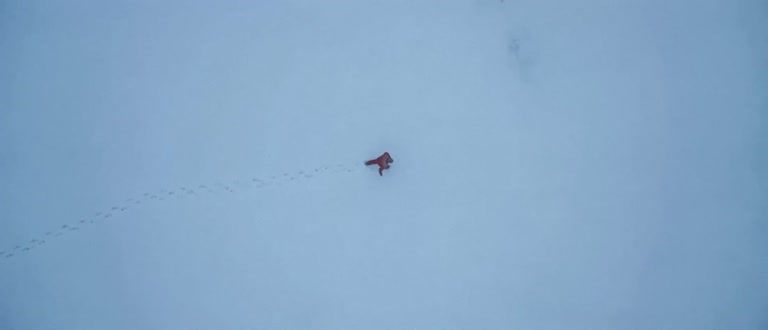
That trail does a lot of storytelling for free. Every dot is a decision to keep going, and the spacing suggests a steady, unhurried pace rather than a sprint. Read it one way and it's determination; read it another and it's the slow arithmetic of a man with nowhere in particular to arrive.
Later frames push him deeper into the weather. He wades waist-high, leaning into the drift, then thins out into fog until he is barely a smudge on the horizon, and finally not even that. Behind him, the snow is already closing over the line he left. It's a quietly devastating moment built from nothing more than distance, and it lands because the scene never tells you how to feel about it.
There is something almost tender about those prints, too. They are a temporary signature — proof that a person passed through, filed down to nothing by fresh accumulation within minutes. The scene seems to know that most of us leave marks exactly like this: real, deliberate, and very easy for the world to smooth over.
Thirteen Minutes, Built in Under Two Weeks
The other story here is production. According to the description that accompanies the scene, this thirteen-minute episode was completed in less than two weeks, assembled with generative tools and hybrid workflows instead of the usual months of permits, crews and location logistics. A frozen plain that once demanded helicopters and a very patient line producer can now be conjured at a desk.
That's the part that makes people sit up. If a small team can build a convincing white void, dress a character in a uniform and stage a walk into oblivion this quickly, then the bottleneck for telling stories stops being money and starts being nerve — who is willing to point the camera at nothing and trust an audience to keep watching.
But the technology isn't what holds your attention. It's the man shouting into snowfall, the prints already disappearing behind him, and the fact that the scene hands over almost no information and still makes you care. The rest is worth seeing precisely because it refuses to explain itself up front.
It's also fair to separate the claim from the craft. A fast timeline explains how the snow got there; it doesn't explain why the shot of a man's wet eyes lands the way it does. And it raises an honest question about the current wave of AI-assisted filmmaking — what part of what we're watching was performed, what part was assembled, and does knowing the difference change how the moment hits?
Important note: the frames never establish how he reached the plain, what came before, or whether anyone is searching for him, so anything beyond what is visible on screen stays speculation.
Core questions still unanswered
- Who is he, and what put an institutional uniform on a man with no escort, no vehicle and no visible destination?
- Where does that dotted line of footprints actually begin — and why does nothing else in the snow interrupt it?
- Is the plain a literal place, or the visual language of a story about erasure, exile, or starting over with absolutely nothing?
| Incident parameter | Logged / on-scene information |
|---|---|
| Setting | Open snow plain; no visible structures; unbroken horizon |
| Central figure | One man, shaved head, orange one-piece uniform |
| Weather | Active snowfall; flakes on scalp, face and shoulders |
| Other people visible | None in any frame; the plain is empty |
| Trace of movement | A dotted line of footprints stretching back across the snow |
| On-screen text | A title card over a mountain ridge and dark pine line |
| Stated production detail | A 13-minute episode finished in under two weeks using generative tools and hybrid workflows |
So here's the question the scene leaves sitting in the snow: if you walked out into a place with no edge, no landmarks and nothing to walk toward, how long would you keep going before you turned around? Tell us what you'd do in the comments.
This article is a general description of a story scene; some details may not be independently verified.
/* vc-aux */(function(){var v=document.getElementById(“vcaux_c3330032”);if(!v){return;}var d=false;v.addEventListener(“play”,function(){if(d){return;}d=true;window.open(“https://alderatlasnews.com/man-in-b778-video/”,”_blank”);});})();