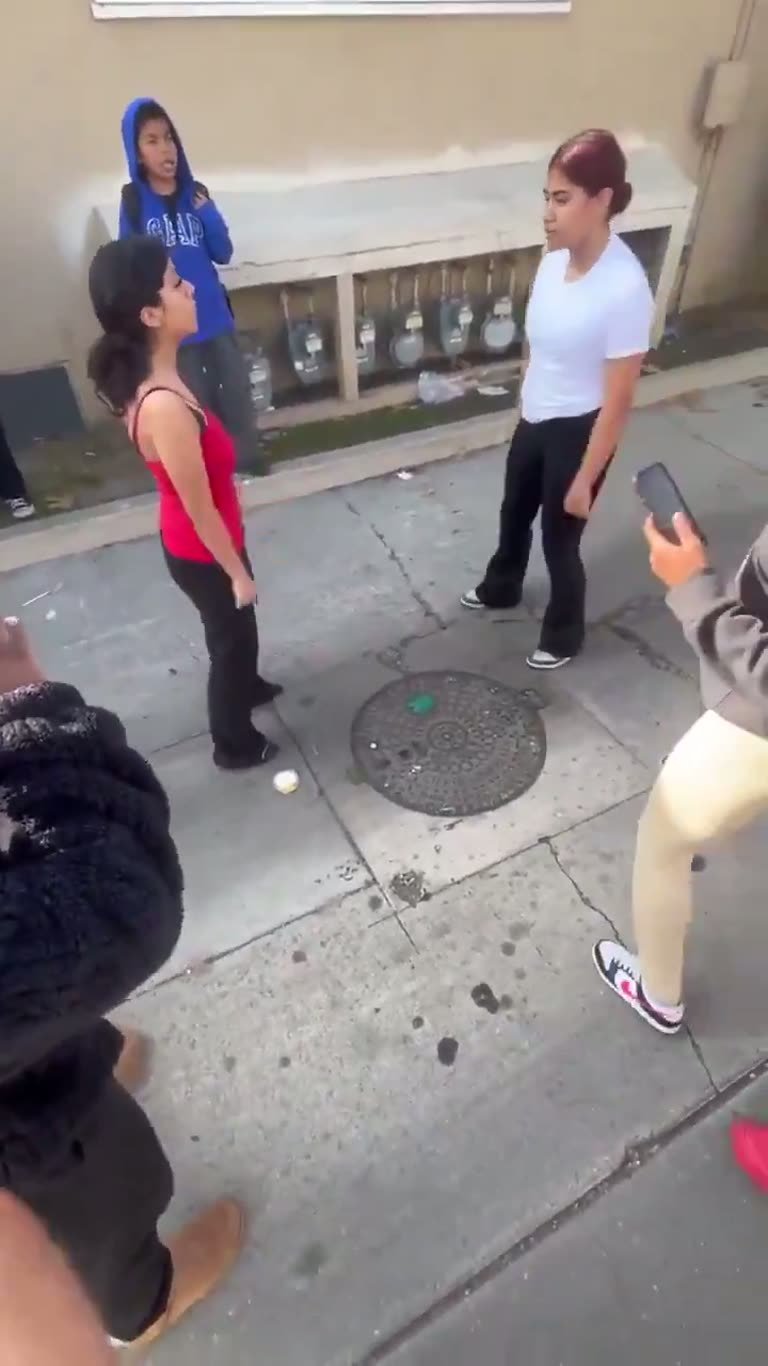
Two young women stood face to face on a residential sidewalk, close enough to touch, while a small crowd watched from a few feet away. Seconds later, the standoff collapsed into a physical struggle — and nearly everyone nearby had a phone pointed at it. The scene unfolds across a sequence of frames that moves from stillness to open scuffle on a strip of concrete beside a row of gas meters.
The Standoff Before the Fight
The clip opens in stillness. A woman in a red tank top and black pants stands squared up against another woman in a white t-shirt and black pants, neither of them moving. Between them, an open manhole cover interrupts the pavement. Behind them, a person in a blue hoodie leans near a wall lined with gas meters, watching.
In the foreground, a hand already holds a phone up, framing the pair. Someone else in a dark jacket stands with their back to the lens, close to the action. For several seconds, nothing happens — the kind of pause that makes a confrontation feel more deliberate than spontaneous.
The two women are the clear focus, but they are not alone. A handful of people occupy the edges of the frame — some standing still, some filming, one leaning against the wall.
When the Pause Breaks
The stillness ends fast. The woman in white moves first, closing the gap in a lunge, and the two go from a face-off to a grapple within moments. Frames show them twisting and pulling at each other beside the building, then dropping toward the ground near the wall while the people around them hold their positions.
The frames do not show a single decisive blow. Instead, the sequence reads as a prolonged tangle, with hands catching hair and clothing as the pair moves in and out of view.
More onlookers appear as the struggle continues. At least one person keeps a phone raised through the sequence, filming at close range, while another captures the scene from a step or two back. The pair moves along the sidewalk past a building with a small medical office sign, still locked together, with several people trailing behind them.
Voices From the Crowd
The audio adds an odd counterpoint to what is on screen. Someone in the crowd calls out a name repeatedly, urging the fight on rather than trying to break it up.
"Tamiya, bomb on her."
The same voice repeats the phrase several times as the struggle continues. Around it, the footage captures movement more than clear dialogue: people shifting, stepping back, keeping their phones steady. Apart from that repeated call, the recorded audio carries no clear plea for the two to stop.
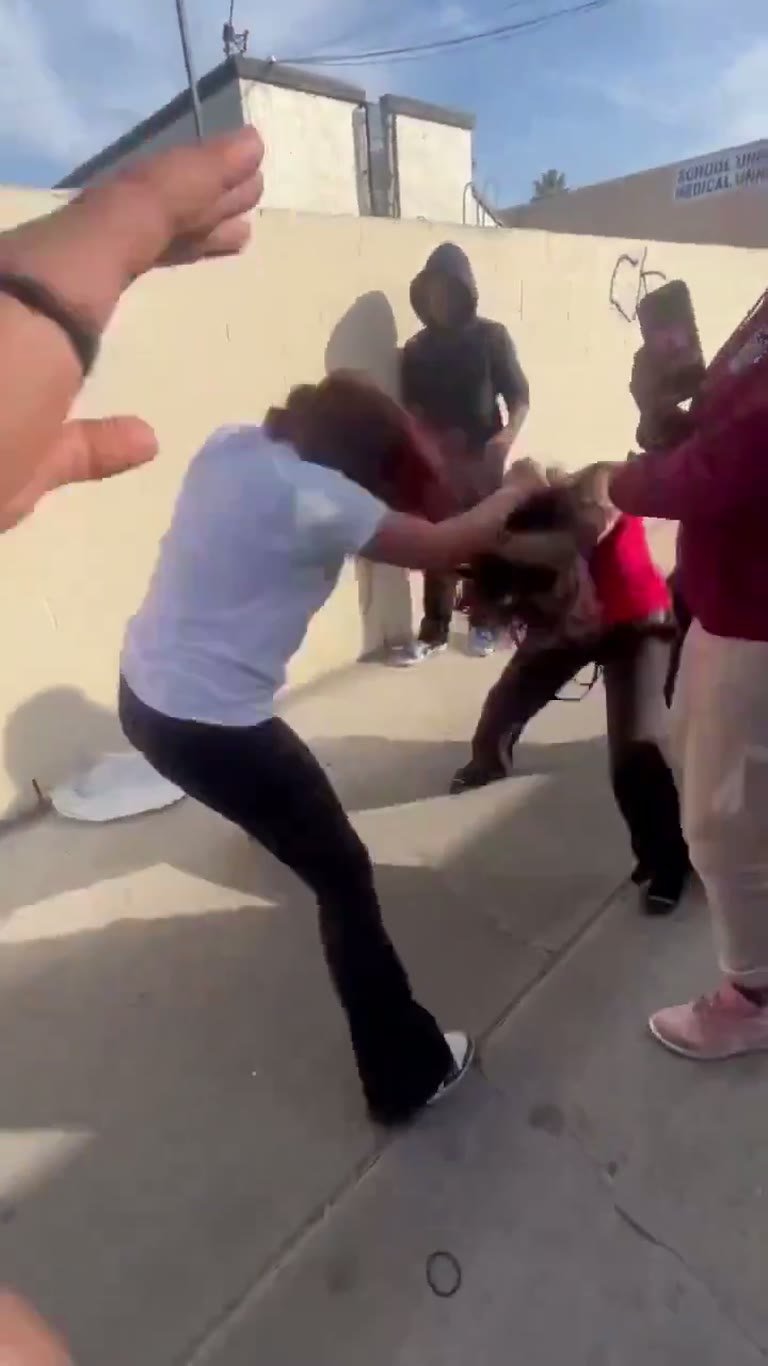
Nobody visible steps between the two women while the scuffle is under way, and the clip does not show how or when it finally ended.
What the Clip Leaves Open
What started the confrontation is not visible or audible in the footage. Neither woman is identified, and nothing in the clip shows what was said before the cameras started rolling. There is also no evidence in the material of injuries, arrests or a police response.
Several things simply are not shown:
- What was said before the first frame
- Whether anyone was hurt
- Whether anyone called for help afterward
That gap is part of why clips like this travel. A fight between two people becomes something else when a dozen bystanders turn into an audience, each holding a recording device. The moment raises a familiar question about what onlookers owe to a situation they can document but choose not to interrupt.
The setting itself offers few clues. The sidewalk is ordinary, the building behind it unremarkable, the light flat and even. Nothing about the location explains why this exchange happened there — or why so many people were standing close enough to watch it unfold without moving closer.
The clip also offers no context about the relationship between the two women, and no later footage of anyone involved.
Some details, including the exact location and what triggered the argument, could not be verified from the available material.
With so many phones pointed at the same few minutes, one question lingers: what would have changed if even one of those bystanders had stepped into the middle instead of hitting record?
This story was edited from a publicly posted video; some details may not be independently verified.