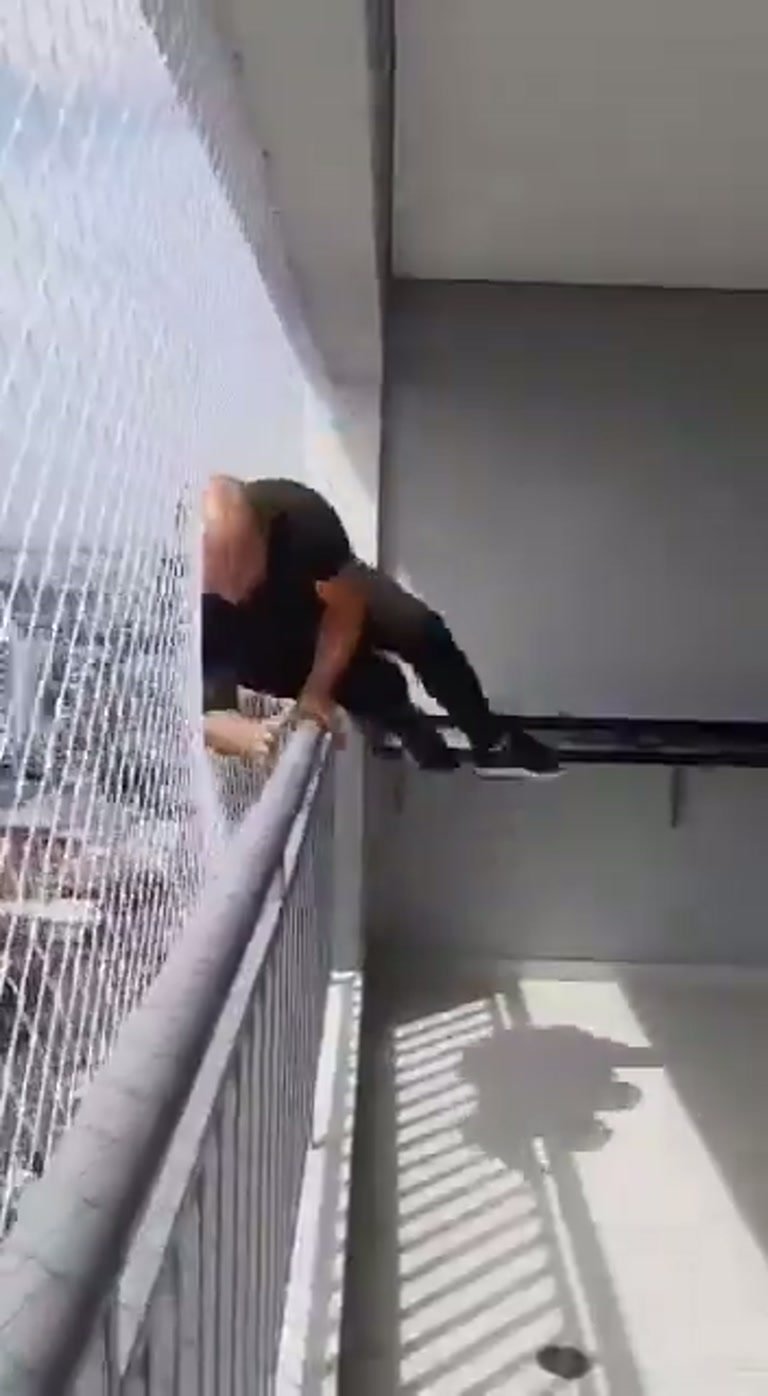
A man climbed over the railing of a high-rise balcony and at one point hung inverted beside a white safety net, his hands away from the metal. The scene plays out in hard afternoon sunlight above a city of tiled rooftops, and it ends with him back on the balcony floor. Nothing in the available material explains what prompted the climb.
A Plain Balcony, High Up
The balcony is narrow and unremarkable: pale grey walls, a grey metal railing along the open side, a dark bar fixed horizontally to the wall, and a round drain set into the pale floor. A white net is stretched across the full opening, running from the ceiling edge down past the railing, so the city is visible only through the mesh.
Beyond the net, the view drops away to rooftops with terracotta tiles, antennas and low buildings — a view that places this balcony well above street level. Within the sequence, the balcony holds one person. No furniture, no second figure and no movement appear on it at any point.
The light does much of the scene-setting. Shadows run in long diagonal bands across the wall and floor, and the man's own silhouette is cast on the tiles behind him — the kind of contrast that appears when the sun is angled past a roof edge.
The Climb Over the Rail
The man, wearing a dark short-sleeved shirt and dark trousers, appears at the railing and leans across it, both hands on the top rail, looking down. His shadow falls across the floor in long stripes, matching the sunlight cutting in from the open side.
Then he moves. He shifts his weight up onto the railing, using the metal and the net for balance, with his body partly on the balcony side and partly beyond it. Throughout, the white mesh and the drop below stay visible together in the same view.
Between those moves he holds still for stretches, hands on the rail, weight settled, while the view through the net stays unchanged: rooftops, small buildings, street-level detail too far down to read. He straightens, checks downward again, keeps one hand on the railing and reaches up toward the net line above his head.
Legs Hooked, Hands Free
The most striking stretch comes later. His body turns inverted, legs hooked near the railing while his torso hangs and the net takes part of the load. For a moment he is upended with his hands off the metal.
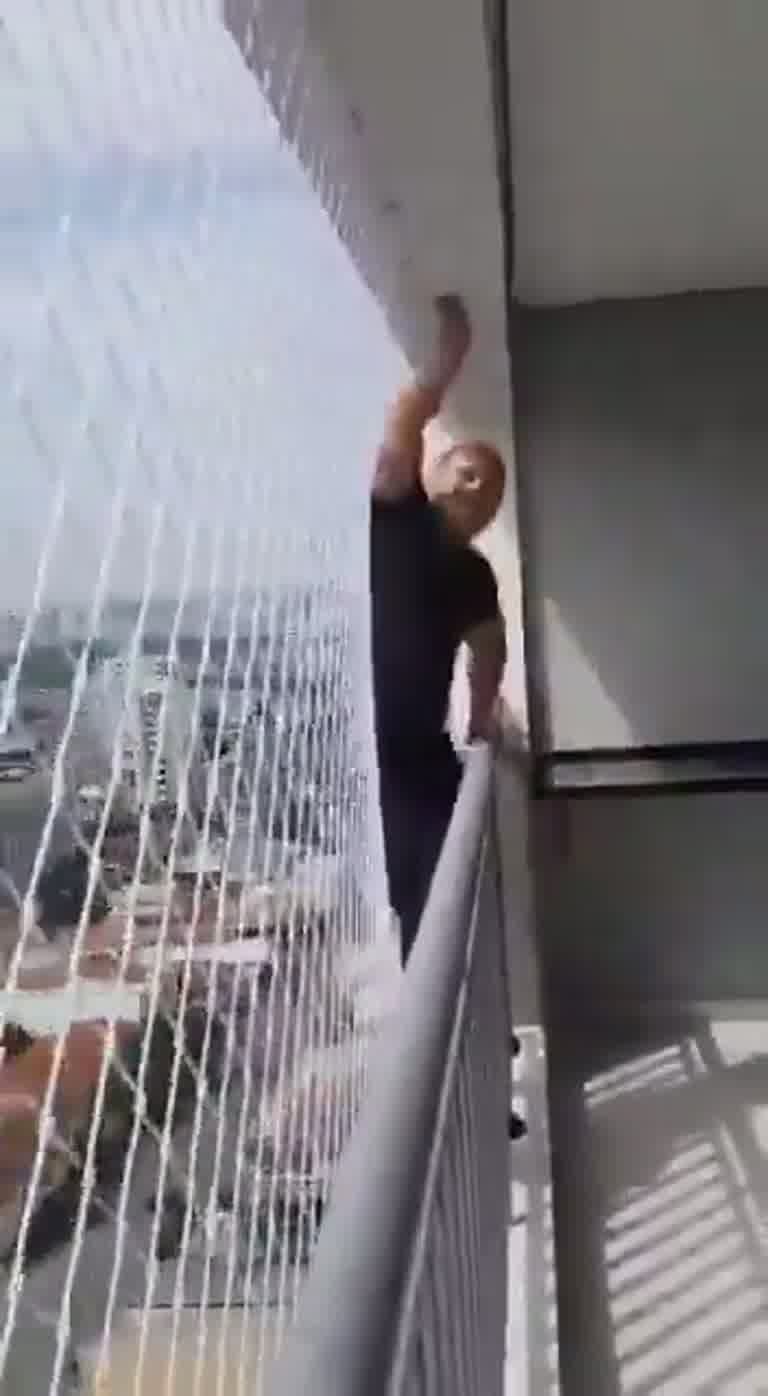
- The railing remains the pivot point throughout.
- The net flexes where his weight presses against it.
- The city below never leaves the view.
Why anyone would take that position is the question the sequence leaves open. A balcony rail is a barrier rather than a platform, and railings, nets and height are exactly the combination that safety guidance warns about, because a single slip changes the outcome.
Nothing in the view suggests a second person on the balcony, and no one appears to step in or assist, which leaves the length of the whole episode — seconds or minutes — impossible to judge from what is available.
Back Onto the Balcony Floor
By the end of the sequence, the man has come back over the railing. He is bent forward with one shoe lifted toward the pale floor, his body still over the metal, reversing the climb. The balcony then looks the way it did at the start.
For anyone who lives on a high floor, the detail that draws the eye is not the city but the net: a fixed barrier between the railing and the open air, already in place before anything happened. What the material does not supply is what most readers will want: who he is, where this building stands, whether anyone inside knew, and how long the whole episode lasted. Nets of this kind are fitted to high balconies for different reasons — to keep birds off, to stop objects from falling, or as a safety measure — but nothing here states which one applies.
Some details remain unverified: the city, the building, the man's identity and what prompted the climb are not confirmed by the available material, and the short audio line accompanying the clip does not clearly describe the scene.
What would you want to know first — how long he stayed out there, or why the net was already in place?
This story was edited from a publicly posted video; some details may not be independently verified.