A shirtless young man stands chest-deep in water so cold it has formed a skin of ice. Seconds later, the view drops below the surface, where a hand is pressed flat against the underside of that ice. The sequence ends without showing how the moment was resolved.
A Shirtless Dive Into Freezing Water
The footage opens on a young man, shirtless, standing chest-deep in dark water crowded with broken slabs of ice. Rough stone or concrete edges the water on one side, suggesting a canal, a channel or a shallow basin rather than a swimming pool. In one hand he holds a long tool with a strap or cord attached; its exact shape is not clear from the frames.
The surface is already partly frozen. Slush and loose ice drift past him as he moves, and the water around him would be dangerous within minutes for anyone without protection. The scene has stirred discussion online precisely because he appears to be preparing rather than struggling.
Only one line of speech is clearly audible in the material:
"Let's go."
Everything after that is water.
A Hand Under the Ice
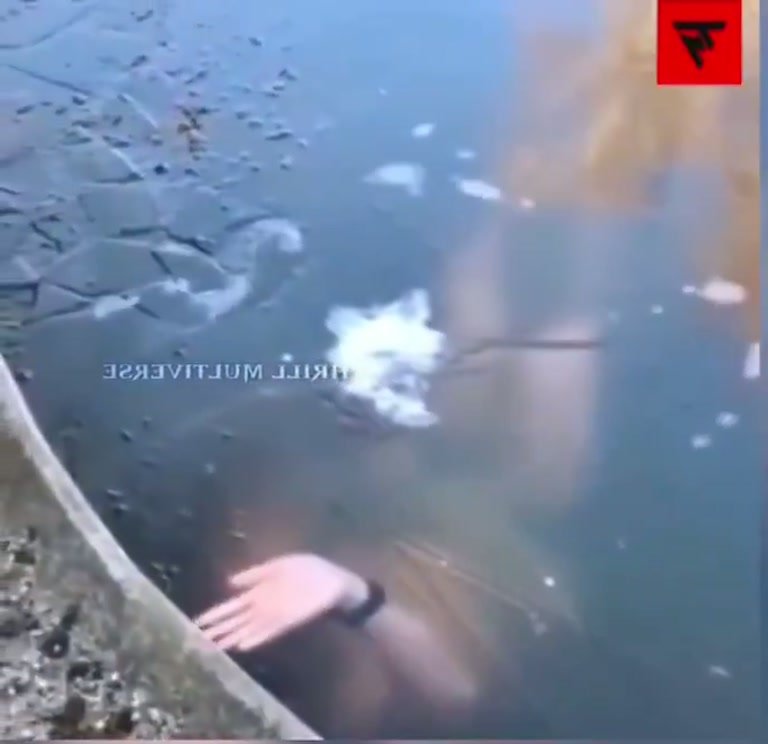
The camera then moves below the surface. Instead of a face, the view finds a pale hand pressed against the ice sheet from underneath, fingers spread, with trapped air and foam pushing at the frozen layer. A dark band or watch sits on the wrist.
Broken ice floats overhead in blue-grey water. Patches of open water let light through the sheet, and a coiled blue pipe or hose rests on the bank at the edge. In one frame, the blurred outline of a body moves beneath the surface, indistinct and impossible to read clearly.
That sequence is what holds the attention: one hand flat on the ice, no obvious way to tell which direction is up. Whatever the plan was, the water is setting the terms. A few visible details frame the rest of the story:
- The water is partly covered with broken ice, slush and drifting fragments.
- Text overlays on several frames appear mirrored and are not written in Latin script.
- No frame shows the person leaving the water.
Above the sheet, the water looks calm and shallow. Below it, the movement is constant: bubbles, foam, drifting ice and a hand that keeps returning to the same spot on the underside. The contrast between the two views is what makes the sequence feel longer than it is.

Labels, Mirrored Text and Missing Context
Several frames carry those text overlays, along with a red graphic in the upper corner. The uploaded title labels the material as banned content, a common wrapper for reposted footage that circulates outside its original channel.
Because the overlays are mirrored, the source is not clear from the images alone. The location, the date and the identity of the young man cannot be established from what is available, and there is no official conclusion about what happened to him.
The word in the title does a lot of work. Material presented as banned or restricted tends to travel faster than material presented plainly, because the label promises something the viewer cannot easily find elsewhere. Here the promise outruns the evidence: the footage is brief, the overlays obscure their origin and the ending is left off-screen.
What is consistent is the general warning that applies to any frozen water: thin ice over moving water is unpredictable, and cold shock can overwhelm a strong swimmer within seconds. Rescues on rivers and canals recur every winter when people test the surface, which is part of why clips like this spread and part of why reactions online stay divided.
What the Footage Does Not Show
The sequence stops near the bank, with ice fragments, dark water and the blue hose in the frame. Nothing in the available material shows the man climbing out, and nothing confirms that anyone was injured.
Reposted stunts tend to lose their context in transit, leaving viewers to read a few seconds as a whole story. That is the case here: the reason for the dive is never stated, and the reaction has been mixed, with some questioning the risk and others treating it as a stunt.
With no verified ending to the clip, the question that remains is simple: who should be answering what happened after the camera stopped — and does footage like this belong on public feeds while that answer is still missing?
This story was edited from a publicly posted video; some details may not be independently verified.