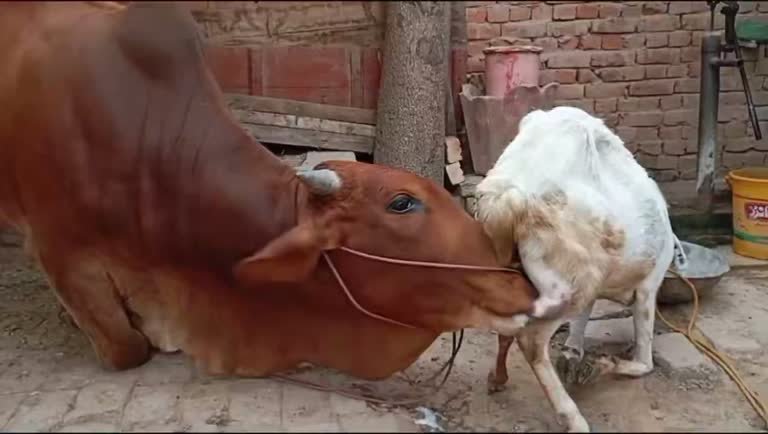
In a courtyard framed by brick walls, a large reddish-brown bull presses its head gently against the side of a small white goat. The goat neither bolts nor bleats — it plants its legs and stays put. The silent, patient exchange has left viewers guessing what either animal is actually doing.
A Courtyard Standoff
The setting is plain and domestic: an unpaved yard, brick walls, a tree trunk rising near the middle of the frame, a metal pail and a hand pump off to one side. A reddish-brown bull stands on the left, a thin rope halter looped across its muzzle and behind its ears, the loose end trailing on the ground. A small white goat — a fraction of the bull's size, its coat blotched with dirt — stands on the right.
What happens next gives the scene its strange charge. Instead of charging, bellowing or chasing, the bull lowers its heavy head and leans it into the goat. Its muzzle rests against the goat's neck, shoulder or flank. Then it does it again. And again.
Nothing in the pair's posture suggests panic. The goat does not sprint for the wall. It shifts its feet, dips a front leg, braces — and holds its ground while the larger animal keeps pressing its head into it.
Repeated, and Still Unexplained
Across the sequence, the pattern barely changes. The bull readjusts its stance, dips its head lower, leans in. The goat scrambles for footing on the packed ground, bends a leg, straightens again. At one point the goat lowers its own head toward the bull's muzzle, as though meeting it halfway.
Near the edge of the yard, a second white animal moves beside a metal basin, apparently unfazed by whatever is happening in the middle of the frame. No person steps in. No hand pulls the bull back by its rope.
That absence of intervention is part of why the moment reads as ordinary farm life rather than an emergency — and part of why it is so hard to label. There is no obvious trigger: no food, no intruder, no visible sudden noise, just two animals of wildly different size locked into the same stubborn routine.
Many viewers have split over what it means. Some read it as a playful nudge, the animal equivalent of a shove that ends in a shrug. Others see a smaller animal being crowded and refusing to give way. Neither reading has been confirmed, and the people who know these animals best are not part of the frame.
Why Nobody Can Say for Sure
The honest answer is that a short clip is a poor witness. It shows behaviour without history. There is no way to know whether these two animals share a pen every day, whether this happens constantly, or whether the encounter lasted thirty seconds or half an hour.
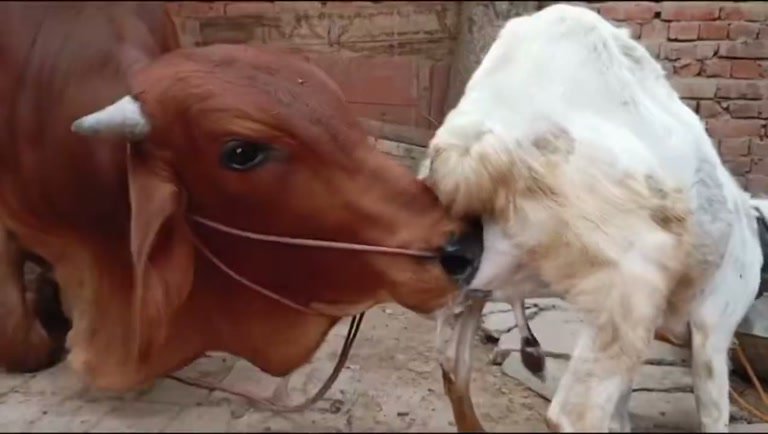
Size also bends how people read the scene. A bull that outweighs a goat many times over looks threatening by default, even when the contact itself is slow and controlled. The goat's reaction, meanwhile, looks calmer than most people expect from a much smaller animal facing something that large.
Anyone who works with livestock would ask different questions: whether the smaller animal keeps eating and moving normally, whether the behaviour is new or long-running, and whether either animal shows signs of discomfort. Those details decide whether something is worth worrying about — and none of them are visible here.
The clip's pull is easy to understand, though. It offers no plot, no villain and no verdict, just a mismatch of scale in a quiet yard. That blank space is exactly what invites people to fill it in with their own theories.
Which leaves the scene where it started: two animals, one brick yard, and a head that keeps coming down.
Reading Animal Body Language
When animals of very different sizes interact, the useful signals are rarely the dramatic ones. Watch the ears, the tail, the eyes, and whether an animal retreats or holds its position. Head-to-head or head-to-body contact is common among social animals: it can be play, an itch being scratched, a claim over space, or simple reassurance. Stillness is information too — an animal that freezes is paying attention, not necessarily relaxed. Short clips strip away context, so a moment that looks alarming can be routine and a moment that looks calm can follow something we never saw. Behaviour that repeats over days is usually what tells a keeper to look closer.
What do you make of this pair — play, irritation, or a smaller animal quietly refusing to move?
Content edited from a publicly posted video; some details have not been independently verified.