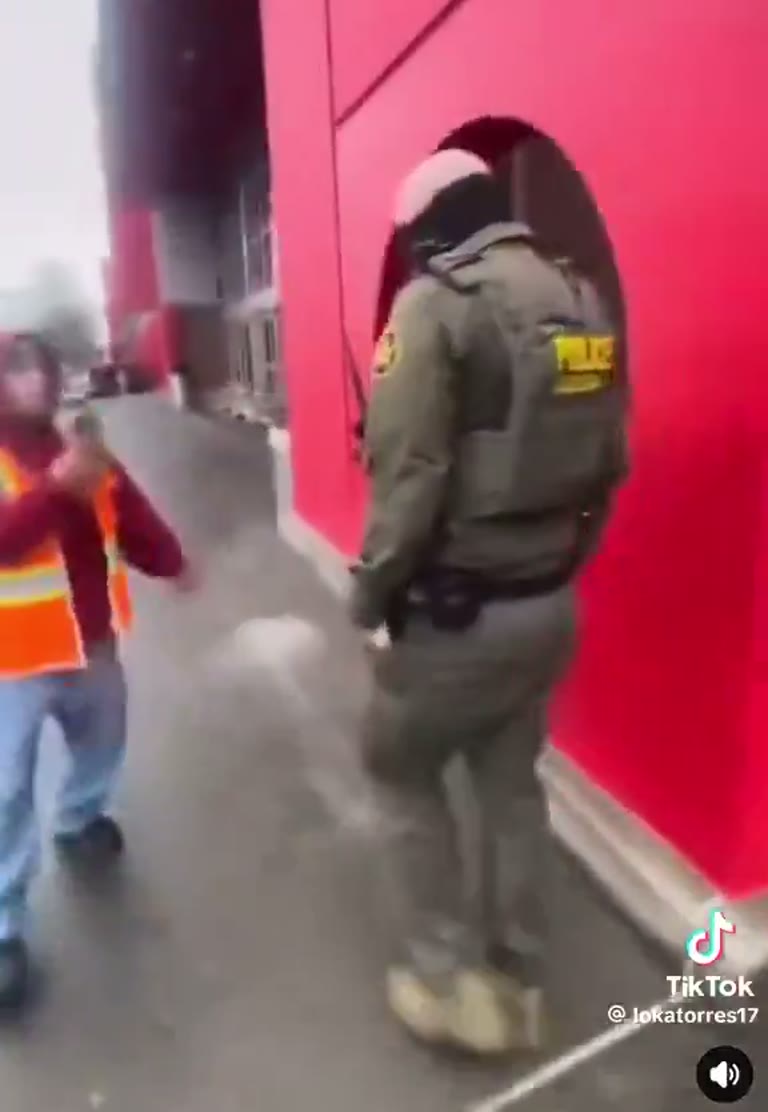
A brief but charged encounter outside a fast-food outlet has drawn attention online, showing a uniformed officer moving quickly towards a doorway while a bystander in a high-visibility jacket gestures and speaks. The footage, which runs for only a few seconds, captures a sudden escalation that has left viewers asking what preceded it and what happens next in an environment where immigration enforcement and public reaction often collide.
Overview of the incident and the key facts
- The video shows a uniformed officer walking past a stainless-steel cycle rack towards a takeaway entrance marked "order pickup".
- A bystander wearing an orange high-visibility vest and blue jeans is visible to the left, gesturing with one hand as the officer moves.
- The officer's jacket carries a yellow "POLICE" patch on the back and a radio on the shoulder, indicating law-enforcement status.
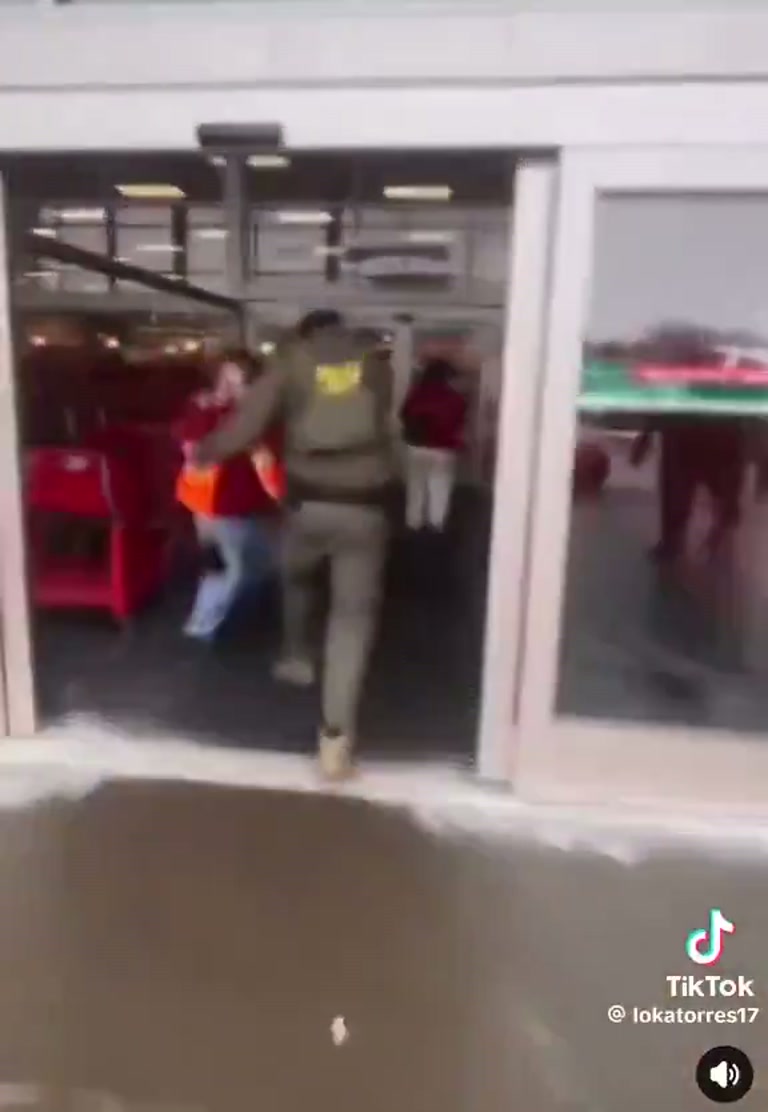
- The footage ends as the officer steps through the doorway; no clear outcome, arrest or injury is visible within the clip.
- The source description frames the clip as an immigration-enforcement arrest video, though no official confirmation appears in the footage itself.
The video opens on a wet, grey pavement outside a building with a bold red panel and a white-framed takeaway window. A uniformed officer is already in motion, walking away from the camera with steady, deliberate strides, the word "POLICE" stamped in yellow across the back of an olive-green jacket. To the left, a person in a bright orange high-visibility vest and blue jeans is visible in profile, one arm raised slightly as if speaking or gesturing towards the officer.
The setting is unmistakably a fast-food outlet. The window behind the officer is marked "order pickup", and a row of curved stainless-steel cycle stands sits along the wall, catching the dull light of an overcast day. There is no crowd, no sirens, no visible weapon — just a small cluster of people and a doorway that becomes the focus of the entire clip.
What the footage captures is a moment of movement rather than a resolved event. The officer approaches the entrance, pauses briefly in front of the glass, then steps inside. The camera follows at a short distance, close enough to catch the reflection in the window and the faint sound of a voice off-screen saying, "Hey, don't touch him. Don't touch him. What are you doing?" The words hang in the air without context, leaving the viewer to piece together what is happening inside.
Because the clip is so short, the verified facts are limited: one officer, one bystander, one entrance, one short verbal exchange. Everything beyond that — the reason for the officer's presence, the identity of the people involved, and the outcome of the encounter — falls outside what the video actually shows. That gap is exactly what has driven the clip's circulation online, where viewers fill the silence with their own interpretations.
The scene, the sound and the sudden turn
There is a particular quality to footage shot in the rain — the pavement shines, colours deepen, and every sound seems closer than it should be. Here, the grey light flattens the street, and the only vivid colours are the red panel of the building and the orange vest of the bystander. The officer's boots make no audible sound on the damp concrete, but the camera's slight wobble suggests the person filming is moving quickly to keep up.
Then comes the audio. A voice, urgent but not shouting, repeats: "Hey, don't touch him. Don't touch him. What are you doing?" It is the kind of line that immediately raises questions. Who is being touched? Is the speaker a friend, a colleague or simply a passer-by? The video does not show the answer, and the repetition of "look" in the transcript that follows suggests someone is pointing at something off-camera, drawing attention to a detail the viewer cannot see.
The tension in the clip does not come from violence or chaos. It comes from uncertainty. The officer's posture is calm and purposeful; the bystander's gesture is animated but not aggressive. The doorway swallows the officer, and the camera lingers for a moment on the glass before the footage ends. It is a fragment — a slice of an evening that could be routine or could be the start of something significant.
What makes such clips circulate so widely is the way they invite the audience to become detectives. Every frame is scrutinised: the patch on the jacket, the position of the radio, the reflection in the window, the exact words spoken. Yet the fragment resists a tidy conclusion, and that ambiguity is precisely what fuels debate in comment sections and group chats.
Why this clip matters beyond the pavement
Immigration enforcement has become one of the most polarising topics in public life, and any footage connected to it tends to travel fast. The source description for this video frames it as an "ICE arrest" clip, and the caption adopts a celebratory tone. That framing matters, because it shapes how viewers approach the footage before they have watched a single second. A clip presented as a triumph will be read differently from one presented as a warning.
At the same time, the footage itself does not show an arrest. It shows an officer entering a takeaway while a bystander speaks. The gap between the caption and the content is a useful reminder of how quickly narratives attach themselves to short videos. Once a clip is labelled, the label often outruns the evidence, and viewers inherit an interpretation they did not build themselves.
For the people actually present — the officer, the bystander, the staff inside the takeaway, the person filming — the moment was real and immediate. For everyone else, it is a puzzle. And puzzles of this kind have real-world consequences: they shape public attitudes, they influence how communities interact with law enforcement, and they can affect everything from business footfall on a street to the willingness of witnesses to come forward in future incidents.
It is also worth remembering that filmed encounters carry legal and financial weight long after the camera stops rolling. Businesses can face disruption, staff can face stress, and individuals can face costs that insurance policies may or may not cover. The viral afterlife of a thirty-second clip can be far more expensive than the encounter that produced it.
Insurance and who pays
When an enforcement encounter happens at a commercial premises, several types of insurance can come into play — though the exact cover depends entirely on the facts, which remain unverified here. The most relevant policies are typically commercial property insurance, public liability insurance, employers' liability insurance, and, for individuals, home or motor policies if property is damaged or a vehicle is involved.
Public liability cover is designed to respond when a business is held legally liable for injury or damage to a third party on its premises. Employers' liability cover protects staff who are injured or become ill because of their work. Commercial property cover deals with damage to the building, fixtures, stock and equipment. If a vehicle is damaged during an incident, motor insurance — including comprehensive cover — may respond, though enforcement-related damage can raise complex questions about who is legally responsible.
Exclusions matter enormously. Most policies exclude intentional acts, criminal acts, and losses arising from law-enforcement operations where the policyholder is not legally liable. Business interruption cover may respond if a premises is closed following damage, but it usually requires physical damage or a specified peril, not merely a disruption caused by an enforcement visit. In the UK, the Financial Ombudsman Service can review complaints if a claim is rejected unfairly; in the US, state insurance regulators and the policy's own appeals process serve a similar function.
The excess, or deductible, is the amount the policyholder pays before the insurer contributes. For commercial claims this can range from a few hundred to several thousand pounds or dollars, depending on the policy. Claimants should document everything: photographs, witness details, receipts, and any correspondence with authorities. They should report the incident promptly, keep damaged items, and avoid admitting liability. If a claim is declined, they have the right to ask for the specific policy wording relied upon and to escalate the matter.
In the US, liability rules vary by state, and some states apply comparative negligence, which can reduce a payout if the claimant is partly at fault. In the UK, the principles are broadly similar but the procedural route differs, with the Financial Ombudsman Service offering free dispute resolution. Readers should treat any figure they see online with caution, because no verified repair or compensation cost exists for this particular clip.
What viewers should take from a thirty-second clip
Short videos are powerful because they compress. They strip away context, preamble and aftermath, leaving a sharp visual impression that feels complete even when it is not. This clip is a textbook example: a wet street, a red wall, a uniform, a raised hand, a doorway. It is memorable precisely because it withholds so much.
For anyone who finds themselves in a similar situation — as a business owner, a member of staff, or a bystander — the practical lessons are straightforward. Keep cameras rolling if it is safe to do so. Note times, locations and descriptions. Avoid physical interference. Report incidents to the appropriate authorities and to insurers promptly. And keep records, because memories fade long before paperwork does.
Insurance is not a political statement; it is a financial backstop. Whether a claim succeeds depends on the policy wording, the facts and the law, not on how a clip is captioned online. That is why it is worth reading the exclusions before an incident, not after. It is also why businesses on busy streets often carry public liability cover as a matter of course, and why individuals should check whether their home or motor policy extends to incidents away from home.
Ultimately, this footage is a fragment of a larger story that the camera did not capture. The officer walked into the takeaway, the bystander spoke, and the clip ended. Everything else — the reason, the result, the cost — is still unknown. And that, perhaps, is the most honest thing that can be said about a video that has already been given a hundred different meanings by the people who shared it.
What do you make of this — should short enforcement clips carry more context before they spread, and would your own insurance actually cover you if a similar scene unfolded outside your local shop?
| Incident parameter | Logged / on-scene information |
|---|---|
| Location | Commercial takeaway entrance with cycle rack |
| Time of day | Daytime, overcast and wet pavement |
| People visible | One uniformed officer, one bystander in high-vis vest |
| Officer markings | Yellow "POLICE" patch, shoulder radio |
| Verbal exchange | "Hey, don't touch him" and repeated "look" |
| Visible outcome | Officer enters doorway; no arrest shown |
| Source framing | Caption describes it as an ICE arrest video |
Important note: Some details in this report, including the identities of those involved and the reason for the officer's presence, remain unverified.
Core questions still unanswered
- What happened immediately before the officer reached the takeaway entrance?
- Who was speaking in the audio, and who were they addressing?
- Did the encounter result in an arrest, a release, or no further action?
🎥 Watch the video at the bottom of the page 👇
This story was edited from a publicly posted video; some details may not be independently verified.