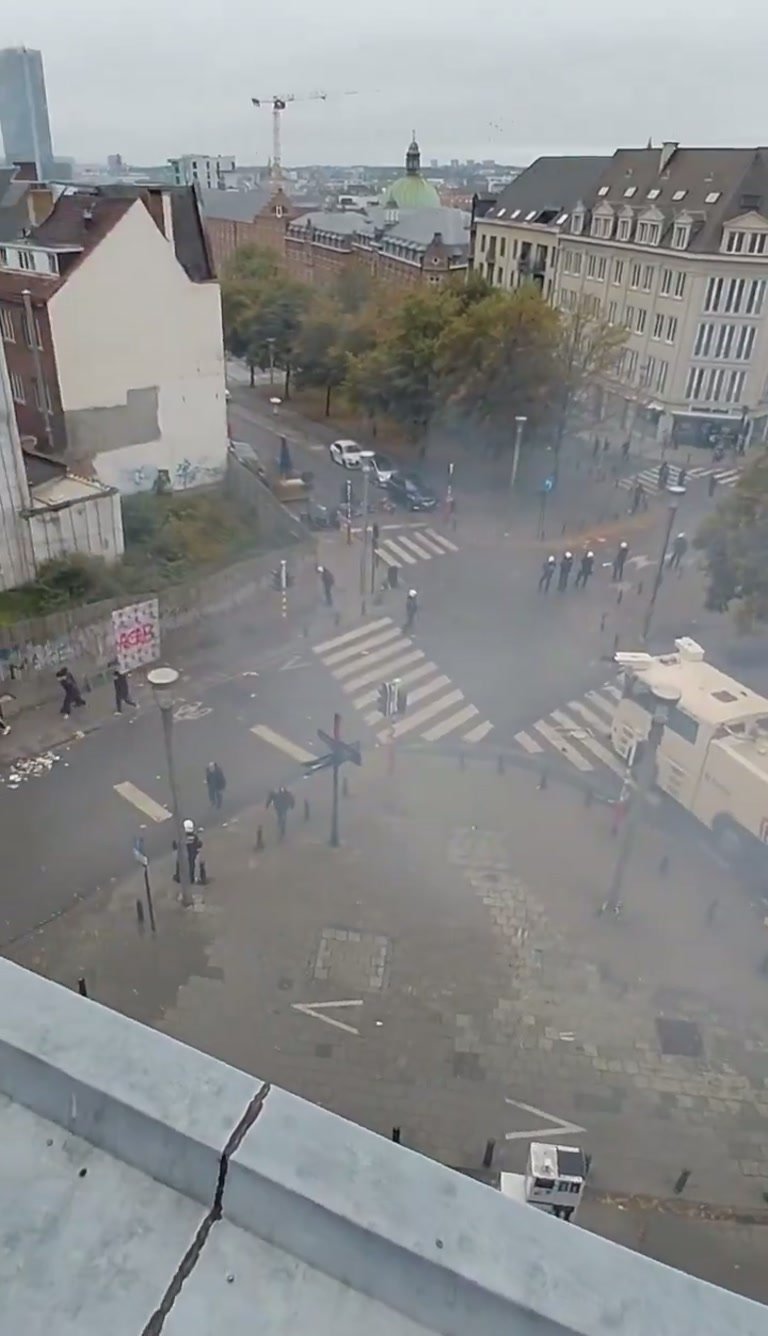
Lyon Street Clashes: Smoke, Fire and a Message to Mélenchon (video)
ADVERTISEMENT
🎥 Watch the video at the bottom of the page 👇
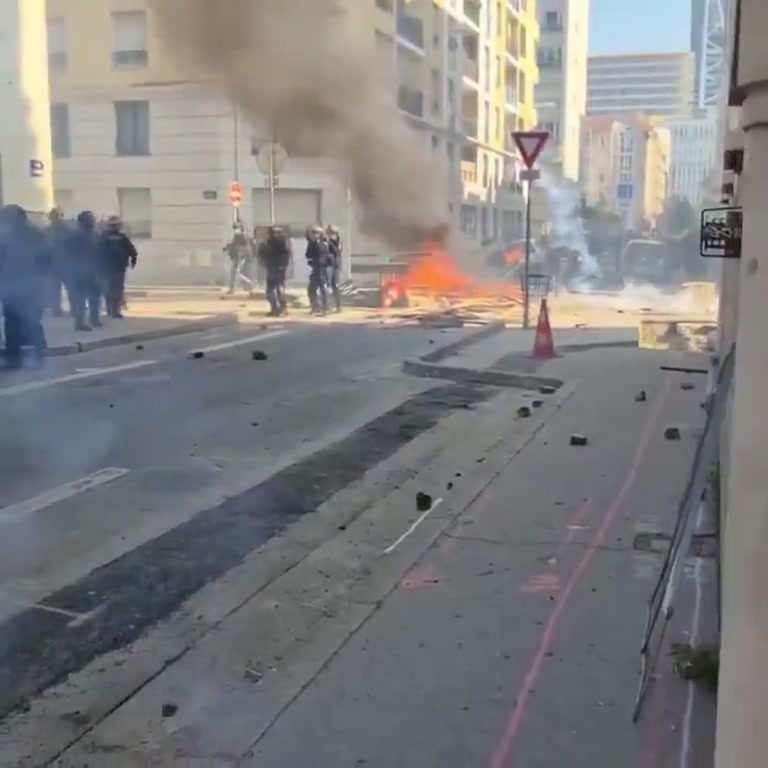
The street is sunlit and almost ordinary — a white box truck at the kerb, a give-way sign, scaffolding climbing a corner building. Then the smoke arrives. It rolls between the apartment blocks, a fire burns low and orange against the asphalt, and a line of officers in dark uniforms and helmets moves forward with clear shields raised. The clip was posted by Matthieu Valet, and the caption he attached to it aimed a short, pointed message at Jean-Luc Mélenchon — a message about 'the famous paperclips' that, according to the post, injure CRS officers.
Overview of the incident and the key facts
- Where it takes place: a residential street in Lyon, according to the caption posted with the footage.
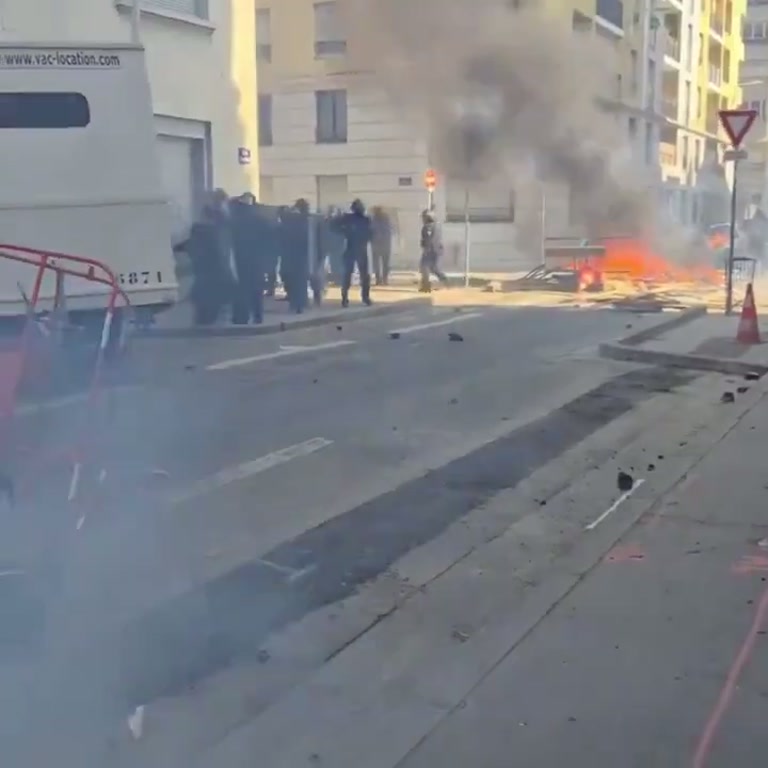
- What can be seen: officers in helmets and dark uniforms, several holding clear shields, standing and moving in the roadway as a grey plume of smoke rises and a small fire burns near the kerb.
- What surrounds them: a white box truck, an orange traffic cone, give-way signs, scaffolding on a corner building and dark debris scattered across the tarmac.
- What the post claims: the caption, addressed to Jean-Luc Mélenchon, refers to 'the famous paperclips that injure CRS officers' and invites him to stand beside 'those who receive them'.
- What is not stated: there are no injury figures, no arrests and no official account of how the confrontation began.
A Street That Stops Being Ordinary
The opening frames carry a strange kind of calm. Officers stand in a loose cluster beside the truck, shields angled toward the road, while the buildings on the right keep their everyday colours — cream walls, yellow facades, rows of apartment windows, a corner that could belong to any French city on any weekday. A single figure in dark clothing crosses the middle of the road at a run, boots hitting the tarmac, and the smoke thickens behind him until the far end of the street dissolves into grey. Daylight does the rest of the work: the sun is low enough to stretch long shadows across the asphalt, to catch the orange of the traffic cone, to make the small fire at the kerb look absurdly bright against a pale afternoon.
ADVERTISEMENT
City streets like this one are built for small, unremarkable moments — a delivery driver swinging the truck into a loading bay, a shopper cutting the corner, children walking home in the last of the light. That is the backdrop the smoke lands on. It is the reason images from a single overlooked block can feel heavier than the event itself, because the contrast is not between order and chaos in the abstract, but between a street people know and a version of it they would rather not see.
Notice what the footage does not supply. There are no banners, no packed pavements, no obvious crowd waiting at the barriers. What is left is the texture of disruption — fragments on the road that did not fall there by themselves, dark pieces scattered over the lane markings, chalk-pink lines daubed along the kerb, a street emptied of the people who normally fill it. Even the officers move as if working inside a routine they know too well: a shield lifted, a step back, a glance over the shoulder at whatever is coming from the far side of the smoke.
And the camera never explains the beginning. It arrives mid-event, which is the defining feature of almost every clip like this one. There is no build-up, no first throw, no signal of what the previous minute looked like. That gap is exactly where the caption steps in — and where the argument starts.
ADVERTISEMENT
The Message Attached to the Footage
The post does not present itself as neutral reporting. It is written as a service message to Jean-Luc Mélenchon, telling him that the famous 'trombones', the paperclips, have been found, that it happened in Lyon, and that when he has two minutes he should come and stand beside those who receive them. You will finally know what you are talking about, the caption adds, before turning to the idea of watching from behind a screen.
Every word there is doing work. The invitation is not really an invitation; it is a challenge about proximity — about who is close enough to a street like this to describe it. The claim about paperclips, meanwhile, is asserted, not shown: the footage records smoke, fire, debris and officers holding a line, but the objects themselves never appear in the frames. Anyone watching is asked to accept the caption's framing of what those officers were facing.
Read the caption slowly and the structure becomes clear. First a claim. Then a location. Then an invitation with a sting in it. The phrase about standing behind a screen is the hinge: it is aimed at a reader as much as at a named politician, and it implies that watching from a distance is a moral position rather than a practical one. Whether that lands depends entirely on how much of the scene the reader believes is already visible.
ADVERTISEMENT
That is why the clip is difficult to treat as simple evidence. It is a political message that comes with pictures attached, and the pictures are powerful enough to carry the message further than it would otherwise travel. The visual record and the written argument are fused into one post, and they cannot easily be pulled apart again.
Why a Few Seconds Travel So Far
Arguments about policing, injury and protest in France have a long life online, and this post arrived with all the ingredients that keep such arguments alive: a well-known name, a short clip, a claim that is easy to repeat and hard to verify, and a setting that looks entirely ordinary until it does not. A street with a box truck and a corner shop makes the fire on the road feel closer to home than any wide shot of a square ever could.
The format matters too. Clips of this length lose their first ten seconds and their last, and the missing edges are precisely where context lives — who was there, what was thrown, what happened after the smoke thinned. Without those edges, the caption becomes the narrator. Readers fill the rest in themselves, and they rarely fill it in the same way twice.
ADVERTISEMENT
Then there is the timing of attention. A post like this arrives in a feed between cooking videos and football highlights, and it is judged in about two seconds: the smoke, the shields, the fire. The political content of a caption is absorbed slowly, sometimes not at all, while the image is absorbed instantly. That mismatch is the engine of the whole debate — people share a street, then discover an argument attached to it.
The people in the frames add the final pull. The officers are anonymous behind visors and helmets, which makes them both specific and universal; a viewer in Lyon recognises the street, a viewer a thousand miles away reads a symbol. Opinions were split almost immediately, as they are in most disputes where the footage is short and the caption is confident. The scene keeps developing in comment sections long after the fire on the tarmac has gone out.
ADVERTISEMENT
Important note: The footage shows a street scene and the post makes a political argument; nothing in the material reviewed establishes who threw what, what injuries occurred, or what preceded the moment the camera started rolling.
A Gap Between Footage and Conclusion
The most honest reading of the material is also the least satisfying one. A street in Lyon, officers with shields, smoke, fire, debris, and a caption with a name in it. Everything beyond that — cause, sequence, consequence — sits outside the frames. The post states a position; the footage documents a moment; neither is the same as a finding.
That distinction matters more, not less, when the subject is sensitive. Public order incidents generate strong feelings quickly, and strong feelings travel faster than verification. Watching responsibly here means holding two things at once: the scene is real and vivid, and the meaning attributed to it is still contested.
Somewhere on that street, when the smoke cleared, someone swept up the debris and traffic returned to a normal afternoon. Online, nothing was cleared away. That is usually how these stories end — the road reopens long before the argument does.
ADVERTISEMENT
Core questions still unanswered
- Who was throwing objects toward the officers, and what exactly was being thrown?
- What happened in the minutes before the recording began, and in the minutes after it stopped?
- Has any authority confirmed the claim about paperclips, or reported injuries from this street?
The details logged from the post and the footage can be set out plainly, with the gaps left visible:
| Incident parameter | Logged / on-scene information |
|---|---|
| Location | A street in Lyon, per the caption posted with the footage |
| Scene on the ground | Officers with clear shields, a grey plume of smoke, a small fire, debris on the road |
| Vehicle visible | A white box truck at the kerb, with lettering and a plate ending 6871 |
| Street furniture | Give-way signs, an orange traffic cone, scaffolding, pink markings along the kerb |
| Time of day | Daylight, low sun, long shadows across the roadway |
| Posted by | Matthieu Valet, in a caption addressed to Jean-Luc Mélenchon |
| Official findings | None stated in the material reviewed |
Some of the most important details — the sequence before the camera rolled, the nature of the objects involved, any confirmed injuries — remain unverified outside the post itself. What the footage does give is a clear sense of place and mood: a bright, ordinary street, suddenly full of smoke, with officers holding a line and onlookers expected to take sides from a distance.
So when the fire is out, the debris swept and the comment threads finally cool, what would it take for a street like this one to be described the same way by the people standing in the smoke and the people watching behind a screen?
ADVERTISEMENT
This story was edited from a publicly posted video; some details may not be independently verified. According to Matthieu Valet.