Acapulco Market Flood: Rain Turns Aisles Into Rivers (video)
ADVERTISEMENT
🎥 Watch the video at the bottom of the page 👇
The rain had been falling for hours before the water ever found the aisle, and by then the aisles of the Mercado Central had already stopped behaving like aisles at all. What the camera catches is a narrow corridor turned into a moving channel, shoppers pinned against the frames of wooden stalls, and the oldest question a flooded street can ask: what do you hold on to when the floor itself starts to travel?
ADVERTISEMENT
Overview of the incident and the key facts
- Intense rainfall hit the port of Acapulco, in Guerrero, Mexico, pushing water through the streets around the Mercado Central, the city's central market.
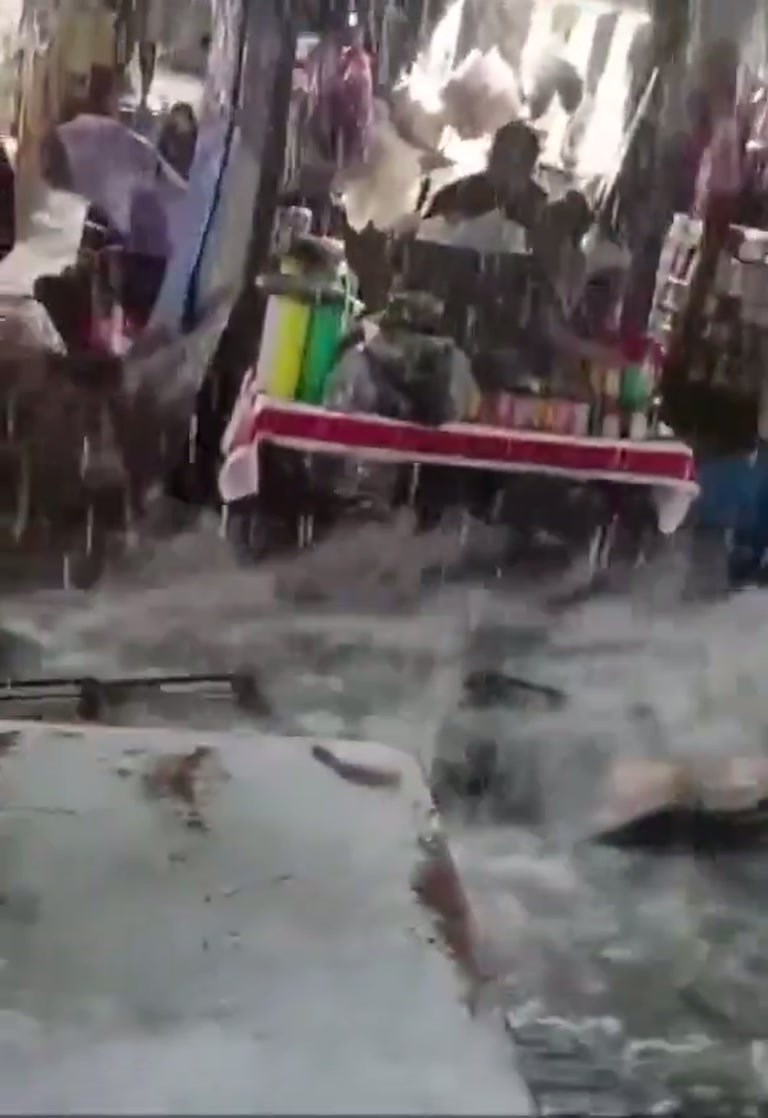
- Runoff moved along the market lanes with enough force to shift adults off their feet, and reports from the ground describe strong currents sweeping people along the flooded floor.
- Frames captured at the scene show water at waist height between the stalls, crates and produce scattered, and shoppers gripping tables, poles and one another.
- A painted sign reading "5" and a bright "Salsa!" sign hang above the water in the footage — small, stubborn details of an ordinary trading day refusing to disappear.
- The images spread quickly online, credited to a local news outlet working on the ground in the flooded port.
A Floor That Stopped Acting Like a Floor
The first thing the footage gives you is sound: a low, continuous roar that is not rain hammering a metal roof but water in motion, carrying weight. Then the picture resolves. It is a market lane — the kind that is loud and crowded and lit by bare bulbs on any ordinary afternoon — now a grey-brown channel running between stalls stacked with boxes. Red-and-white cloth covers still hang where vendors tied them that morning. A blue tarp sags, soaked and heavy. Nothing has been properly packed away, because there was no time to pack anything away.
What makes the scene land is momentum. This water is not pooled, it is traveling. It has direction, it curls around the legs of tables, it shoves debris along at knee height and keeps going. Look closely and you can catch green and yellow plastic containers swaying on a shelf, still upright, still stacked for sale. On the left, a white board carries a single painted numeral: 5. A lane number, a price, a stall marker — nobody watching a compressed phone clip can say for certain, and it hardly matters. Standing in that current, one number means the same thing as every other: this is where somebody's living happens, and right now it is moving past them.
ADVERTISEMENT
And still, in the background, people are standing. That is its own quiet shock. Somewhere between the first ankle-deep inch and the moment the water reached their waists, everyone in that lane made the same calculation — and the calculation did not include running. They climbed onto crates. They pressed themselves flat against stall frames. They stood in doorways and watched the aisle turn into a river. You can't look away, and you can't really blame them either: when water arrives that fast in a place you know by heart, there is no obvious direction to run.
Hands That Closed Around an Arm
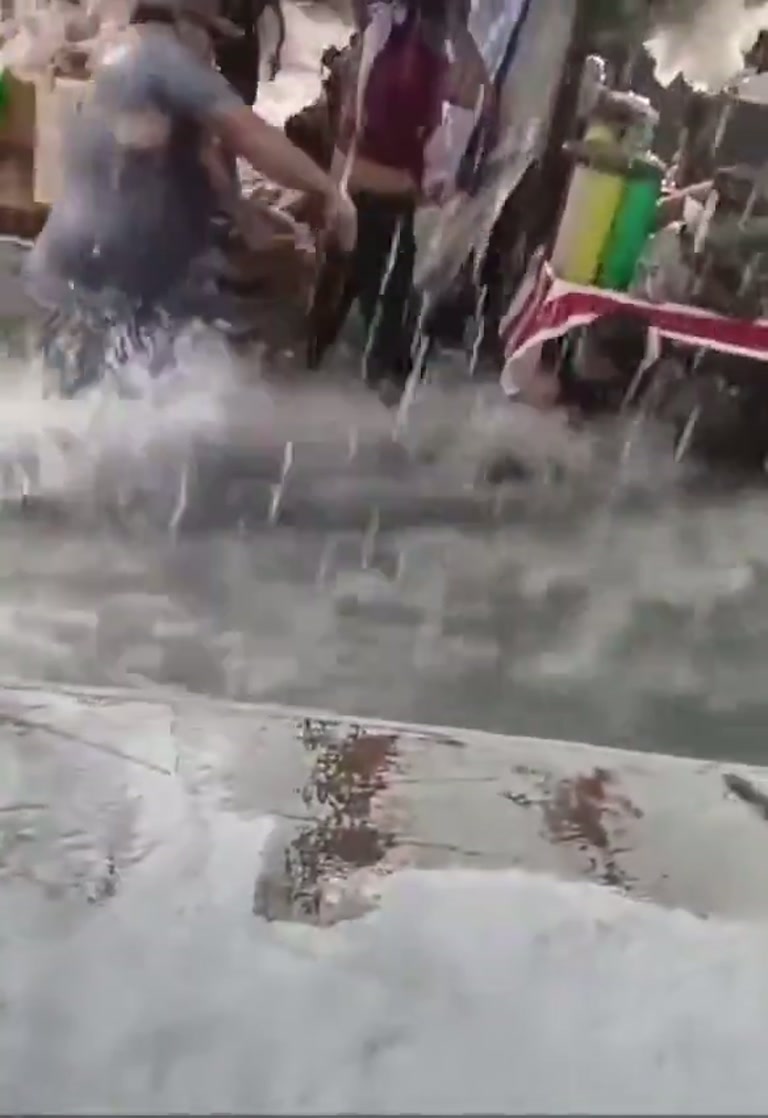
Then the footage changes register. A man in a grey t-shirt wades into the middle of the lane, water shedding off his forearms at chest level, and leans into the flow the way you lean into a hard wind. He is not walking. He is bracing. Around him, the market's geometry has quietly become a set of handholds: a table edge, a doorframe, a metal pole, the side of a crate stack, the corner of a concrete pillar that the current has not yet reached.
ADVERTISEMENT
This is the moment everything changes — not the rain, which was already falling, and not the water, which was already rising, but the instant a person in the middle of that lane stops being scenery and becomes someone with a hand closed around another person's arm. In the final frames, two figures are locked together, low and close, holding on to a stall frame while the water tears at their legs. From a shaky clip shot on a wet phone, it is genuinely difficult to say who is pulling whom, or how the second person ended up in the deepest part of the lane in the first place.
What reads clearly is the shape of the thing: two bodies, four hands, one wooden frame, and a current that does not care. The onlookers matter here too. Other people line the stalls, close enough to help if the water gave them half a second of stillness, watching the way people watch something they cannot quite believe is happening in front of them. Flood footage usually flattens into disaster imagery — sheets of grey, floating objects, no faces. This clip keeps its faces. That is probably why it travels so far and so fast, from one phone to a stranger's feed thousands of miles away.
ADVERTISEMENT
Why Markets Take the Water First
Markets flood first for boring, brutal reasons. They sit low, near the oldest drains in a city. Their roofs and awnings and concrete floors shed rainwater almost instantly, so a downpour that would soak a residential street becomes a surge in a lane built for foot traffic. Add narrow gaps between stalls, uneven pavement, and the loose debris of a working day, and you get a channel that behaves less like a street and more like a small, dirty river with no banks.
ADVERTISEMENT
Acapulco is a coastal port in Guerrero, a place that knows tropical rain well, and that knowledge is exactly what makes this footage unsettling. The difference between a hard afternoon shower and a market full of moving water is measured in minutes, not hours. Vendors face the cruelest version of the trade-off: stay with the merchandise you paid for, or step back and let it go. Somewhere in the frames, you can see both choices being made at once — a table still set, and a person already moving away from it.
There is also a human truth buried in the noise. In the first seconds of an emergency, strangers do not calculate. They reach. The man in the grey shirt did not wait for instructions, a siren, or a guarantee that the water would not take him too; he leaned in. Whatever happened before that moment and whatever happened after the recording stopped, those few frames capture something most of us only hope we would do.
ADVERTISEMENT
Important note: the circulating frames cover only a fragment of that afternoon — the force of the water and the human response to it — not the hours of rainfall that led up to it, nor anything that happened once the camera was lowered.
Core questions still unanswered
- Who was the person pulled toward the stall frame, and how did they end up in the deepest part of the lane?
- How quickly did the water rise inside the Mercado Central, and how many stalls were caught in the flow before anyone could move?
- What did the rest of the market look like once the rain finally eased?
| Incident parameter | Logged / on-scene information |
|---|---|
| Location | Mercado Central, Acapulco, Guerrero, Mexico |
| Weather event | Intense rainfall across the port area |
| Water level in the aisles | Up to waist height between the stalls |
| Reported effect | Strong currents swept people along the market floor |
| Visible in the frames | Flooded lanes, red-and-white stall cloth, green and yellow containers, a "Salsa!" sign, a painted sign reading "5" |
| Time reference | Described as "today" in the original post accompanying the images |
| Source credit | Attributed to a local news outlet on the ground |
The clip ends the way most phone footage from a flood ends — mid-motion, with the water still pushing and the outcome still unclear. That is part of what keeps it in your head: you are handed a beginning and a middle, and the ending is left standing somewhere in that lane, holding on. So here is the question worth arguing about in the comments — if a current like that came down your street tomorrow, what is the one thing you would refuse to let go of?
This article is a general description of a story scene; some details may not be independently verified.
ADVERTISEMENT