Bronx Standoff: A Crowd Surrounds Agents After a Shot (video)
ADVERTISEMENT
🎥 Watch the video at the bottom of the page 👇
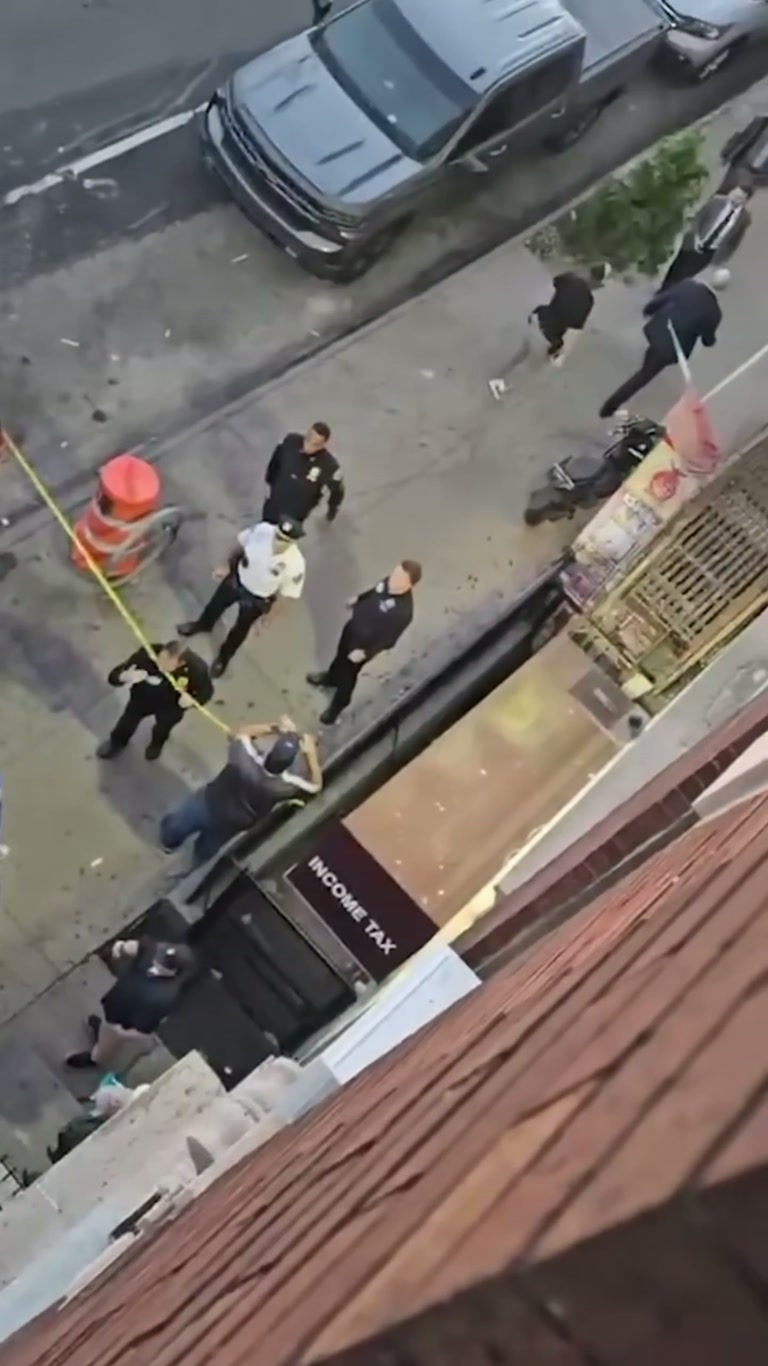
The camera sits high above a sidewalk in Marble Hill, looking down past parked cars, a scooter at the curb and a storefront sign nobody would notice from street level. For a breath, it is only a Thursday afternoon in the Bronx, ordinary and a little sleepy. Then the pavement fills with running bodies, and the moment everything changes arrives so fast that the frame can barely keep up.
Overview of the incident and the key facts
- Footage recorded Thursday from an upper window in Marble Hill, in the Bronx, looks down on a sidewalk where agents were carrying out an arrest.
- According to the accounts that circulated alongside the video, a shot was fired during the encounter and one person was wounded.
- Within seconds a crowd of neighbors formed around the agents, pressing in, pushing and shoving, and refusing to step back.
- People filmed from windows, stoops and the sidewalk itself, so the same minute exists in several versions at once.
- The seconds immediately before the shot are the part no source fully agrees on.
The window above the street
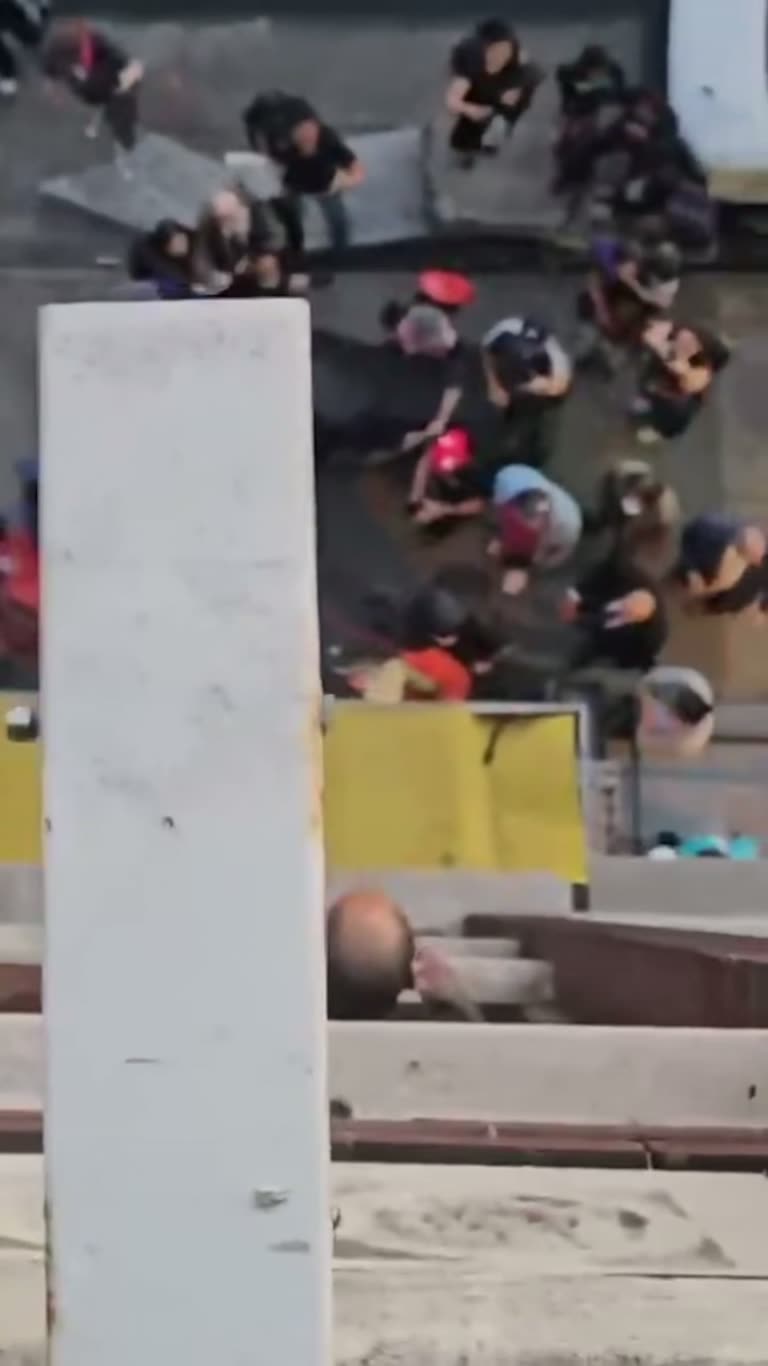
From several floors up, the scene reads almost like a diagram: a white van at the curb, a lamppost, a narrow strip of sidewalk, and a short flight of outdoor steps that becomes a stage. Then the diagram breaks apart. A knot of people converges near those steps — dark jackets, a gray shirt, a red cap bobbing at the center of it, hands reaching for hands, and the loose, forward-leaning posture of a group that has stopped being a crowd and started being an event.
ADVERTISEMENT
What strikes you first is not chaos but compression. A public sidewalk is not built to hold this many decisions at once, and in the space of a few heartbeats it shrinks into something too small for everyone standing on it. The yellow construction barrier running along the bottom of the frame stops being scenery. It becomes a fence between two versions of the same street.
Somewhere inside that scrum, a figure in orange cuts across the pavement, and a man on a scooter eases past the curb as if this were any other afternoon. Traffic never fully stops. A sedan waits with its blinker on. A door opens and closes. That ordinary business continuing in the background is a large part of why the footage is so hard to turn off: the street has no idea yet what it has become.
ADVERTISEMENT
When a crowd becomes its own character
A crowd is not a mob and it is not a witness list. It is a living thing, and this one grows in real time, fed by doorways, corners and stairwells. People arrive in twos and threes. Some shout. Some stand perfectly still with their arms folded, watching. A few are clearly trying to pull someone else out of the middle of it.
Watch the hands. There is a phone raised above the heads. There is a palm pressed flat against a chest, holding someone back. There is a hand grabbing at a sleeve and another letting go. These small gestures are the whole story, because they are how you tell the difference between people recording, people intervening and people who simply cannot decide which they are.
ADVERTISEMENT
There is an instinct that runs through every neighborhood on earth: when something happens on your block, you go outside. It is not a political instinct and it is not a violent one. It is human, and it is older than any uniform. It is also, in a moment like this, genuinely risky — for the people in the middle, for the people pressing in, and for the person who only stepped out to find out what the noise was.
Higher in the frame, more people join from the stairwell, and someone crouches low in a doorway with a phone held out in front of them, arms braced, filming steadily while everyone else moves. A few yards away, a row of officers in white shirts stands in a loose line, watching the crowd watch them. Nobody in that frame looks like they are winning anything. It is a standoff in the purest sense — a moment held in place by mutual uncertainty, and you can't look away from it.
The seconds the overhead camera never saw
The overhead angle captures the aftermath beautifully and the beginning not at all. By the time the lens settles on the action, the first seconds are already gone, which means the single most important part of the story happened just off camera. That gap is the reason the accounts never fully line up.
ADVERTISEMENT
Later frames show the street exhaling. Patrol cars sit double-parked at odd angles. Officers in white shirts stand in small clusters near a truck and a row of storefronts, one of them taking notes, another scanning the block. A man crouches at the curb with a phone angled up at the buildings, still filming, because the story has clearly not ended for him. A scooter leans on its stand where it was left. A traffic cone sits exactly where someone dropped it.
Two people can stand ten feet apart and describe that same minute in ways that sound nothing alike, and that is not lying. It is attention. Under stress, the eye grabs whatever is closest and holds on: the color of a jacket, the pitch of a voice, the direction someone's feet were pointing. You feel it long after the clip stops — the sense of a story told in fragments, each fragment honest and none of them complete.
ADVERTISEMENT
Important note: the details of this encounter are still contested, and the opening seconds of the scene were not captured on the overhead recording, so some specifics remain unclear.
What the quiet afterward tells you
When the shouting recedes, the block goes back to being a block. The light turns amber in the late afternoon and lays a long shadow across the sidewalk. Tape flutters in the breeze against a lamppost. A business sign above a doorway stays lit as if nothing happened at all. A traffic light cycles through green, yellow, red, green, with almost nobody around to obey it.
That is the strange rhythm of a neighborhood after a public incident. The physical street resets within minutes; the people on it do not. They will talk about it on stoops for weeks, in the same shorthand they use for weather and rent. They will recognize each other from that afternoon, whether they want to or not. And the ordinary things — the scooter, the parked sedan, the neighbor who was only running an errand — quietly become landmarks in a story they never chose to be part of.
ADVERTISEMENT
The footage holds its secrets close. It shows you a sidewalk, a scramble, a line of watching faces, and a street that fills and empties like water. What it will not show you is the split second that actually decided everything, and that is precisely why people keep replaying it.
Core questions still unanswered
- What happened in the seconds immediately before the first shot was fired?
- Why did the crowd move toward the agents instead of away from them?
- Who decided the scene was over, and how did the street finally clear?
| Incident parameter | Logged / on-scene information |
|---|---|
| Location | Marble Hill, in the Bronx, New York City |
| Footage recorded | Thursday, shot from an upper-floor window above the sidewalk |
| Nature of the incident | An on-street arrest that escalated into a shooting |
| People involved | Plainclothes agents, a wounded person, a large crowd of neighbors |
| Crowd behavior | Pushing, shoving, shouted exchanges, filming from windows and steps |
| Camera angle | Single overhead view; the first seconds of the encounter are missing |
| Reported outcome | One person wounded at the scene, with accounts differing on the sequence |
There is one thing the overhead camera can never give you, and it is the thing everyone wants most: the moment right before the noise started. If you had been on that sidewalk, watching from that window, would you have walked down the steps toward the crowd — or stayed behind the glass and kept filming? Tell us what you think in the comments.
ADVERTISEMENT
This article is a general description of a story scene; some details may not be independently verified.