Rider Goes Down in Traffic — Who Is Really at Fault? (video)
ADVERTISEMENT
🎥 Watch the video at the bottom of the page 👇
The footage opens on a boulevard that could belong to almost any city: mature trees arching over three lanes, daylight flickering through the canopy, a small two-wheeled machine tracking steadily ahead of the camera car. Then, inside a single breath, the rider is on the ground in a live traffic lane — and everything that follows raises a question the clip never quite answers.
ADVERTISEMENT
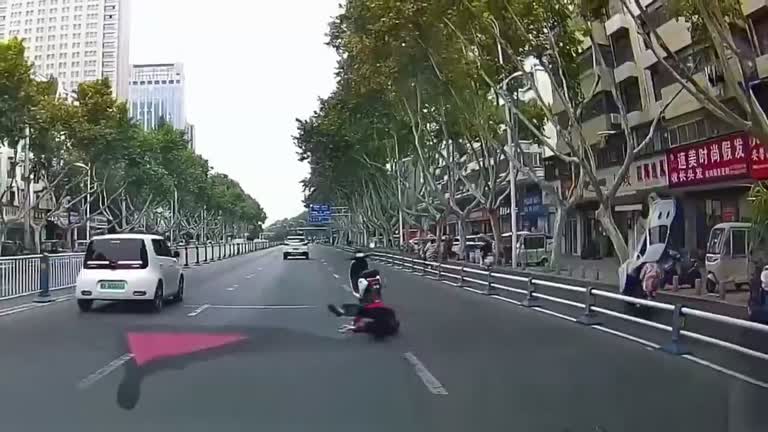
Overview of the incident and the key facts
- A dashboard camera records a steady forward drive along a wide, tree-lined avenue in full daylight, with traffic moving normally in the lanes around it.
- Ahead of the camera vehicle, a rider on a small two-wheeled machine — red top, dark trousers — travels in the same direction, in the same lane.
- Seconds later, that rider is down on the asphalt with no obvious second vehicle in contact, while other cars continue past in adjacent lanes.
- The rider pushes up off the ground, sits, rises onto hands and knees, then stands — and begins walking toward the edge of the road, leaving the machine lying in the lane.
- Later frames in the clip circle the abandoned two-wheeler and the walking figure, with the question of responsibility deliberately left hanging.
What makes the sequence linger is how little it gives away. There is no crash sound, no visible impact, no argument at the roadside — only the aftermath, and the quiet problem of a machine left sitting in a lane where traffic is still flowing.
A Street That Looks Perfectly Normal
The setting does half the work of the story. This is a broad, well-used avenue, the kind built to move a lot of people quickly: three lanes in the direction of travel, a metal railing separating the roadway from the side lanes and parked vehicles, storefronts stacked along the sidewalk with signs above them, and a gantry of blue overhead direction signs far ahead. Plane trees line both sides, their leaves close enough over the road that the light arrives in patches, throwing long, ragged shadows across the asphalt and across the painted lane markers.
ADVERTISEMENT
Traffic is light but constant. A small white compact sits in the left lane. Farther ahead, a handful of cars drift toward the horizon. On the right, vans and small trucks are parked at the kerb, and pedestrians move along the sidewalk in ones and twos, unhurried, ordinary. It is the middle of a working day, warm enough that nobody is in a hurry, and the whole frame hums with that flat, familiar rhythm of a city going about its business.
Watching it, you would never guess this is the kind of clip that ends up in a thousand comment threads. Because the street does not look dangerous — it looks routine. The camera vehicle rolls forward at an even pace. The rider ahead holds a straight line. Two or three seconds of nothing at all, and then the ordinary is gone.
ADVERTISEMENT
The Seconds That Don't Add Up
The fall itself is almost too quick to catch. One frame the rider is upright and moving; the next, the machine is down and the rider is on the ground, sliding to rest in the middle of the lane. There is no dramatic swerve, no vehicle visibly cutting in, no obvious collision. Whatever caused it happened inside a split-second decision — a wobble, a grab at the brakes, a patch of road, a moment of inattention — and the footage simply refuses to say which.
What happens next is what turns a small incident into a puzzle. The rider does not stay down. Slowly, deliberately, the figure in red pushes up off the asphalt, rolls onto hands and knees, and then stands — unsteady, but standing. Traffic continues around them. A car passes in the next lane. Nobody stops. Nobody gets out. The rider, now upright, picks a direction and walks, drifting toward the right-hand side of the road where the parked vans and the railing are, while the fallen machine stays behind in the lane.
ADVERTISEMENT
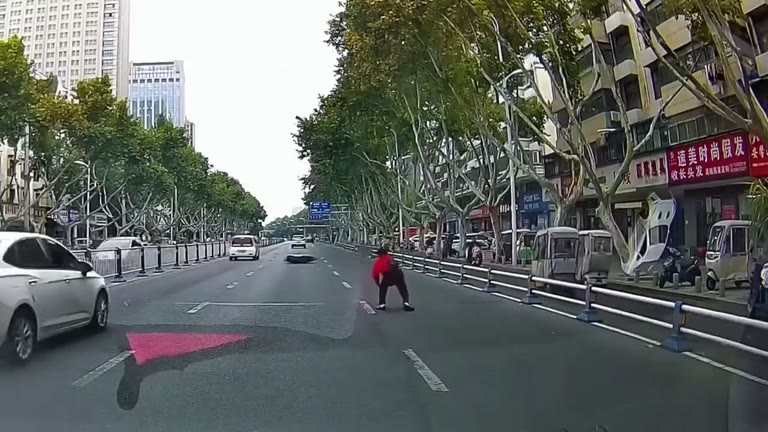
That is the image the clip keeps coming back to. In the later frames, an editor has drawn a bright arrow marker onto the asphalt to point at the scene, and a large circular highlight settles over the abandoned two-wheeler, holding it there in the middle of the road like a piece of evidence. A white box truck edges past on the right. The walking figure in red grows smaller. And the moment everything changes is not the fall — it is the walking away.
Important note: the clip is short and largely silent, and it shows only what the dashboard camera saw; there is no verified cause of the fall, no report of what followed, and no confirmed outcome for anyone involved.
Why the Question of Fault Refuses to Settle
This is where the clip earns its title. A fall on a public road sounds like a simple question of blame, but on a street this crowded, blame has many hands. There is the rider, who went down. There is whatever the rider may have met on the road — a slick patch, a ridge in the asphalt, a sudden movement somewhere else in the frame. There is the traffic that kept moving, each driver making their own instant calculation about whether to stop, slow, or slide past a person standing in the lane. And there is the machine itself, left where it fell, now a hazard for everyone behind.
ADVERTISEMENT
Roads like this one are shared by design: scooters and cars and pedestrians all negotiating the same strip of asphalt with nothing but paint and habit keeping them apart. Dashcam footage has become the unofficial referee of that arrangement — millions of small clips, uploaded so that strangers can adjudicate what a driver should have seen, what a rider should have expected, who should have yielded. It is a strange kind of public court, and it rarely agrees with itself.
That is why this scene is so hard to put down. One detail changes everything depending on where you stand: if the rider simply lost control, the story is about personal responsibility; if something on the road caused it, the story is about maintenance or design; if the drivers passing by had a duty to stop, the story becomes about all of us. The footage shows you the sequence, and then steps back and lets you argue — which is exactly what makes it stick, and why so many people end up watching it twice. See the moment it turns and you will still be unsure whose name belongs at the top of the page.
ADVERTISEMENT
Core questions still unanswered
- Why did the rider go down in the first place, given that no other vehicle appears to make contact in the frames we can see?
- Why did the rider stand up and walk toward the roadside while leaving the two-wheeler lying in a live lane?
- At what point does passing traffic become responsible for a person on the ground — and did anyone stop after the clip ends?
| Incident parameter | Logged / on-scene information |
|---|---|
| Camera position | Dashboard view from a vehicle moving forward in the direction of travel |
| Time and light | Daylight, dry asphalt, hard patchy shadows under a tree canopy |
| Rider | One person in a red top and dark trousers on a small two-wheeled machine |
| Sequence observed | Upright travel, then down on the road, then sitting, rising to hands and knees, standing, walking |
| Machine afterward | Left lying in the traffic lane while the rider moves toward the roadside |
| Other traffic | Vehicles in adjacent lanes keep moving; no stop is shown in the frames |
| Clip annotations | A pasted arrow marker on the asphalt and a circular highlight over the scene |
So here is the thing the clip leaves with you: the fall takes a second, but the argument it starts can run for years. Was this a rider's mistake, a road's fault, or a street full of people deciding in real time that a stranger on the ground was someone else's problem? Watch the walk-away and decide for yourself — then tell us in the comments: in a situation like this, who do you think should carry the responsibility, and what would you have done from behind the wheel?
This article is a general description of a story scene; some details may not be independently verified.
ADVERTISEMENT