AI Short Film Reimagines the Gog and Magog Prophecy (video)
ADVERTISEMENT
🎥 Watch the incident video at the bottom of the page 👇
A sealed bronze wall, an army that has attacked it for thousands of years, and a promise to come back tomorrow — that is the whole premise of a new AI-made short film. The video's description calls it a modern end-times story built around the Gog and Magog prophecy, the theme behind the Yajuj Majuj tag attached to the post. What the film delivers is less a final battle than a loop: the wall is broken, and the wall is restored.
ADVERTISEMENT
A Wall Sealed and Cracked
The film opens on nothing but surface. Bronze-brown metal panels sit in tight geometric rows, joined along a single vertical seam that runs the height of the frame. No sky, no figures, no landmarks — only a barrier that reads as engineered rather than natural.
Stone comes next. A dark slab fills the screen, split by a web of fine cracks crossing near the middle. The damage looks real but shallow, and it sets up the film's central claim. In the audio, a voice describes a world falling apart and asks what that wall is; the answer comes back that the prophecy was true.
ADVERTISEMENT
Two Travellers on the Ridge
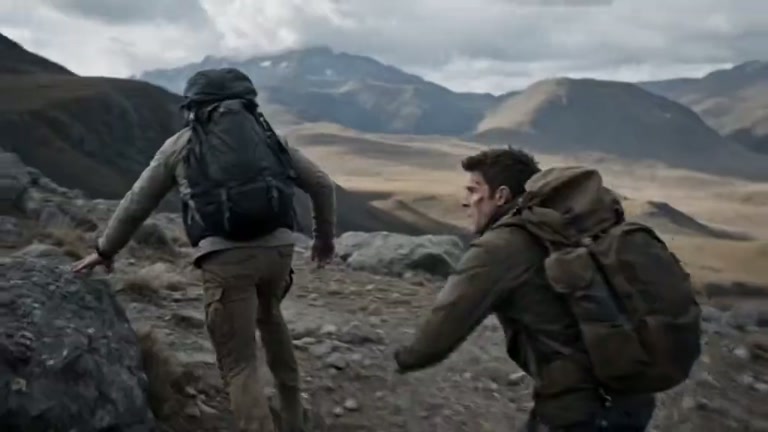
Halfway through, the film steps away from the wall. Two men with heavy backpacks cross a bare, rocky mountainside under flat grey light; one leans forward for balance while the other turns to look behind him. In a closer shot, both faces turn toward something off frame, and a subtitle reads, 'This wall is mentioned in many religious texts.' The question that follows is short: is that really true?
ADVERTISEMENT
Then the story drops into ordinary life. A young man in a blue-and-beige tie-dye shirt stands at a convenience store counter, phone in one hand, a cigarette between his fingers, while a cashier works beside him under fluorescent light. Framed between mountain crossings, the scene makes the prophecy feel like something happening next door.
The Army Returns
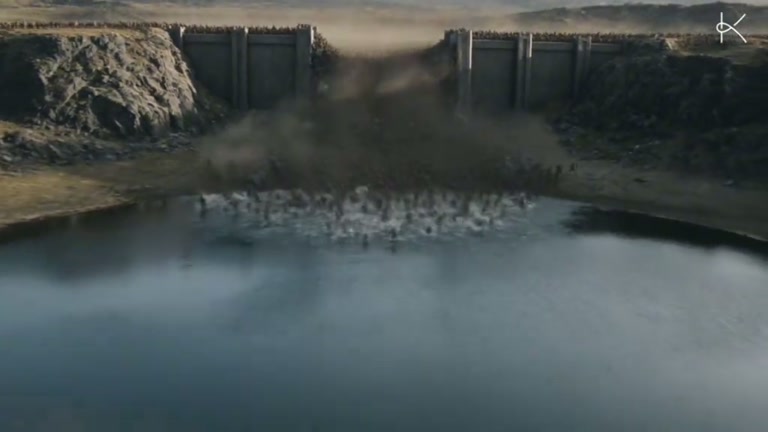
The scale shifts hard. A dense mass of figures presses along the base of an enormous wall, dust hanging over the crowd while light cuts down from above. A subtitle across the bottom reads, 'But by God's power, the wall is restored.'
ADVERTISEMENT
For thousands of years they have tried to destroy that wall, but by God's power the wall is restored.
That line is the film's whole argument. The description frames the sequence as an ancient army attacking a divinely restored wall before a final battle, and the closing shots underline the reading: a dark crevice in the rock at the wall's foot, then a wide landscape view of a vast gate-like structure with a small crowd gathered below it.
Three beats keep repeating:
ADVERTISEMENT
- A wall that is broken and sealed again
- Travellers walking toward it
- A crowd that returns to the same place
An Ending Left Open
The film stops before any final confrontation. The last spoken line is a promise to finish the work tomorrow, with the words 'Insha Allah' translated on screen as God willing. For a story that spends its runtime on destruction, that is an unexpected turn: the ending is patience, not victory.
ADVERTISEMENT
The post labels the project as AI and fantasy work and presents it as a short movie, a label that places it alongside a growing group of generated fantasy pieces retelling prophecy and legend. Whether the narration follows any single text closely, and how much of the imagery was generated rather than filmed, cannot be confirmed from the material itself.
What do you make of this: if the wall is rebuilt every morning, who is really winning — the army that keeps coming back, or whatever keeps sealing it?
ADVERTISEMENT
This story was edited from a publicly posted video; some details may not be independently verified.